
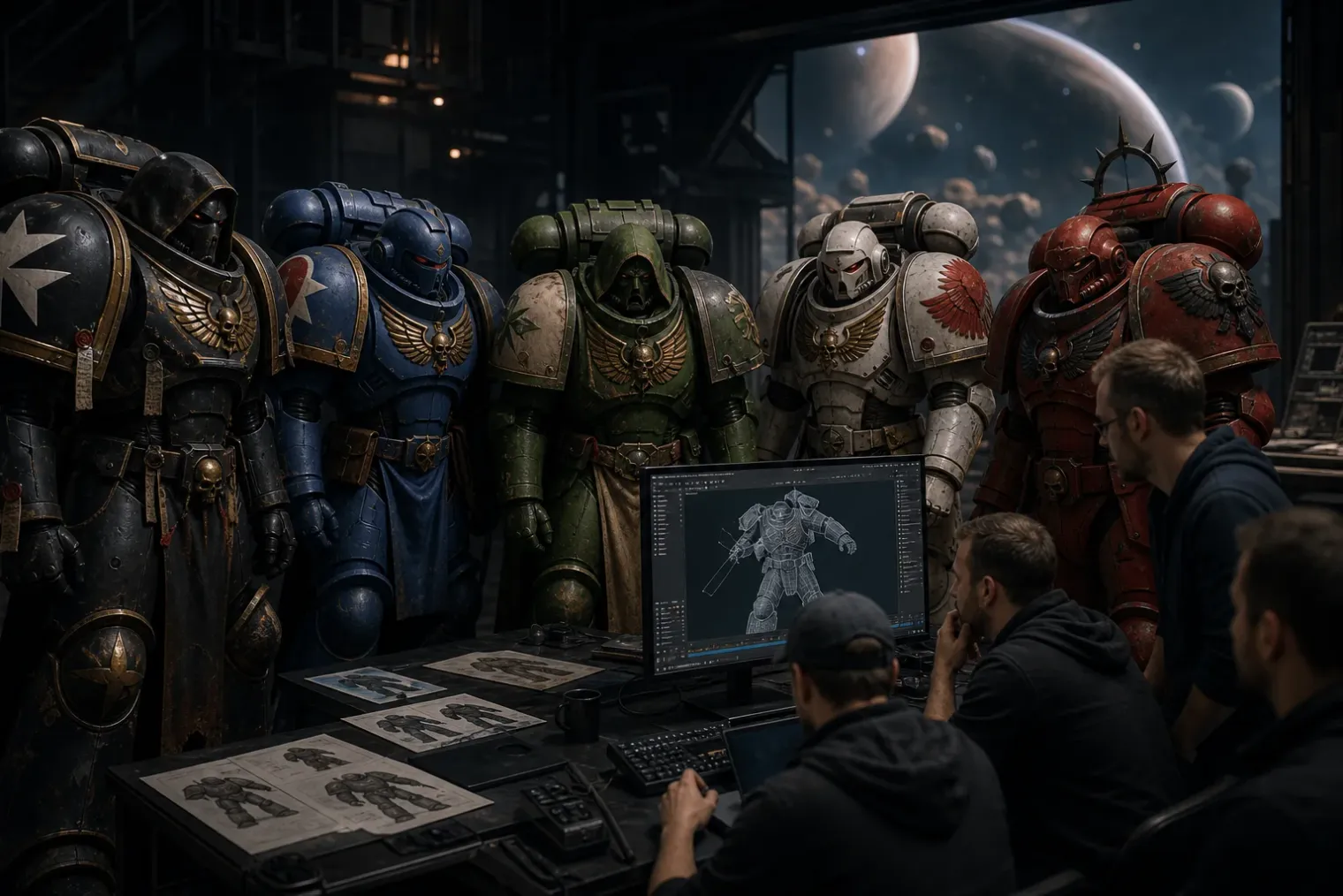
Two projects, two different stages of development
Amazon’s Warhammer 40,000 plans are becoming more tangible, though the latest update is better understood as a statement of creative direction than a conventional series announcement. Games Workshop has confirmed that work is progressing on a live-action adaptation involving Mike Flanagan and Henry Cavill, while a separate animated series centred on the Deathwatch is being developed for Amazon.
The distinction matters. The live-action production has reached the outline and script-development phase, whereas the animated project has begun work with a named writer and animation studio. Neither has a confirmed title, release window, cast list, episode count or story synopsis. The announcements nevertheless establish that Amazon and Games Workshop intend to approach the setting through more than one format rather than relying on a single flagship programme.
Mike Flanagan moves from outlines to script
Games Workshop’s 2025–26 annual report says Amazon has added United Artists and Mike Flanagan to the live-action project. Flanagan has completed initial outlines and is expected to move on to the script. Vertigo Entertainment and Henry Cavill remain involved, according to the company.
That is the clearest official progress report since Games Workshop finalised its agreement with Amazon in December 2024. The deal grants Amazon exclusive rights to develop films and television series set in the Warhammer 40,000 universe, as well as associated merchandising rights. It also includes an option covering Warhammer Fantasy after an initial Warhammer 40,000 production is released.
The wording leaves several important questions unanswered. Games Workshop has not identified the live-action story, confirmed whether Cavill will appear on screen, named a director or provided a production timetable. It has also stressed that the contractual arrangement limits the details it can disclose. Most importantly, the company continues to describe the partnership as long term and warns that successful adaptations will take years to reach audiences.
This caution is sensible for a setting of Warhammer 40,000’s scale. Its future-war imagery, non-human factions, vast battles and heavily stylised armour are likely to require extensive visual-effects work if they are to be represented in live action. A smaller, human-led story could reduce those demands, while a larger military narrative would test both budget and production design. Until a premise is confirmed, it would be premature to assume what part of the universe Flanagan’s script will explore.
Deathwatch gives animation a focused entry point
The animated project is further defined. Games Workshop says the series will feature the Deathwatch, will be written by John Orloff and animated by Blur Studio before being released through Amazon. Reporting on the project has also identified Dave Wilson, who directed the Warhammer 40,000 instalment of Amazon’s animated anthology Secret Level, as a co-creator and director.
The Deathwatch is a particularly adaptable choice for a screen story. It brings together veteran Space Marines drawn from different chapters for missions against alien threats. That structure allows a series to introduce contrasting characters, armour designs and combat approaches without needing to explain the full hierarchy of the wider Imperium at once. It can also support a compact team narrative within a universe otherwise defined by enormous armies and galactic conflict.
Animation offers a practical route to presenting that scale. Blur Studio has experience with high-end computer animation and previously worked on the Warhammer 40,000 episode of Secret Level. Building on that collaboration may allow the new series to retain a consistent visual language while expanding the setting beyond the short-form anthology format.
The announcement does not confirm whether the Deathwatch series will continue a specific Secret Level storyline, share characters with the live-action production or connect directly to any other Warhammer screen work. It should therefore be treated as a separate project set in the same intellectual property, not as an announced spin-off in the strict narrative sense.
A measured expansion strategy
Games Workshop’s update also places the two productions within a broader licensing strategy. The company has spent years extending Warhammer beyond tabletop miniatures through video games, fiction, animation and merchandise. Amazon’s agreement represents a more ambitious move because it covers a potential line of films and television series rather than a single adaptation.
The company is simultaneously continuing its work with Secret Level. Its annual report says an upcoming second-season episode will be set in the Warhammer: Age of Sigmar fantasy universe, rather than Warhammer 40,000. That suggests Games Workshop is using different formats and partners to test how its separate settings can work on screen, while keeping the Amazon live-action agreement focused initially on Warhammer 40,000.
For viewers, the immediate result is not a release calendar but a clearer division of labour. The animated Deathwatch series is positioned to deliver the visual spectacle and factional variety associated with the setting. The live-action project, still moving from outlines towards a script, has more time to determine its tone, scale and entry point for people unfamiliar with the franchise.
What has not been announced
The confirmed information remains limited. There are no release dates for either project, no trailers and no indication of when filming or voice recording may begin. No official casting has been announced for the animated series, and no final live-action cast has been disclosed. Games Workshop has not said whether either production will be a limited series, a continuing series or part of a directly connected screen universe.
The key development is therefore organisational rather than promotional: Amazon and Games Workshop now have two distinct Warhammer 40,000 productions advancing in parallel, with identifiable creative teams and different production methods. Their eventual success will depend on how well each can translate a deliberately dense, visually extreme tabletop universe into stories that work for existing fans and newcomers alike.
Sources
- Annual Report 2025–26 — Games Workshop Group PLC
- Agreement with Amazon for films and television series — Games Workshop Group PLC
- Major update on Amazon Studios Warhammer stories — Warhammer Community
- Mike Flanagan joins Henry Cavill's Warhammer 40K series at Amazon — GamesRadar+


