
A framework rather than a single prescription
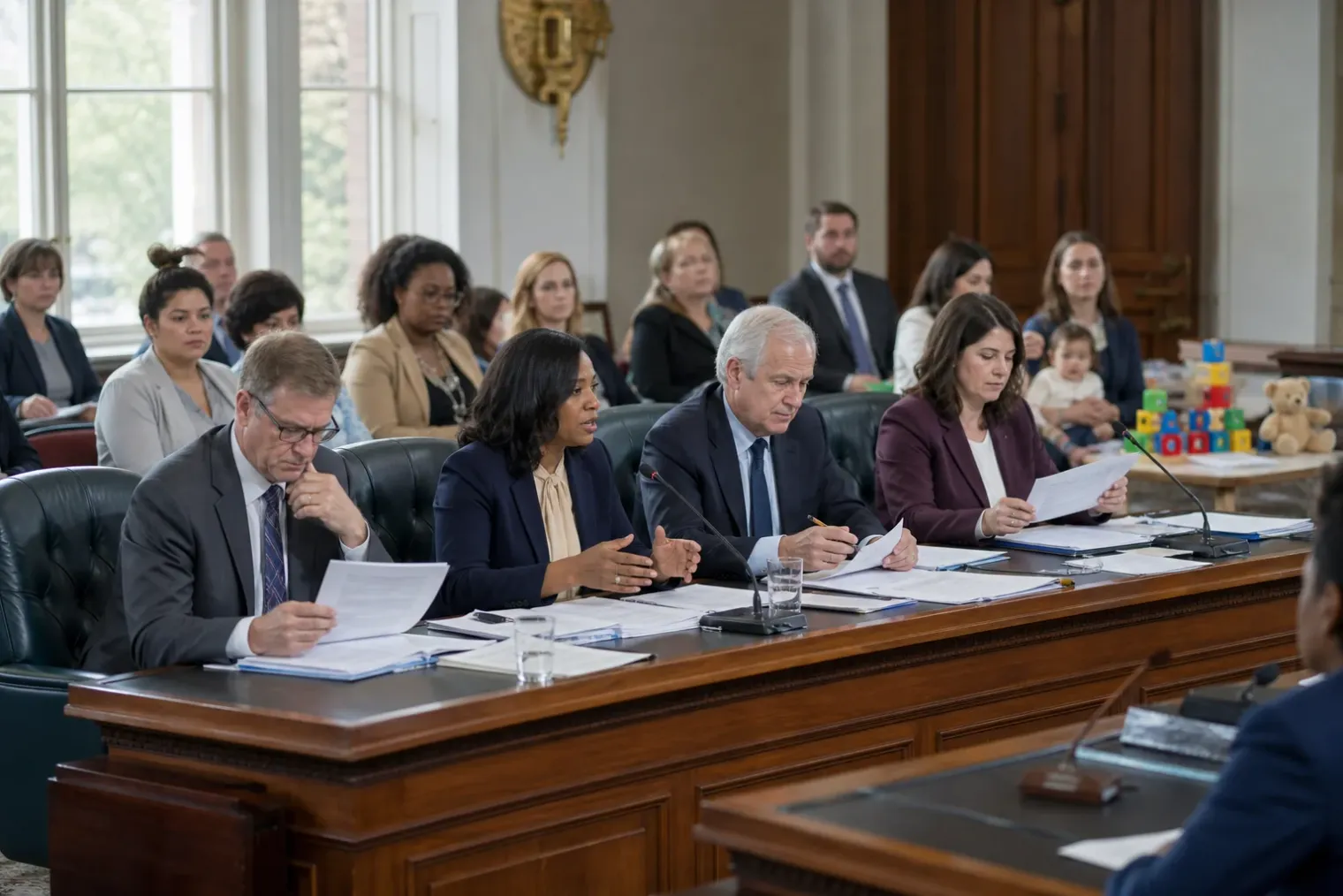
The National Conference of State Legislatures released “Childcare at a Crossroads: A State Legislative Framework for Strengthening Childcare Systems” on July 27, 2026, offering state lawmakers a shared menu of reforms rather than a model bill or federal-style blueprint. Developed by a bipartisan work group of 13 legislators, the report draws examples from all 50 states and is designed for adaptation to differing fiscal capacities, political priorities and local childcare markets.
That design is significant. Childcare policy has often been approached as a narrow question of subsidies for low-income families or as an early-education issue. The NCSL framework instead treats it as an interconnected system: families need care they can find and afford; providers need viable businesses; workers need pay and career prospects sufficient to remain in the field; and employers and state economies depend on parents being able to work reliably.
The document does not claim that every state should enact the same policies. Its core argument is that piecemeal interventions are unlikely to resolve a problem in which pressures reinforce one another. Raising quality requirements without helping providers meet their costs, for example, may reduce capacity. Increasing subsidies without expanding the workforce may leave families with funding but no available places.
Seven areas for state action
The framework groups its proposals under seven recommendations: expand access and availability; address affordability; invest in the childcare workforce; modernise licensing and quality-rating systems; strengthen small childcare businesses; create sustainable funding; and improve early-childhood governance and leadership.
On access, it urges legislators to begin with better local data on supply, family demand and gaps by geography, age group and work schedule. It highlights the particular difficulty of finding infant and toddler care, non-traditional-hours care and inclusive settings for children with disabilities or developmental delays. Suggested tools range from capital grants and revolving loans for facilities to zoning reforms that make it easier for home-based providers to operate.
The affordability section recognises a central tension in childcare economics. Families can struggle to pay tuition while providers still operate on narrow margins and workers receive relatively low wages. The framework therefore points to a mix of approaches: broader subsidy eligibility, lower family copayments, tax credits, employer contributions and reimbursement policies that more closely reflect the cost of providing care.
Its workforce recommendations are equally consequential. Childcare provision is labour-intensive, owing to safety rules and staff-to-child ratios, but compensation often remains insufficient to support recruitment and retention. The report points to wage supplements, benefit support, scholarships, apprenticeships and clearer credential pathways as options for states. The policy challenge is not only to recruit new educators, but to stop classrooms and programmes from losing capacity when experienced workers leave.
Providers are businesses as well as care settings
One of the framework’s more practical features is its attention to the business structure of childcare. Many programmes are small, locally owned operations, including family childcare homes where the owner is simultaneously the caregiver, manager and administrator. Their challenges include insurance, payroll, enrolment, compliance, facilities, finance and access to credit, alongside the work of caring for children.
This focus broadens the usual policy debate. It implies that a childcare expansion strategy cannot rely only on demand-side assistance to parents. States may also need to help providers with business coaching, shared back-office services, insurance solutions and capital finance. Such measures may be less politically contentious than large new entitlement programmes, but their effectiveness will depend on whether they are substantial enough to change providers’ underlying financial position.
The report similarly calls for licensing and quality systems that protect children while being understandable and workable for providers. It advocates streamlining duplicative administrative requirements, aligning standards across programmes where appropriate and offering technical assistance rather than treating regulation solely as an enforcement exercise. The balance will be sensitive: simplifying rules can reduce barriers to opening or expanding programmes, but states must preserve rigorous health, safety and safeguarding standards.
Funding is the test of ambition
The most difficult part of the agenda is likely to be financing. The framework acknowledges that dependable childcare systems require predictable, long-term revenue rather than short-lived grants. It identifies possible state and local sources, including dedicated funds, endowments, payroll taxes, bond funding, local levies and public-private cost-sharing arrangements.
That breadth may help legislators find approaches suited to their states, but it also means the framework does not settle the central distributional question: how much should be paid by parents, employers and taxpayers? Different answers will produce markedly different systems. Employer-supported models can help participating workers, for instance, but may be harder to extend to small firms, part-time workers or families outside formal employment. State subsidies can reach more households, but require continuing budget commitments that compete with other public priorities.
The framework’s value is therefore less in offering a universal answer than in making the trade-offs visible. It places sustainable revenue alongside access, quality and workforce policy, rather than presenting funding as an afterthought.
Why bipartisan agreement matters
Childcare legislation has already been active across the states. NCSL’s review of 2025 activity found that all 50 states, Washington, D.C., and Guam introduced early-childhood bills, with 326 enacted measures recorded by early December. The new framework attempts to give that legislative momentum a more coherent structure.
Its bipartisan origins may make it especially useful in statehouses where agreement on national policy remains elusive. The participating lawmakers do not erase ideological differences over public spending, regulation or the role of employers. But they agree that childcare affects children, family budgets, labour-force participation and local economic resilience.
Whether the report changes outcomes will depend on implementation. States will need to decide which shortages are most acute, measure whether reforms add places and improve stability, and avoid transferring costs from one fragile part of the system to another. Still, the framework offers a notable common starting point: childcare is not a peripheral family service, but essential social and economic infrastructure that needs to be built as a system.
Sources
- Bipartisan NCSL Work Group Releases Framework to Help States Strengthen Childcare Systems — National Conference of State Legislatures
- Childcare at a Crossroads: A State Legislative Framework for Strengthening Childcare Systems — National Conference of State Legislatures
- Early Childhood Has Momentum: 2025 Legislative Trends — National Conference of State Legislatures
- Child Care: Subsidy Eligibility and Use and State Waiver Requests Related to New Program Requirements — U.S. Government Accountability Office
- National Employment and Wage Data from the Occupational Employment and Wage Statistics Survey by Occupation, May 2025 — U.S. Bureau of Labor Statistics


