
Cooling as shared infrastructure
Extreme heat is increasingly exposing a basic weakness in many cities: cooling is usually treated as a building-by-building purchase rather than as essential urban infrastructure. When temperatures rise, millions of individual air conditioners can turn on at once, driving sharp electricity peaks, straining local grids and discharging heat into already hot streets.
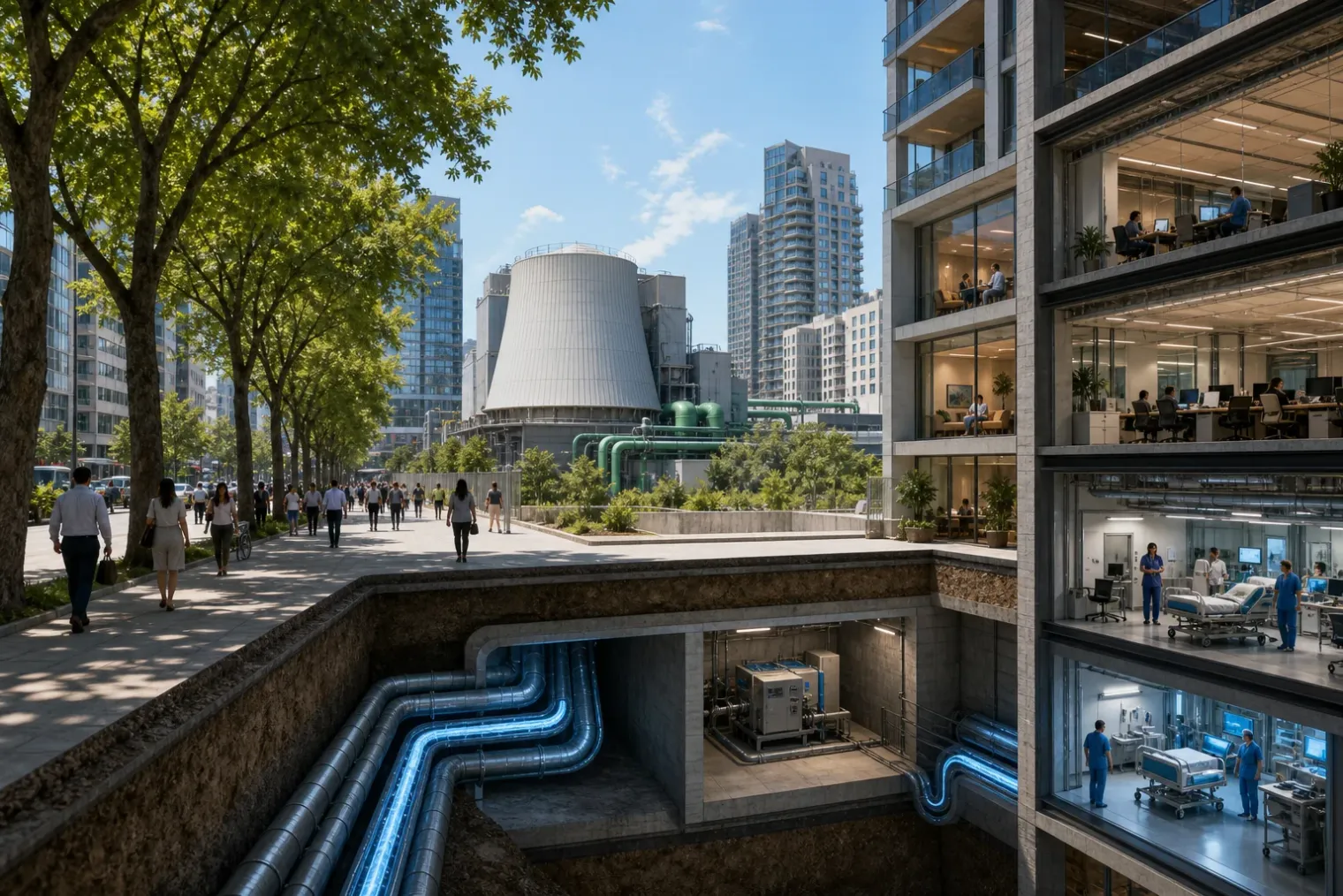
District cooling takes a different approach. A central plant produces chilled water and pumps it through insulated underground pipes to connected buildings. Inside each building, a heat exchanger transfers cooling to its air-conditioning system; warmer water then returns to the plant to be cooled again. The network supplies a service, rather than selling each customer a separate chiller.
That model is established in some dense commercial districts, airports, campuses and large new developments. Its renewed relevance comes from the collision of rising temperatures, expanding cities and rapidly growing demand for mechanical cooling.
Why a shared system can be more efficient
The core advantage is scale. Large central chillers can operate more efficiently than a patchwork of small units, while operators can manage the combined demand of many buildings. Not every connected building reaches its maximum cooling load at the same time, so a network can avoid duplicating as much equipment.
A district system can also use resources that are difficult for an individual building to exploit. Depending on local geography and engineering, these include cold deep water from lakes or seas, cooler night air, treated wastewater, geothermal exchange and large thermal stores. Chilled-water or ice storage can be created when electricity demand is lower and used later in the day, reducing pressure on the grid during heatwave afternoons.
Hong Kong’s Kai Tak system illustrates the potential in a planned, high-density development. Its government operator says the network has been supplying buildings in stages since 2013 and, at full operation, is designed to serve about 2.54 million square metres of non-domestic floor space through roughly 63 kilometres of piping. It estimates annual electricity savings of about 138 million kilowatt-hours. Such figures should be understood as project-specific estimates, not a promise that every city will achieve the same result.
The climate benefit also depends on what powers the central plant. District cooling reduces electricity use only relative to the alternative it displaces, and its emissions still reflect the electricity mix and the refrigerants used. A system operated with fossil-heavy power may reduce demand while remaining emissions-intensive; one combined with efficient equipment, low-carbon electricity and thermal storage has a stronger case.
A heat solution, but not a substitute for heat protection
District cooling protects people mainly by making indoor cooling more reliable and potentially less energy-intensive. It does not by itself lower citywide outdoor temperatures. Central plants and cooling towers still have to reject the heat removed from buildings, though they can do so more efficiently and in locations that may be less disruptive than countless street-facing condensers.
That distinction matters. Heat adaptation must start before air conditioning: well-insulated buildings, external shading, reflective roofs, ventilation designed for local conditions, trees, parks and access to public cooling spaces can all reduce exposure and the amount of mechanical cooling required. These measures are particularly important during power failures, when electrically driven cooling may not be available.
The strongest strategy is therefore a layered one. Passive measures reduce heat entering buildings; efficient room or building systems serve dispersed areas; and district cooling addresses concentrated demand where pipes and central equipment make sense. Treating any one of these as a complete answer risks locking cities into a costly and energy-intensive response.
Density and timing determine feasibility
District cooling is not naturally suited to every neighbourhood. It requires substantial upfront spending on plants, pipes, street works, building connections and controls. Heat losses, pumping energy and capital costs all become harder to justify when customers are distant or cooling demand is sparse. Retrofitting crowded streets can be particularly disruptive and expensive.
It is most compelling where planners can coordinate construction: new urban districts, redeveloped waterfronts, central business areas, hospital clusters, university campuses, transport hubs and mixed-use precincts with a steady, high cooling load. New developments can reserve plant space, install compatible internal systems and lay pipes before roads and buildings are finished. Existing districts require a clearer long-term business case, reliable customer commitments and careful rules on pricing, service standards and access to the network.
The ownership model matters as much as the machinery. A monopoly provider can simplify investment in shared infrastructure, but cities need transparent tariffs and oversight so users do not face excessive connection or service costs. Public investment may be justified where a network helps avoid grid upgrades or supports resilience, but that should not become a reason to direct scarce heat-protection funding away from low-income residents and poorly cooled homes.
A useful tool for particular urban forms
District cooling deserves a larger place in city heat planning, especially in fast-growing, compact districts where construction is still under public control. It can curb peak demand, integrate thermal storage and make use of local cooling resources that individual buildings cannot access. It may also free building owners from maintaining major cooling equipment themselves.
But it is not a quick retrofit for an entire metropolis, nor an alternative to reducing heat exposure outdoors and improving the fabric of buildings. Its value lies in matching a shared network to the right urban geography, power system and governance model. In that setting, district cooling can be an important part of a heat-resilient city; outside it, efficient building-level cooling and passive design will often remain the more practical response.
Sources
- Is district cooling the solution we need for extreme heat in cities? — New Scientist
- Global Cooling Watch 2025 — UN Environment Programme
- Renewables in District Energy: Executive Summary — International Energy Agency
- District Cooling Systems in Operation: Kai Tak Development — Electrical and Mechanical Services Department, Hong Kong
- Sustainable District Cooling Systems: Status, Challenges, and Future Opportunities — Energies


