
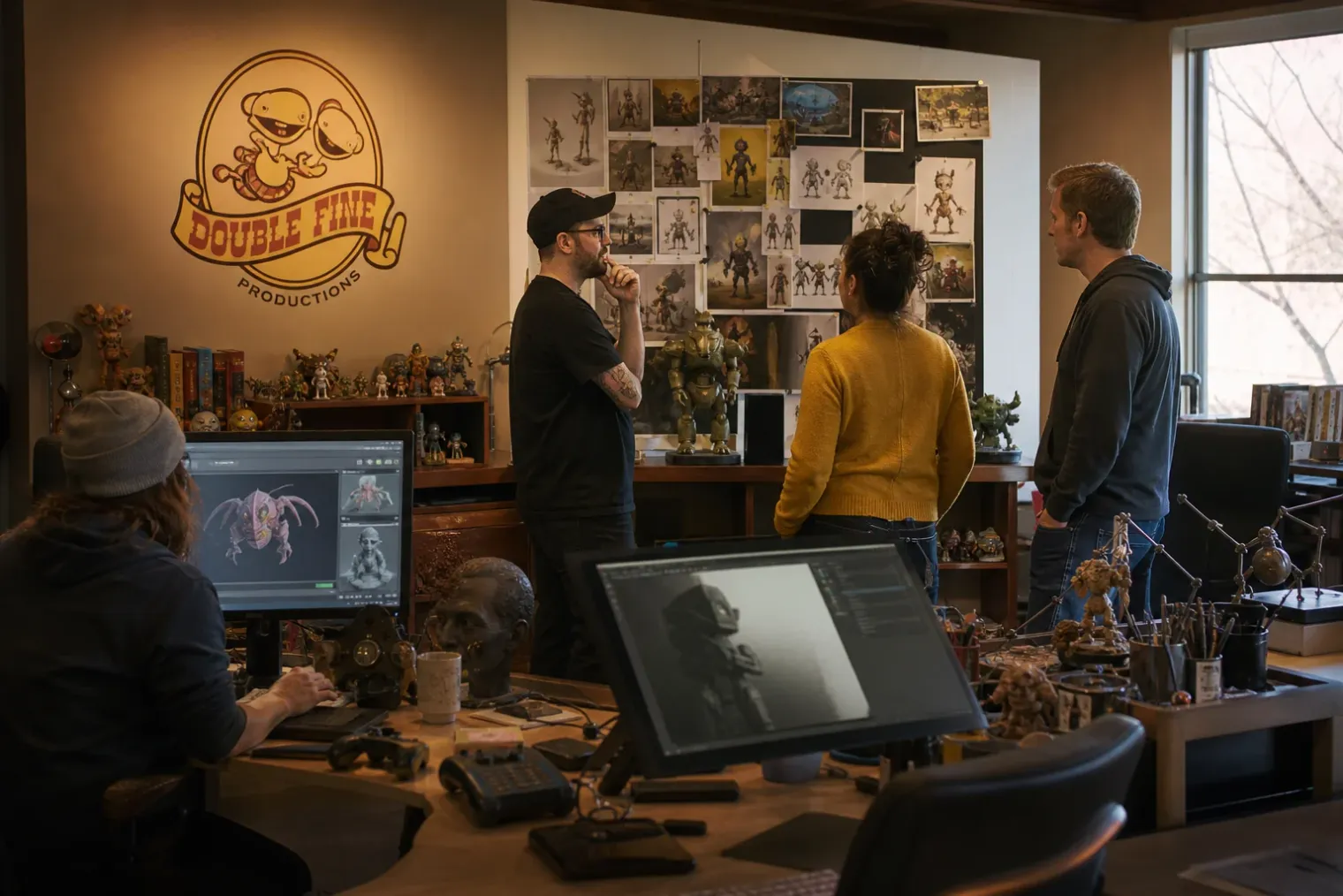
A fuller picture of Double Fine’s return to independence
Double Fine Productions has clarified that it now holds both the intellectual-property ownership and publishing rights for all of its games following its separation from Xbox. Studio head Tim Schafer said the transfer covered the company’s IP and publishing rights, meaning revenue from purchases of its games is intended to support the independent studio directly.
The confirmation adds important detail to Double Fine’s initial announcement on 6 July, when it said that it was becoming independent again and that Xbox had worked with the team to return ownership of its games. Xbox’s own restructuring announcement said Double Fine would return to management with its IP, catalogue and funding runway for its next projects.
For a developer whose reputation rests on distinctive original work, control of the catalogue is more consequential than the simple change from first-party studio to independent company. It gives Double Fine a greater say over new instalments, remasters, licensing, platform distribution and publishing arrangements connected with its games.
Ownership and publishing are separate but connected
Game IP ownership governs the underlying worlds, characters, titles and other creative assets. Publishing rights concern the commercial process: releasing games, managing storefront listings, negotiating distribution and handling the revenue that follows sales.
Double Fine’s statement that it has both is therefore significant. A studio can sometimes regain operational independence while leaving a former parent company with rights over particular franchises or releases. In Double Fine’s case, Schafer’s comments indicate that the agreement went further, returning control over the games as well as the ability to publish them.
That does not automatically reveal every detail of the underlying arrangements. Existing platform distribution, subscription, retail or licensing agreements may continue according to their respective terms, and public store pages can take time to reflect a change of publisher. Schafer noted that some listings still showed Xbox Game Studios as publisher while administrative changes were being processed.
The central point is that Double Fine now presents itself as the commercial beneficiary of future sales of its catalogue. For players, the immediate experience of buying and playing existing games may not change. For the studio, however, those sales can become a more direct source of operating income at a time when it needs to finance development independently.
A return after seven years with Xbox
Double Fine joined Xbox Game Studios in 2019, after nearly two decades as an independent developer. The acquisition gave the studio financial backing during the development of Psychonauts 2, which launched in 2021, and later supported the releases of Keeper and the multiplayer pottery brawler Kiln.
The studio’s own account describes the Xbox period as one in which it could focus less on finding funding and more on creative work. That background makes the current transition more complex than a conventional publisher change. Xbox’s backing reduced some of the financial pressures that have historically shaped Double Fine’s choices, including its early use of crowdfunding and its creation of smaller experimental projects through Amnesia Fortnight.
Microsoft’s decision to separate from Double Fine came as part of a wider Xbox restructuring announced on 6 July. Xbox said that Double Fine and Compulsion Games would become independent studios, while other teams faced different ownership outcomes or consultation processes. The company also said the restructuring would involve approximately 3,200 job reductions across its gaming businesses during fiscal year 2027.
For Double Fine, independence has preserved its identity and catalogue, but it has not removed the financial strain associated with the move.
Independence accompanied by a smaller team
On 28 July, Double Fine said it had let go of 23 employees. Schafer described the decision as necessary for the studio’s survival and said the company needed to become a size it could sustain as an independent business.
The layoffs underline the distinction between retaining IP and having the resources to turn that IP into new games. Ownership creates options, but it does not by itself provide the cash flow needed for salaries, long development cycles, marketing or the risks of releasing an original game in a crowded market.
Double Fine is attempting to rebuild that runway through a mixture of catalogue sales, project pitching and community support. Its next crowdfunding effort, Amnesia Fortnight 2026 – Indie Reboot, is scheduled to begin on 31 August. The campaign is designed around the studio’s established internal game-jam process: backers will help select four concepts for prototype development, with one later developed into a smaller finished game under the Double Fine Action Labs label.
The plan is consistent with the studio’s history. Earlier Amnesia Fortnight prototypes helped generate projects including Costume Quest, Iron Brigade and Stacking, while crowdfunding played a major role in the creation of Broken Age and Psychonauts 2. This time, however, the format has a more immediate business purpose: it can provide funding, audience engagement and a public test of which concepts resonate before the studio commits to a larger production.
Why the catalogue matters now
Double Fine’s back catalogue is unusually useful for an independent developer because it combines recognised series with a strong creative identity. Psychonauts remains the most prominent example, but the studio’s work also includes titles such as Broken Age, Costume Quest, Stacking, RAD and remastered LucasArts adventures.
Control over these properties does not guarantee sequels or remasters. Each project still requires a viable budget, a development plan and, potentially, outside funding or a distribution partner. Yet ownership means Double Fine can assess those opportunities itself rather than seeking approval from Xbox for uses of its established worlds.
It also allows the studio to decide how to balance its business. It could pursue a new original game, revisit an existing property, arrange external publishing, self-publish digitally or combine these approaches. The flexibility is especially relevant for a team known for ideas that do not always fit the scale or market expectations of major publishers.
A valuable outcome with demanding implications
The IP transfer is a notably favourable result for Double Fine compared with many studio closures or divestments, where creative teams can lose access to the games and worlds they built. It protects continuity for the studio and leaves open the prospect that its existing series can continue under the same creative organisation.
At the same time, the coming months will show how durable that independence is. The smaller workforce, the need to secure projects and the return to crowdfunding demonstrate that creative control arrives alongside commercial responsibility.
Double Fine’s position is therefore best understood as a reset rather than a simple restoration of its earlier independent model. It has regained ownership of its work and the ability to publish it, but it must now turn those rights into a sustainable business. The success of catalogue sales, the forthcoming Amnesia Fortnight campaign and its ability to secure future development funding will determine how much room the studio has to keep making the unusual games for which it is known.
Sources
- Double Fine confirms it owns all its games’ IP and publishing rights after Xbox split — Eurogamer
- Double Fine is Independent again — Double Fine Productions
- Resetting XBOX — Xbox Wire
- The newly independent Psychonauts developer now earns revenue from games made under Xbox — PC Gamer
- Amnesia Fortnight: The Kickstarter — Double Fine Productions


