
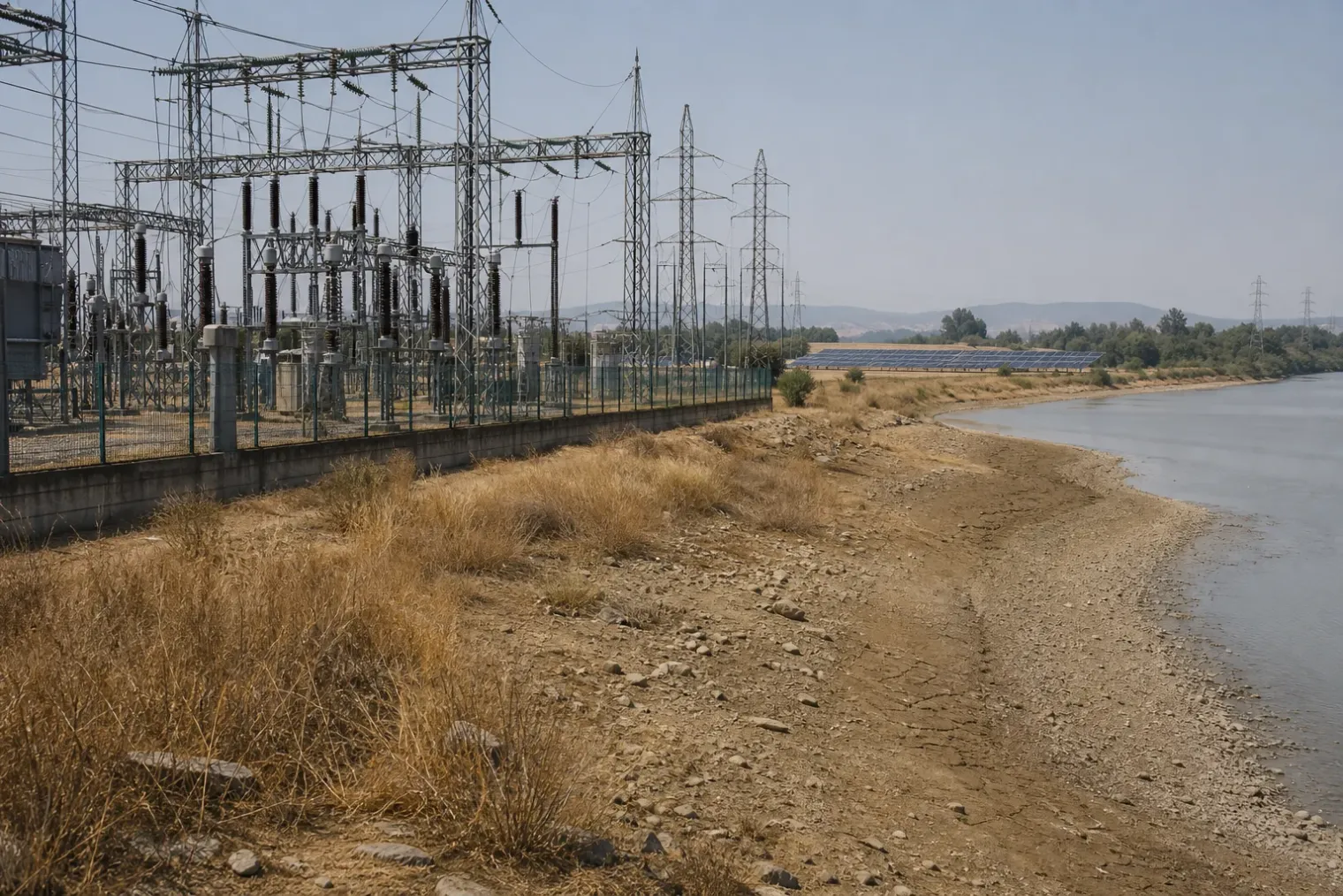
A compound stress test for electricity systems
Drought and extreme heat are not a single threat to Europe’s electricity system. They are a compound event: high temperatures lift demand for cooling just as dry, warm rivers can restrict electricity supply and weaken the operating margins available to grid managers. The immediate result is not necessarily a continent-wide blackout. Rather, the danger lies in local shortages, expensive emergency measures and a greater dependence on imports or fossil-fuelled backup at the precise moment neighbouring countries may face similar pressures.
This summer has made that interaction more visible. The European Drought Observatory reported worsening drought across much of Europe in mid-June, including alert conditions in parts of France, Germany, Austria, Hungary and Romania. Subsequent heatwaves further depleted soil moisture across western and southern Europe. In early August, record-low Danube levels were reported to be disrupting power generation in central and eastern Europe, with authorities seeking electricity savings as water constraints affected plants dependent on the river.
The phrase “breaking point” should therefore be treated carefully. Europe’s interconnected electricity system retains substantial resilience, and ENTSO-E’s Summer Outlook, published in May, did not identify a systemic adequacy risk across most of the continent for summer 2026. But the outlook also depends on assumptions about available generation, demand, imports and reserve capacity. Persistent heat and exceptionally low water levels can make several of those assumptions less secure at the same time.
Why heat and drought hit both sides of the balance
Thermal power stations, including nuclear, coal and gas plants, commonly need large quantities of water for cooling. A drought can lower river flows, while a heatwave raises water temperatures. Either condition can limit a plant’s ability to withdraw water, return it without breaching environmental constraints, or cool equipment efficiently. Operators may have to reduce output even if the plant itself is mechanically sound and fuel is available.
Hydropower faces a separate but related exposure. Lower rainfall, depleted snowpack and reduced reservoir inflows can cut the water available to generate electricity. This matters beyond countries heavily reliant on hydroelectricity: flexible hydropower can help balance the variable output of wind and solar plants, so diminished hydro availability narrows the system’s ability to respond quickly to sudden changes in demand or generation.
At the same time, households, offices, shops and public services turn to air conditioning and other cooling equipment. Eurostat estimates that final energy use for space cooling in EU households doubled from 40.5 thousand terajoules in 2018 to 80.4 thousand terajoules in 2024. Cooling is still a relatively modest share of household energy use in many northern countries, but its growth changes the seasonal profile of electricity demand. Systems historically designed around winter heating peaks increasingly have to manage intense summer afternoon and evening loads.
Heat can also affect the network itself. Transmission and distribution lines carry less power safely when ambient temperatures are high, while transformers and substations work harder during sustained peak demand. These physical constraints are highly location-specific, but they matter because the ability to move electricity across borders is central to Europe’s security-of-supply model.
Interconnection remains a strength, not a guarantee
European interconnection allows a country with tight supply to draw on power from elsewhere. It is one reason that individual plant deratings do not automatically become customer outages. Greater solar capacity and rapidly growing battery storage also improve the ability to meet daytime demand and shift some energy into later hours.
The European Commission noted in May that renewable capacity had increased by more than 90 gigawatts compared with the preceding summer and that installed battery capacity had doubled. ENTSO-E projected overall demand to be 2.5% higher than in summer 2025, but still found the broad European adequacy picture favourable.
That is an important counterweight to alarmist interpretations. A difficult weather episode is not proof that the grid has failed. Nevertheless, imports are least dependable when a heatwave covers several countries at once. If the same weather pattern raises cooling demand in multiple markets, reduces river-dependent generation and limits transfer capacity, the diversity that interconnection normally provides becomes less effective. In such conditions, wholesale prices can rise rapidly even where supply remains technically adequate.
The geographical distribution of risks is also uneven. ENTSO-E had already identified more specific summer concerns in Ireland, Malta and Cyprus, where limited interconnection or backup availability reduces room for manoeuvre. Moldova faces structural adequacy risks linked to gas-supply limitations, import dependence and weak interconnections. The drought-related pressure now evident along the Danube illustrates a different vulnerability: a major river basin can tie several national systems to the same water constraint.
Planning for climate conditions, not average summers
The central policy challenge is to design electricity systems for correlated extremes rather than average weather. Generation planners need to test how nuclear and fossil plants perform under low-flow and high-water-temperature conditions, not simply count their nameplate capacity. Hydropower assessments need to reflect drought sequences and changing snow conditions. Network operators need more detailed forecasts for local cooling demand, line ratings and the availability of cross-border transfers during heat stress.
Adaptation is not limited to adding generating capacity. Water-efficient cooling technologies, carefully governed use of seawater where appropriate, reservoir management, demand-response programmes and better building design can all reduce exposure. The most durable way to contain cooling-driven peaks is often outside the electricity sector: shading, insulation, ventilation, reflective surfaces and efficient cooling systems can reduce the electricity required to keep homes and workplaces safe.
A more diverse low-carbon supply mix also matters. Solar generation often performs strongly during sunny heatwaves and can help meet daytime air-conditioning demand. Yet its output falls in the evening, when temperatures may remain high and residential demand can persist. Storage, flexible demand, firm low-carbon generation and stronger grids are therefore complements rather than substitutes.
Europe’s recent drought and heat provide a warning about operational fragility, not a verdict that the continental grid is on the verge of collapse. The system has so far shown significant capacity to absorb shocks. But as heat stress becomes more frequent and cooling demand rises, resilience will depend on whether investment and planning move fast enough to account for the shared climate risks facing water, power plants, networks and consumers.
Sources
- Drought and heat push Europe’s power grid to breaking point — New Scientist
- ENTSO-E releases 2026 Summer Outlook Report — ENTSO-E
- Current drought situation in Europe — European Commission Joint Research Centre
- Energy use for cooling in EU households doubled in 6 years — Eurostat
- Record low Danube levels push some countries in Eastern Europe to the brink of energy emergency — Associated Press


