
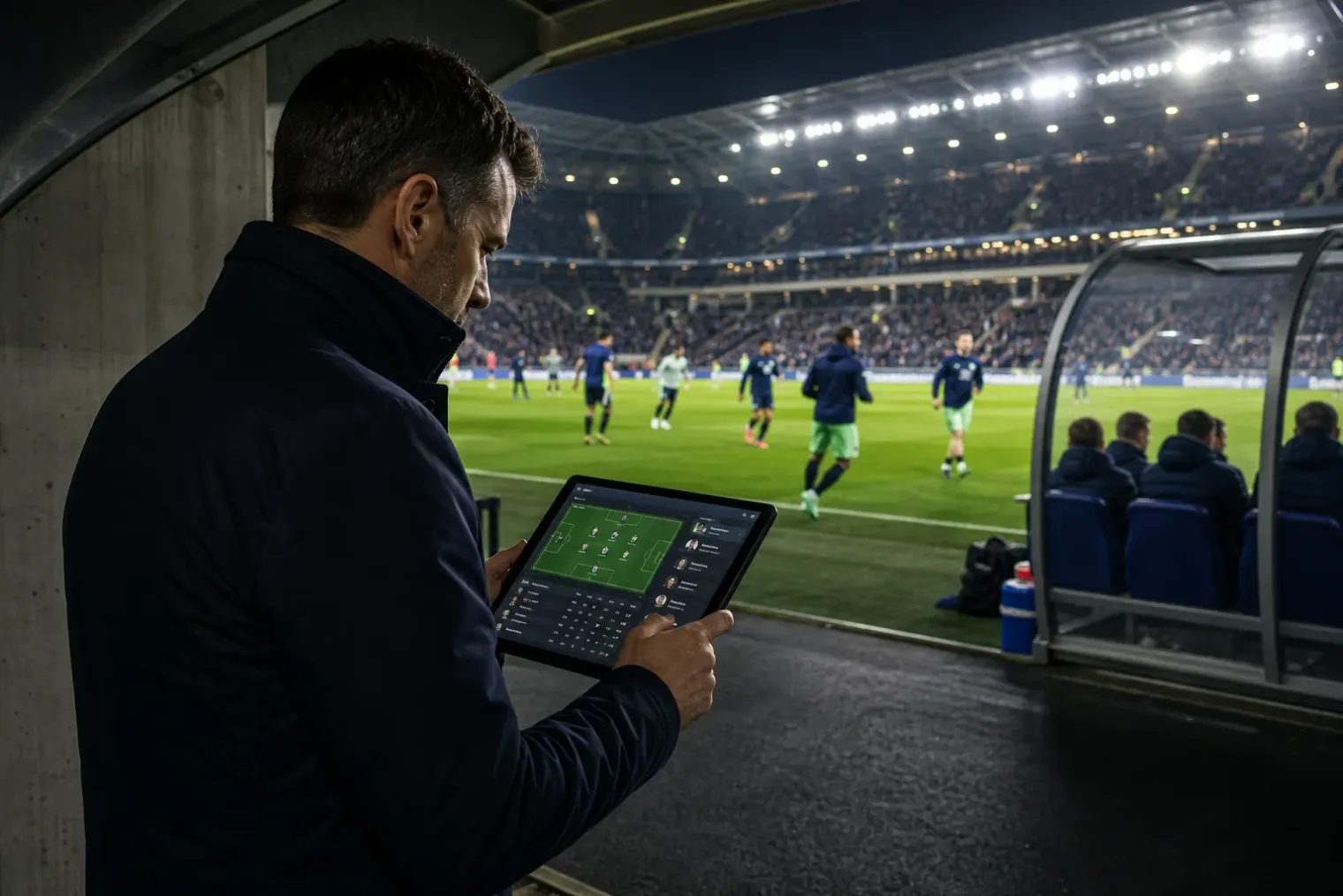
A shift from fixed squads to changing football worlds
Career Mode has long been one of the most durable parts of EA Sports’ football series, but it has also carried a familiar limitation: after several seasons, the wider game world could begin to feel predictable. Transfers often followed simple logic, player values were relatively easy to read, and overall ratings did not fully reflect a footballer’s changing circumstances.
For EA Sports FC 27, Electronic Arts is promising to revise those foundations rather than add isolated menu features. The headline changes are a rebuilt transfer market for Manager Career and a Dynamic OVR system that makes a player’s overall rating respond to form, morale and fitness. The game is scheduled to launch worldwide on 25 September 2026, so the claims remain pre-release commitments rather than changes that players can yet assess in the finished game.
The significance of the update is not simply that transfers may become harder. It is that the systems governing recruitment, development, squad selection and long-term planning are intended to affect one another. If that interaction works consistently, a successful career could require more adaptation than accumulating highly rated players and repeating a familiar development routine.
Transfers are intended to become negotiations, not transactions
EA’s new transfer-market framework is built around a partnership with TransferRoom, a football industry platform used by clubs, agents and scouts to identify opportunities. In FC 27, that influence is expected to be visible in player valuations and in the way computer-controlled clubs pursue targets.
A player’s estimated value is set to take account of more than age, rating and potential. Club buying power, league, contract situation, salary, form and the quality of the buying and selling sides are among the factors expected to shape the market. That should make the same player a different proposition depending on the club attempting to sign them.
Negotiations are also due to cover a wider set of terms. Managers will be able to discuss timing, payment structures, bonuses, player exchanges and future clauses. Reported examples include loan-backs, buy-back provisions and sell-on percentages. Contract talks are expected to include the player’s proposed squad role, with unmet expectations affecting satisfaction later in the save.
The most important change may be competitive recruitment. Rather than treating a transfer as settled once the human player reaches an agreement, rival clubs can intervene and force the deal back into contention. AI teams are also meant to maintain multiple candidates for a position and follow distinct recruitment philosophies. A club focused on youth should not behave like a title contender seeking immediate impact.
That approach addresses a longstanding issue in football management games: market realism depends as much on credible competition as on accurate prices. A transfer system that produces more believable values but still allows managers to complete every deal without pressure would only partly solve the problem. Active bidding, club-specific priorities and relationship factors could make recruitment less routine, although their value will depend on the consistency of the AI decisions behind them.
Dynamic OVR could change how squads are managed
The other major feature is Dynamic OVR. Previously, an overall rating primarily represented a player’s established ability, with changes arriving through growth, decline and certain temporary effects. FC 27 plans to make the figure more responsive to the current season.
EA says form, morale and match readiness will influence players across every club, not only the user’s squad. A forward on a sustained scoring run could receive a meaningful uplift, while an injured player or a footballer struggling for form could decline. Age and potential are also expected to matter: emerging players may be more capable of surpassing expectations, while veterans should have less room to improve.
This could make rotation and man-management more consequential. Selection decisions, playing time, media interactions and dressing-room issues are expected to influence morale, which in turn affects a player’s rating. Minor injuries are also meant to linger as performance concerns rather than disappear as a simple short-term absence. Managers may therefore have to weigh the value of starting an important but unready player against the risk of a poorer performance or a longer setback.
The system also appears designed to curb positional shortcuts. Players will have a primary role and up to six secondary positions, while the rating impact of a positional switch should vary by player. Versatile footballers may retain much of their usefulness in several roles, whereas specialists could be penalised more sharply when used out of position.
There is a potential trade-off. Dynamic ratings could make career saves feel more alive and reduce the certainty of long-term squad building. But it also creates a balancing challenge: rapid changes that are too severe could make player quality feel arbitrary, while subtle changes may be difficult for users to notice. The effectiveness of the feature will rely on whether the game explains why ratings move and whether its calculations feel credible over a full season.
Development and scenarios broaden the long game
FC 27 is also expected to replace traditional training plans with a match-readiness system, shifting attention from routine attribute boosts towards player availability and preparation. Youth prospects will reportedly receive growth profiles that determine their development speed, peak and later decline. Crucially, this logic is intended to apply to AI clubs too, helping the football landscape evolve beyond the user’s own academy.
Other planned additions aim to provide more variety between matches. EA is introducing community-created challenges through a web tool, allowing players to build and share custom career starting points. These could range from a financial crisis to a relegation fight without transfers. More than 65 potential season events, expanded historical statistics, a training arena and deeper league simulation options are also intended to make individual saves less uniform.
Player Career is due to receive a rivalry system in which positional peers become recurring targets. Goals may include outperforming a rival in goals, assists or another measure across a defined stretch of matches. It is a smaller-scale counterpart to the managerial changes, but it could give individual careers clearer narrative momentum.
A promising direction, with implementation still to prove
The announced Career Mode changes are ambitious because they concentrate on interconnected systems rather than presentation alone. More nuanced deals are useful only if AI clubs recruit logically; dynamic ratings are compelling only if players can understand and influence them; and unpredictable events must add context without becoming disruptive noise.
EA has identified several areas that matter most to Career Mode players: credible transfers, meaningful squad decisions and a world that changes even when the user is not directly involved. FC 27’s proposals directly address those demands. Whether this becomes the series’ most substantial Career Mode revision in years will be determined after launch, but the design points towards a mode where football management is less static and where every season carries more uncertainty.
Sources
- Kariéra v EA Sports FC 27 dostane najväčšie zmeny za roky — Sector.sk
- Kylian Mbappé and Jude Bellingham Welcome You to EA SPORTS FC 27, Launching Worldwide on September 25 — Electronic Arts
- EA SPORTS FC 27 Official Site — Electronic Arts
- EA SPORTS FC 27 Editions and Release Dates — Electronic Arts


