
A showcase led by familiar worlds
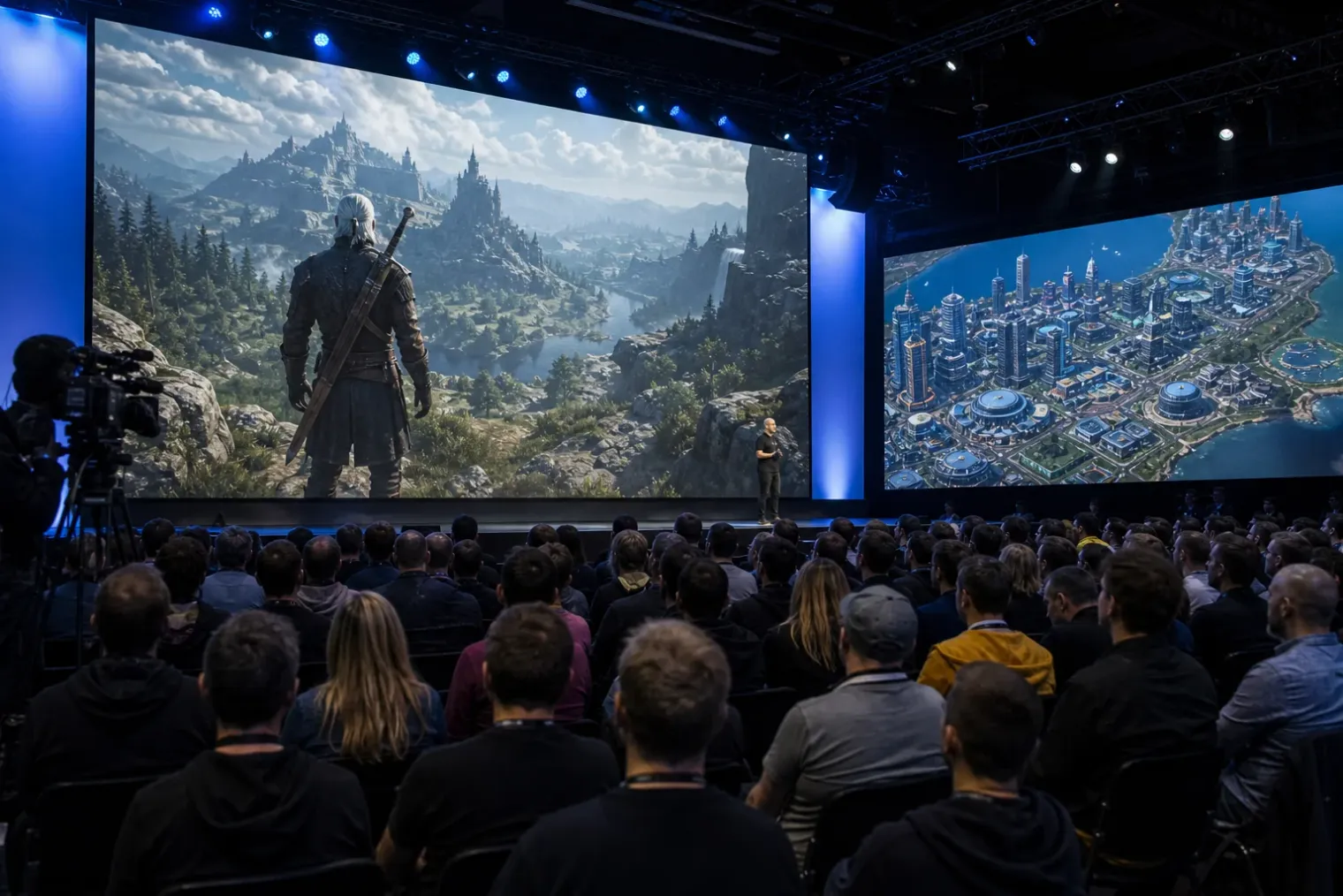
Gamescom Opening Night Live on 25 August put established series at the centre of its 2026 programme, but its biggest surprise was not a new sequel. CD Projekt Red used the closing slot to announce The Witcher 3: Wild Hunt — Remastered, a substantial update due on 29 September for PC, PlayStation 5 and Xbox Series X|S, with a native Nintendo Switch 2 edition also planned. Existing owners on qualifying platforms will receive the upgrade without charge.
The update goes beyond a technical re-release. CD Projekt Red has outlined visual and performance improvements alongside changes to combat, movement, mount handling, monster behaviour, skills, finishing moves and photo mode. It will also add transmogrification. In a consumer-friendly move, the studio is making the earlier Hearts of Stone and Blood and Wine expansions available at no additional cost to current owners of the base game.
That remaster is strategically useful because it creates a fresh entry point before Songs of the Past, a paid expansion scheduled for 2027. The first teaser confirmed a new region, Letten, described as a seemingly peaceful rural land shaped by folklore and festivals, with a concealed threat at its core. Geralt will return as the playable lead, using a chain as a new weapon while confronting new enemies. The expansion is being co-developed with Fool’s Theory.
The scale of this Witcher announcement made it more than a routine DLC trailer. A game released in 2015 is being repositioned simultaneously as an updated current-generation product and as the platform for a major new story. It also suggests that publishers continue to see long-lived role-playing games as valuable ecosystems rather than completed catalogue titles.
Final Fantasy and the sequel pipeline
Square Enix brought Final Fantasy VII Revelation to the stage, offering a closer look at the huge Weapon creatures that will feature in the concluding instalment of the Final Fantasy VII remake trilogy. Director Naoki Hamaguchi presented the trailer, which focused on Ruby, Emerald and Ultima Weapon.
The appearance mattered less for new release information than for confirmation of the project’s direction. With Revelation positioned as the trilogy’s finale, the trailer emphasised spectacle and the enlargement of the original game’s major encounters. It was a reminder that Gamescom remains a useful venue for publishers with major games already announced: a trailer can renew attention without requiring a new date, platform or pre-order campaign.
Microsoft also returned to a well-known series with a story trailer for Gears of War: E-Day. The game is scheduled to launch on 6 October, making the show an opportunity to shift its marketing emphasis from announcement to impending release. Konami, meanwhile, used the event to reveal more of Silent Hill: Townfall, continuing its gradual return to the psychological-horror series after several years of revival announcements.
Release dates begin to define 2027
Several announcements gave clearer shape to the next release calendar. Archetype Entertainment’s science-fiction role-playing game Exodus received an 7 April 2027 launch date. Ananta, the free-to-play open-world action game, is due on 15 January 2027. Game of Thrones: War for Westeros is also planned for early 2027, while Turok: Origins is targeting spring.
These dates underline the increasing importance of Gamescom as a bridge between the autumn release window and the following year. The show contained fewer immediate blockbuster launches than a conventional holiday presentation, but it supplied a roadmap for publishers whose projects need visibility well before they arrive.
Other release-oriented moments included Path of Exile 2, which is set to leave early access with its 1.0 release on 11 December, and Aion 2, scheduled for 5 October. Road Kings received a 11 March 2027 date, while Stage Tour is planned for 10 December.
The broad spread of dates also reflects a fragmented market. Rather than being dominated by a handful of platform holders, the programme mixed subscription-era franchises, free-to-play games, large licensed projects and independently developed releases. For audiences, the result was a less concentrated showcase but a fuller picture of the types of games competing for attention in 2027.
Strategy, remakes and new concepts
The most striking pattern outside role-playing games was the renewed confidence in strategy and simulation. LEGO Skylines was announced as a city-building collaboration from the creators of Cities: Skylines. The pairing is immediately legible: the construction freedom and recognisable visual language of LEGO fits naturally with a management genre built around urban planning and emergent player-made spaces.
Ubisoft also announced a remake of Heroes of Might and Magic III, reviving a turn-based strategy classic first released in 1999. Separately, the publisher revealed Rainbow Six Tactics, a turn-based strategy adaptation of its tactical-action brand. Together, the announcements demonstrate that publishers are willing to test strategy games both through nostalgia and through new interpretations of established properties.
The event was not limited to legacy brands. Hoyoverse unveiled Nodusfall, a new co-operative action game, and also presented Petit Planet, a cosy life simulation game. Neon Giant returned with No Law, while Octopus Panic announced co-operative action game Gravhounds. There were further world premieres for Lofsöng, Dust: Origins, There Are No Ghosts at the Grand and Roco Kingdom.
This mix was important because it prevented the show from becoming solely a parade of remasters and sequels. However, most of the new properties were introduced through short trailers rather than extended demonstrations. Their longer-term impact will depend on whether subsequent gameplay presentations establish a distinctive identity in increasingly crowded action, co-operative and open-world categories.
What Gamescom’s opening show established
Opening Night Live was strongest when announcements offered a concrete change: a release date, a new edition, a playable premise or a meaningful expansion. The Witcher 3’s remaster and Songs of the Past combined all of those elements, making CD Projekt Red’s closing segment the clearest example of how to turn an existing hit into a new commercial moment.
Final Fantasy VII Revelation and Gears of War: E-Day supplied the major-franchise momentum, while LEGO Skylines, Heroes of Might and Magic III Remake and Rainbow Six Tactics showed that strategy games can still secure prominent showcase space. The overall message was pragmatic rather than revolutionary: in an uncertain development environment, publishers are relying on proven worlds while still reserving room for new teams and new formats.
For players, the immediate takeaway is a calendar extending from October 2026 into 2027. For the industry, the more significant point is that Gamescom’s opening show remains an effective global stage for both preservation of older successes and the slow construction of the next release cycle.
Sources
- Gamescom Opening Night Live 2026 report — Eurogamer
- The Witcher 3: Wild Hunt — Remastered Announced, Songs of the Past Gets First Look — CD PROJEKT RED
- Gamescom Opening Night Live: All the big news and reveals — Video Games Chronicle
- Every announcement from Gamescom Opening Night Live 2026 — PC Gamer


