
A broader public test before launch
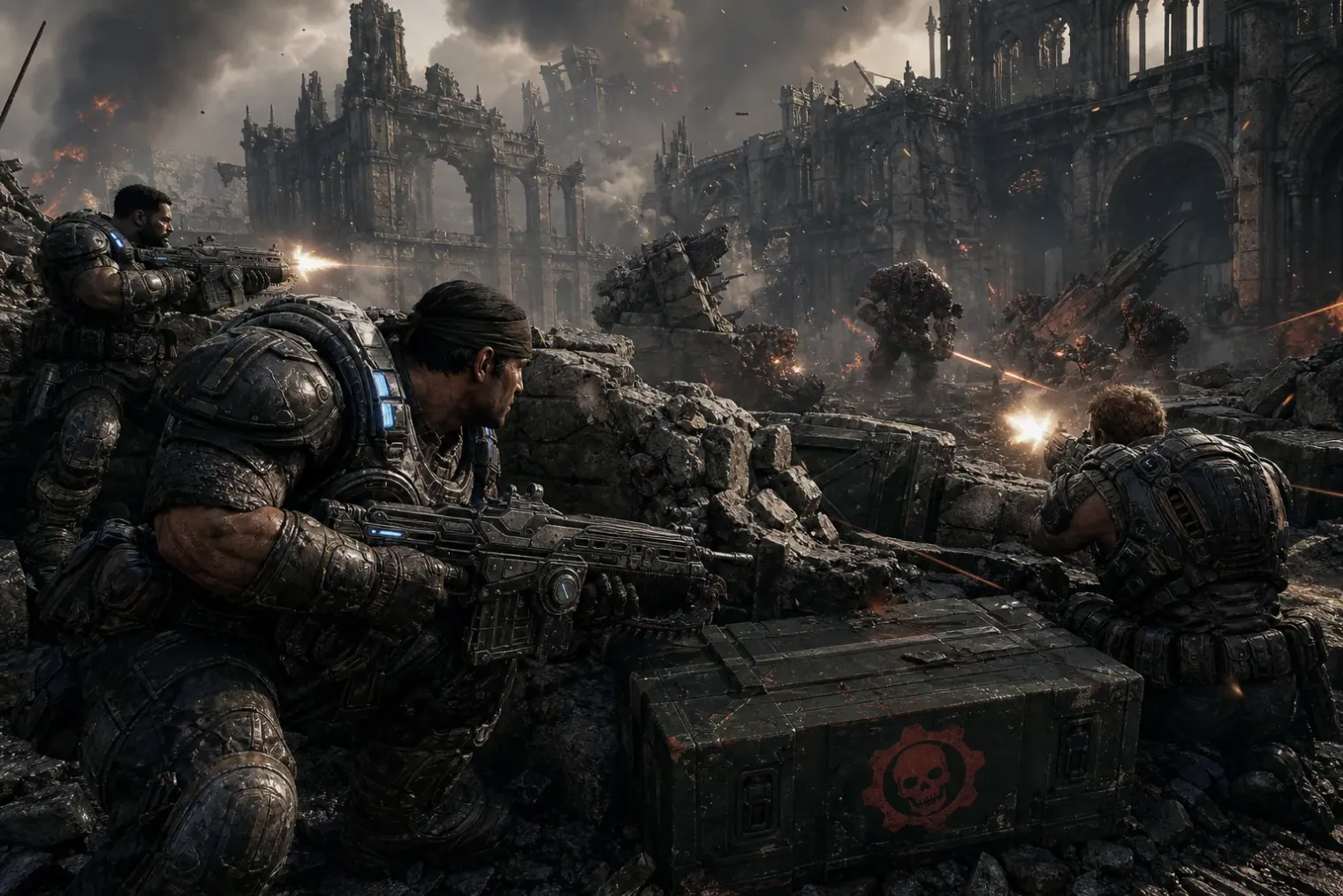
Gears of War: E-Day has moved from a restricted early-access test to an open beta available to all players on Xbox Series X|S and PC, including through the Xbox app and Steam. The public phase runs until August 17, giving developer The Coalition a final large-scale opportunity to test its multiplayer systems before the game launches on October 6, 2026.
The first beta weekend was reserved for people who pre-ordered the game or had eligible Game Pass subscriptions. Removing that requirement for the second weekend changes the purpose of the test. It is no longer only a reward for committed players; it is also a practical stress test of matchmaking, connection stability, anti-cheat measures and balance under a broader mix of experience levels and hardware configurations.
That distinction matters for a series whose multiplayer identity has traditionally depended on responsive cover movement, precise weapon behaviour and close-range confrontations. These are areas where technical imperfections are immediately visible to players, especially in competitive modes. A public beta cannot guarantee a smooth launch, but it provides data that controlled internal testing cannot reproduce at the same scale.
Two contrasting multiplayer pillars
The beta presents the two multiplayer directions that will underpin E-Day: the cooperative Horde Siege mode and the competitive Versus offering.
Horde Siege is The Coalition’s expanded interpretation of the series’ wave-survival formula. Rather than placing one small team in a fixed defensive arena, it supports up to 12 players spread across three squads on larger maps. Squads take on separate objectives within the same ongoing battle, can encounter the consequences of other teams’ actions and eventually work towards extraction. The format is designed to make the familiar Horde concept feel less static, with movement between objectives and shifting tactical priorities.
Its beta map, Golden Quarter, is set in the damaged city of Kalona, the central location for E-Day’s multiplayer. Players choose from four classes: Assault, Breacher, Marksman and Medic. Each has a dedicated combat role and tactical equipment, but the system does not enforce a fixed party composition. That provides scope for experimentation while retaining distinct functions for close-quarters pressure, support, precision damage and flexible mid-range play.
The mode also introduces a more persistent progression loop. Successful extraction is important because it preserves resources collected during a mission for weapon customisation. This makes survival and completion more meaningful than simply reaching the next round, while also giving the developer a substantial economy and progression system to observe during testing.
Versus takes the opposite approach. Its matches are four-versus-four, with equal starting loadouts and no weapon modifications, keeping the focus on map control, movement, teamwork and the contest for powerful weapons placed around each arena. The initial structure includes Team Deathmatch, Conquest, Demolition and the new Crucible mode.
The design suggests The Coalition is trying to protect the competitive clarity associated with earlier Gears multiplayer while adapting it to the game’s revised movement and combat systems. New mechanics are only valuable if they expand tactical choices without making engagements unpredictable or weakening the importance of positioning. The open beta is therefore an important test of whether that balance has been achieved.
Changes based on the first weekend
The second weekend reportedly uses feedback and telemetry from the early-access period to implement gameplay and technical adjustments. The Prototype Lancer has received a higher base damage value, while the bonus damage from a perfect reload has been reduced. Taken together, the changes appear intended to make the weapon more consistent in ordinary combat while limiting the advantage gained from one specific timing mechanic.
The Coalition has also addressed hit registration in Horde Siege and matchmaking in both Social and Ranked Versus playlists. These are fundamental issues rather than cosmetic refinements. In a cooperative mode, unreliable hits can undermine confidence in the game’s combat feedback; in a ranked environment, inconsistent matchmaking can quickly erode players’ sense that results reflect skill and teamwork.
Other reported work includes improvements to stability, connection problems, certain controller support on Steam, Microsoft account linking and stuttering on Xbox Series S. Anti-cheat protections have also been strengthened, with action taken against confirmed cheating. The range of fixes illustrates why the test is useful: launch readiness is not defined only by the quality of maps and weapons, but by the full chain of platform access, account services, network performance and fair play.
Progress earned in the first beta weekend carries into the second. However, most progression will be reset before release. Only selected beta rewards, including a title and medal, will move into the full game. That approach lets testers experiment with classes and systems during the event without creating an enduring advantage for those able to play before launch.
A test of the live-service proposition
The beta also offers a clearer view of E-Day’s longer-term multiplayer ambitions. The Coalition plans five themed post-launch seasons, beginning with Season 1: Emergence. These updates are intended to add maps, modes, characters, classes, events and cosmetics.
At the same time, the studio has outlined a model in which nearly all customisation items can be earned through gameplay, challenges, medals or in-game currency. Premium content and some partnership or charity items are exceptions. There will still be a premium currency and a rotating shop, but the stated approach differs from a conventional battle-pass structure. Whether players view that as a meaningful improvement will depend on the practical rate of rewards, the cost of items and the consistency of post-launch support.
For now, the open beta has a narrower objective: establish whether the core experience works reliably and whether the two major modes offer enough contrast. Horde Siege must prove that its larger-scale cooperative format retains the tension of classic Horde, while Versus must demonstrate that its new systems preserve the disciplined, high-pressure combat that has long defined Gears multiplayer.
The game’s campaign remains the centre of its Emergence Day prequel story, following Marcus Fenix and Dominic Santiago before the original Gears of War. But the beta makes clear that multiplayer is being positioned as a major, evolving part of E-Day rather than a secondary addition. The response during the final public test will help determine how convincing that proposition is when the game arrives in October.


