
Internal inquiry and resignation
A former patrol officer in Alpharetta, Georgia, allegedly used Flock Safety’s automated licence-plate reader system to follow the movements of a former romantic partner and another police officer. The case, disclosed on August 27, is based on internal investigation records obtained through a public-records request.
According to those records, Patrolman Dustin Bozzo searched for the licence plate associated with his former partner 56 times between March and May 2026. The woman had worked for the Alpharetta Police Department and is now a civilian employee there. He also made 29 searches for the vehicle of another officer after repeatedly seeing that vehicle near hers in the results. Both people told investigators that they were only friends.
The department placed Bozzo on paid leave on July 20. He resigned on August 5, after the internal investigation, and the department has said that its Criminal Investigations Division is conducting an ongoing criminal investigation. Bozzo did not respond to requests for comment reported by WIRED.
The records describe a personal relationship that had ended before the searches began. Bozzo told investigators that he was checking on the former partner’s welfare because she sometimes drove late at night, and said he had no intention to intimidate or harm her. Investigators did not find evidence contradicting his stated lack of malicious intent. However, the inquiry concluded that the searches were inconsistent with department policy and the authorised use of the system.
That distinction is important. A surveillance tool can be misused even where an officer claims a benign motive. Access to a searchable history of vehicle sightings gives an authorised user a capability far beyond ordinary observation: it can turn a licence plate into a practical means of reconstructing parts of a person’s routine and associations.
Why audit logs matter
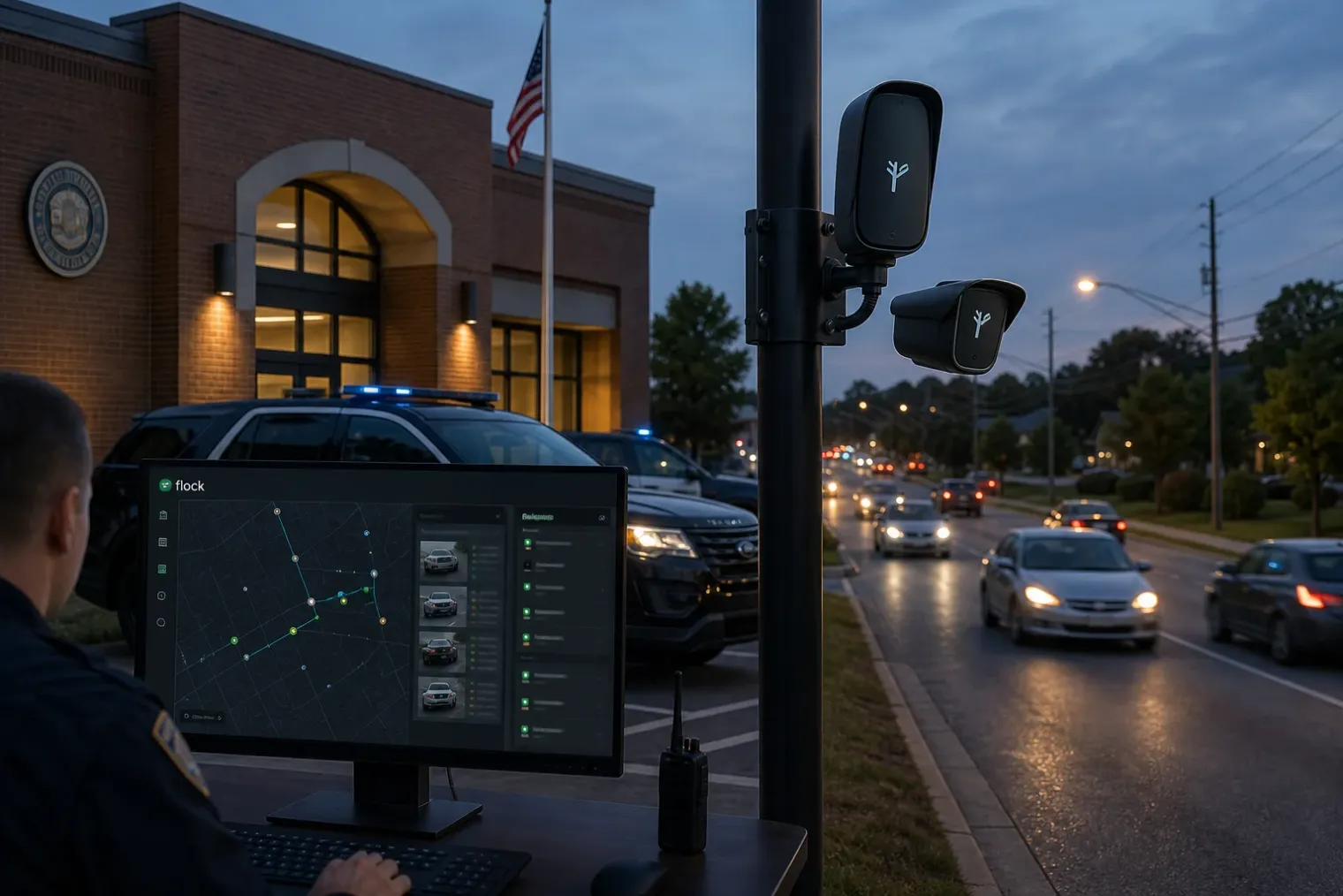
Flock’s systems use cameras to collect vehicle images and plate data, then make results searchable by authorised agency users. The company says access is limited to approved personnel, every search is tied to an individual account, and searches must relate to a specific investigation under local policy. It also says agencies decide whether and how to share their data with other participating agencies.
Those controls have a dual significance in the Alpharetta case. Audit logs appear to have made the alleged misuse visible and provided the basis for a detailed internal review. The same facts also illustrate the limits of a system that records activity but is not necessarily reviewed quickly enough to stop questionable searches as they occur.
The records reportedly show Bozzo commonly selected generic search reasons, including “Wanted Person” and “Traffic Infraction.” He said those options were simply quick keystrokes. Such explanations may be valuable for recordkeeping, but they are a weak safeguard if supervisors do not compare them with a real case number, incident report or clearly defined investigative purpose.
An effective control framework therefore needs more than an audit trail. It needs regular, independent review of patterns such as repeated searches for the same plate, searches outside an officer’s current assignments, unusually frequent queries, or justifications that do not match a documented case. It should also require swift suspension of access when anomalies arise, followed by a review that is separate from the user’s chain of command where appropriate.
A wider pattern of personal misuse
The Alpharetta investigation has emerged amid growing scrutiny of personal misuse of automated licence-plate reader data. The Institute for Justice, which tracks publicly reported incidents, has catalogued more than 100 alleged cases of abuse across several categories, including stalking, non-law-enforcement searches and wrongful stops. Its separate review of cases involving romantic interests says that many were exposed only after a target complained, rather than through routine internal auditing.
The database is not a measure of total misuse; documented incidents depend on complaints, news reporting, public records and official action. Still, it points to a recurring governance problem. The risk is not limited to technical error or an external attacker gaining access. It also arises when legitimate users are able to apply a powerful search capability to a personal dispute.
That problem is particularly acute for people known to an officer, including current or former partners, colleagues, relatives and neighbours. They may be easier to identify in a system, while an officer can give a superficially plausible explanation for a search. Repeated queries can nevertheless create a detailed picture of where someone has travelled, when their car appeared in particular places and which vehicles were nearby.
New vendor safeguards, continuing agency responsibility
Flock announced new privacy, security and accountability measures in August, including a recommended seven-day default retention period for automated licence-plate-reader data. It also said it would require its Audit Assistance monitoring feature, mandatory multi-factor authentication and case codes for law-enforcement searches by the end of 2026. The company says its monitoring can flag abnormal activity for administrator review and can trigger proactive user lockouts.
These measures could make personal misuse easier to identify and interrupt, especially where they are consistently configured and reviewed. Shorter retention may also reduce the amount of historical movement data available for inappropriate searching. But the practical effect will depend on implementation by both the supplier and its customers.
Police agencies retain decisive responsibilities: defining permitted uses precisely, limiting user roles, enforcing case-based searches, conducting meaningful audits and publishing enough policy information for communities to understand the rules. Clear consequences are also essential. Administrative action, loss of access and, where the evidence supports it, criminal investigation signal that surveillance privileges are not personal entitlements.
The Alpharetta case is not an argument that licence-plate reader systems have no investigative value. Police leaders and supporters of the technology cite uses involving stolen vehicles, missing people and serious crime. It is, however, a reminder that a tool’s public-safety rationale does not itself constrain individual behaviour. Accountability has to be designed into daily use, tested through audits and backed by consequences before personal curiosity becomes sustained surveillance.
Sources
- A Georgia Cop Used Flock to Track 2 Other Cops: His Ex and Her Friend — WIRED
- Law Enforcement Data Access — Flock Safety
- Flock Updates Privacy, Accountability, Security, and Transparency Safeguards — Flock Safety
- Surveillance tech company Flock announces platform changes amid public backlash — Associated Press
- The IJ Database of ALPR Abuse — Institute for Justice


