
An apparent leak, not a confirmed disclosure
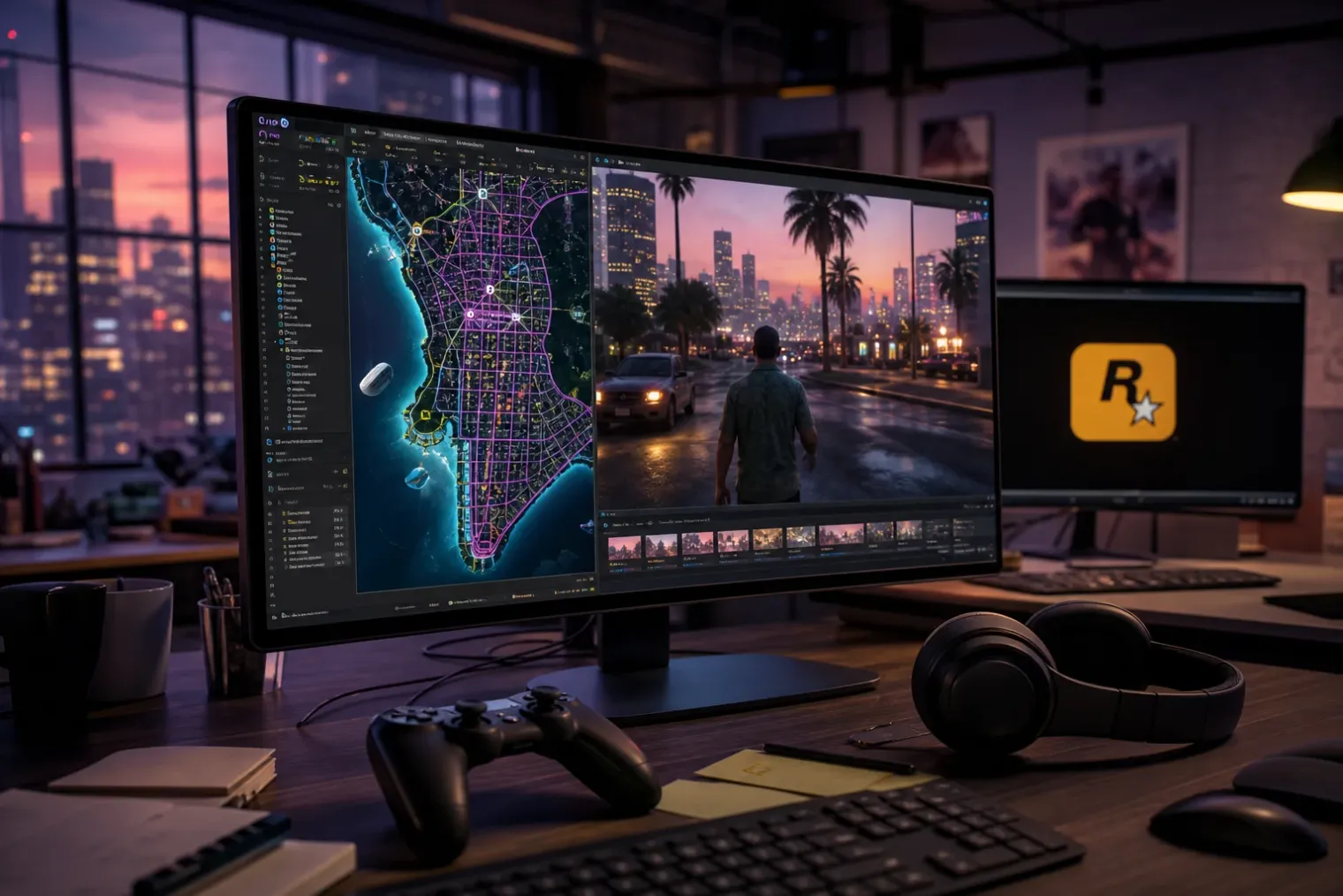
Footage and images presented as material from Grand Theft Auto VI began circulating online on August 18, prompting renewed scrutiny of Rockstar Games’ security and of the risks surrounding late-stage development of a major release. The posts attributed to the name Cyberleek appear to show gameplay involving Jason, one of the game’s two confirmed protagonists, as well as a purported map of Leonida, Rockstar’s fictional Florida-inspired setting.
Reports describing the clips point to ordinary open-world activities and systems: a basketball interaction apparently linked to a “Focus” meter, vehicle collisions, melee combat and interface elements that may suggest separate cash totals. A separate map image purports to show the state’s road network and locations. These details have inevitably encouraged close analysis among fans, but none should be treated as confirmed game features.
Rockstar Games has not publicly authenticated the circulating footage or map. The reported removal of some reposts through copyright complaints may indicate that the material has attracted legal attention, but takedowns alone do not establish what every image or clip represents, when it was made, or whether it reflects the version that will ship. Unauthorised material can be altered, selectively edited or drawn from obsolete builds.
The official baseline is much narrower
The official Grand Theft Auto VI site confirms that Jason and Lucia are at the centre of a criminal story spanning Leonida, including Vice City. It also lists the game’s release date as November 19, 2026. Rockstar’s public materials, however, are the only reliable guide to its setting, characters, editions and launch plans; they do not validate the newly shared gameplay details.
That distinction matters particularly for map claims. An open-world map is an unusually attractive target for leaks because it seems to promise a complete answer to a central fan question: the size, geography and activities of the game world. In practice, a diagrammatic road map or a partial interface capture can say little about density, interiors, mission areas, travel systems or the final placement of activities. Even genuine development material can change significantly before release.
The same caution applies to apparent mechanics. A meter, icon or interaction observed in a short clip might represent an unfinished feature, a temporary test tool, a context-specific mission system or an element whose design later changes. Gameplay footage is more persuasive than an anonymous text post, but it is still not equivalent to a formal product demonstration.
Cyberleek’s stated campaign complicates the story
The account or group using the Cyberleek name has framed its actions as a campaign about consumer rights. Its published demands reportedly include ending digital pre-orders, avoiding additional charges for content already contained in a game’s files, and providing offline-capable versions of single-player content. Those issues overlap with real debates about ownership, preservation and access to games after online services close.
Yet the campaign’s approach is fundamentally at odds with that rhetoric. It uses unauthorised distribution of material from a developer and publisher while directing attention towards a cryptocurrency fundraising effort. That combination makes it difficult to assess the group’s claims as a straightforward consumer advocacy initiative. It also creates a clear incentive to maximise attention, speculation and the perceived significance of each post.
The physical-edition issue is more nuanced than the group’s messaging suggests. Rockstar says that Grand Theft Auto VI will be available in physical packaging, but that the box will contain a download code rather than a game disc. For players concerned about offline ownership or long-term preservation, that is a meaningful limitation. It is nevertheless different from the claim that there will be no retail physical version at all.
That distinction does not settle the wider argument over disc-free releases. A boxed code can still be affected by platform policies, account access, download availability and server dependence. But it does show why politically charged leak claims require careful separation between a genuine consumer concern and the accuracy of the leaker’s framing.
A familiar problem for Rockstar, with different conditions
Rockstar has experienced a far more consequential Grand Theft Auto VI breach before. In September 2022, dozens of videos from an early development build were posted online after an intrusion into the company’s systems. The scale of that incident made it one of the most prominent leaks in modern game development, and it exposed how easily unfinished work can be misread when stripped of production context.
The current episode arrives under different circumstances. Grand Theft Auto VI is now publicly announced, has an established release date and is much closer to launch. That makes purported gameplay footage more desirable to fans, but it also makes its potential effect more complicated. Material that appears close to final can shape impressions of performance, graphics, combat or interface design before Rockstar has chosen how to present them.
There is also a practical distinction between a confirmed system breach and the appearance of leaked-looking assets online. A claim of responsibility is not proof of a compromise, and the current public reporting does not establish how Cyberleek obtained the material, whether it had access to internal systems, or whether the latest posts are connected to any previous incident involving Rockstar.
Why restraint is the useful response
For players, the main risk is not simply encountering spoilers. It is forming expectations from a fragmentary and potentially unrepresentative view of a game that is still months away from release. A visible map can encourage assumptions about scale; an interface icon can become a supposed confirmed feature; an unfinished sequence can be treated as a final technical benchmark.
For Rockstar and Take-Two, the episode illustrates how leaks now operate as both a security problem and an information problem. Fast-moving reposts can make removal difficult, while the surrounding discussion rewards anonymous actors who mix plausible-looking material with demands, ideology and promotion. A measured official response may be appropriate if the company needs to correct misinformation, but validating every circulating claim would also amplify it.
The most defensible conclusion, as of August 19, is limited: apparent Grand Theft Auto VI clips and map imagery are circulating, and the self-described Cyberleek campaign has used them to publicise its demands. Their authenticity, source, date and relevance to the release version remain unconfirmed. Until Rockstar addresses specific material publicly, official announcements remain the sounder basis for judging what Grand Theft Auto VI will actually be at launch.
Sources
- GTA 6 gameplay footage and map appear to leak online, as group seemingly responsible makes demands of Rockstar — Eurogamer
- Grand Theft Auto VI — Rockstar Games
- Grand Theft Auto VI Platforms, Editions, and Versions — Rockstar Games
- New GTA 6 leaks show gameplay and the full Leonida map as Rockstar issues DMCA takedowns — GamesRadar+
- Grand Theft Auto VI footage leaks, and hacker threatens to spill more — Axios


