
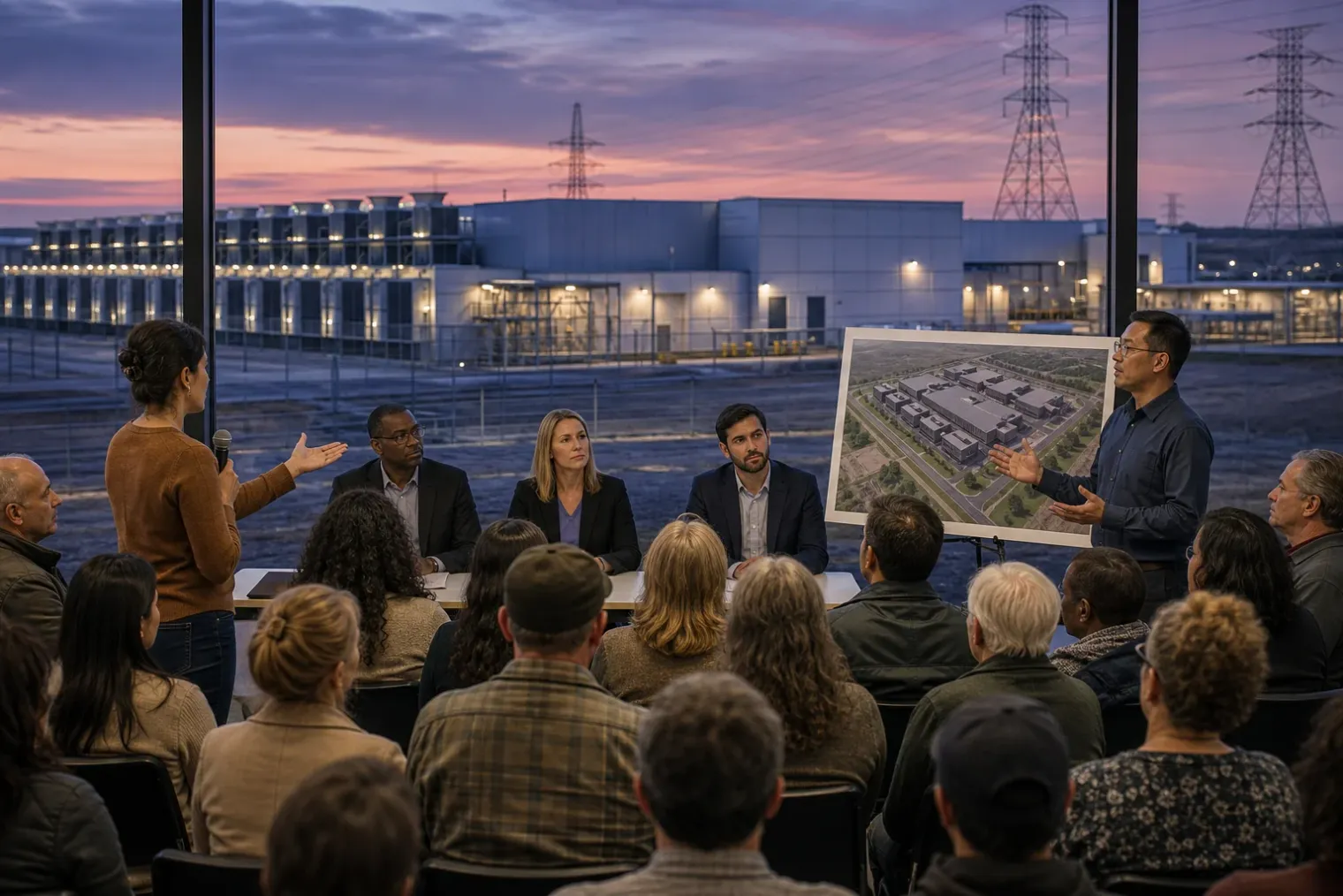
From invisible infrastructure to a public issue
For much of the internet age, data centers were treated as background infrastructure: secure, low-profile facilities whose economic value was assumed to outweigh their local footprint. The artificial-intelligence boom has changed that calculation. New campuses can require exceptionally large, reliable supplies of electricity, substantial grid upgrades and, depending on their design and location, significant water resources. Their arrival has consequently moved debates over AI out of laboratories, corporate boardrooms and Washington policy circles and into planning hearings, utility commissions and state legislatures.
The scale explains why the issue has become political. The US Department of Energy estimated that data centers used 176 terawatt-hours of electricity in 2023, about 4.4 percent of national consumption. Its earlier projection for 2028 placed the range between 325 and 580 terawatt-hours. These are uncertain forecasts rather than guarantees, but they have altered how utilities and regulators think about demand growth after a long period of relatively flat electricity use.
The political importance is not simply that facilities consume power. It is that decisions about who builds generation, transmission and substations, who pays for them, and how quickly approvals are granted are inherently distributive decisions. The benefits of a project may be concentrated in a developer, technology company, utility or host locality, while potential costs are felt across a wider group of ratepayers and residents.
A new form of bipartisan resistance
Opposition to data centers does not fit neatly into the familiar division between supporters of economic development and environmental campaigners. Local coalitions can include rural landowners worried about landscape change and noise, environmental advocates focused on water use and emissions, residents concerned about electricity bills, and critics of large technology companies who see AI as too powerful or insufficiently accountable.
That mix has produced unusual political alignments. Some conservatives frame the issue around local control, scepticism of corporate power and resistance to rapid technological change. Some progressives stress climate commitments, consumer protection and the concentration of economic and informational power in a small number of firms. Their motivations differ, but their policy demands can overlap: greater disclosure, stricter siting rules, enforceable commitments from developers and a clearer guarantee that households will not underwrite new infrastructure.
This does not mean every community rejects data centers. Local governments continue to see prospective investment, construction activity, tax revenue and a place in the expanding digital economy. Supporters also argue that computing capacity is strategically important and that delaying projects may transfer investment elsewhere. The point is that the old presumption of automatic welcome has weakened. A proposal now has to demonstrate local value as well as technical feasibility.
The electricity-bill question
Utility costs have become the most immediate political pressure point. A large facility may need new lines, substations and generation capacity, but those investments are typically planned years ahead and recovered through regulated rates. Residents understandably ask whether a project that promises private returns will leave them paying for a larger grid.
The answer varies by state, utility territory and contract. Data-center demand does not mechanically translate into a higher household bill: added demand can make better use of existing systems, and large customers can contribute substantial revenue. Yet rapid growth can also require costly infrastructure before demand is fully realised. If a customer withdraws, downsizes or delays a project after the grid has been expanded, regulators must decide who carries the risk.
Oregon offers an illustration of the emerging response. State law established a framework for large energy-use facilities, and the Oregon Public Utility Commission subsequently approved a dedicated rate structure for Portland General Electric’s large data-center customers. It uses tailored contracts, minimum-payment provisions and charges intended to direct the costs of serving rapid load growth towards the customers creating it. The policy is not a universal template, but it shows the political transition from general assurances to detailed allocation of financial responsibility.
Reliability and climate are now linked
The question of cost cannot be separated from reliability and emissions. The Energy Information Administration expects particularly rapid demand growth in regions managed by ERCOT in Texas and PJM, which spans all or parts of 13 states and Washington, DC. When demand rises faster than generating capacity and transmission connections can be built, system operators face greater pressure during periods of peak use.
That creates a difficult policy trade-off. Governments want more computing capacity and industrial investment, but also reliable power and affordable bills. Meanwhile, climate-focused constituencies want new demand met with low-carbon generation rather than prolonged use of fossil-fuel plants. Developers increasingly propose onsite generation, batteries, renewable-energy contracts and flexible operations. Each approach has different implications for air quality, land use, system resilience and the public grid.
The crucial political test is whether commitments are specific and enforceable. Broad claims of clean power or community benefit offer little reassurance unless regulators can establish what resources will be built, when they will be available, and who pays if the plan changes.
A test of democratic capacity
Data-center politics is ultimately about governing at the speed of private capital. A project can be announced, financed and presented as essential to an AI race long before a community has the information needed to assess its water use, electricity requirements, tax arrangements or long-term employment effects. Local officials may also have limited leverage when competing jurisdictions are offering incentives.
Better governance does not require treating every data center as a threat or every expansion plan as a public good. It requires matching the scale of the decision to the scale of the effects. That means transparent reporting of anticipated resource use, public review before major commitments are made, rate designs that protect non-participating customers, and contracts that place meaningful performance obligations on developers.
The debate has broadened because data centers make AI tangible. They are visible sites where national ambitions for technological leadership meet the everyday concerns of communities. Whether that produces more durable public consent will depend less on slogans about innovation than on the credibility of the rules governing its physical infrastructure.
Sources
- How Data Centers Broke American Politics — WIRED
- DOE Releases New Report Evaluating Increase in Electricity Demand from Data Centers — US Department of Energy
- Fossil generation could rise with faster-than-expected growth in data center power demand — US Energy Information Administration
- Oregon PUC Approves New Rate Structure to Protect Customers Amid Rapid Data Center Growth — Oregon Public Utility Commission
- Data center backlash signals a fight over AI power — Brookings Institution


