
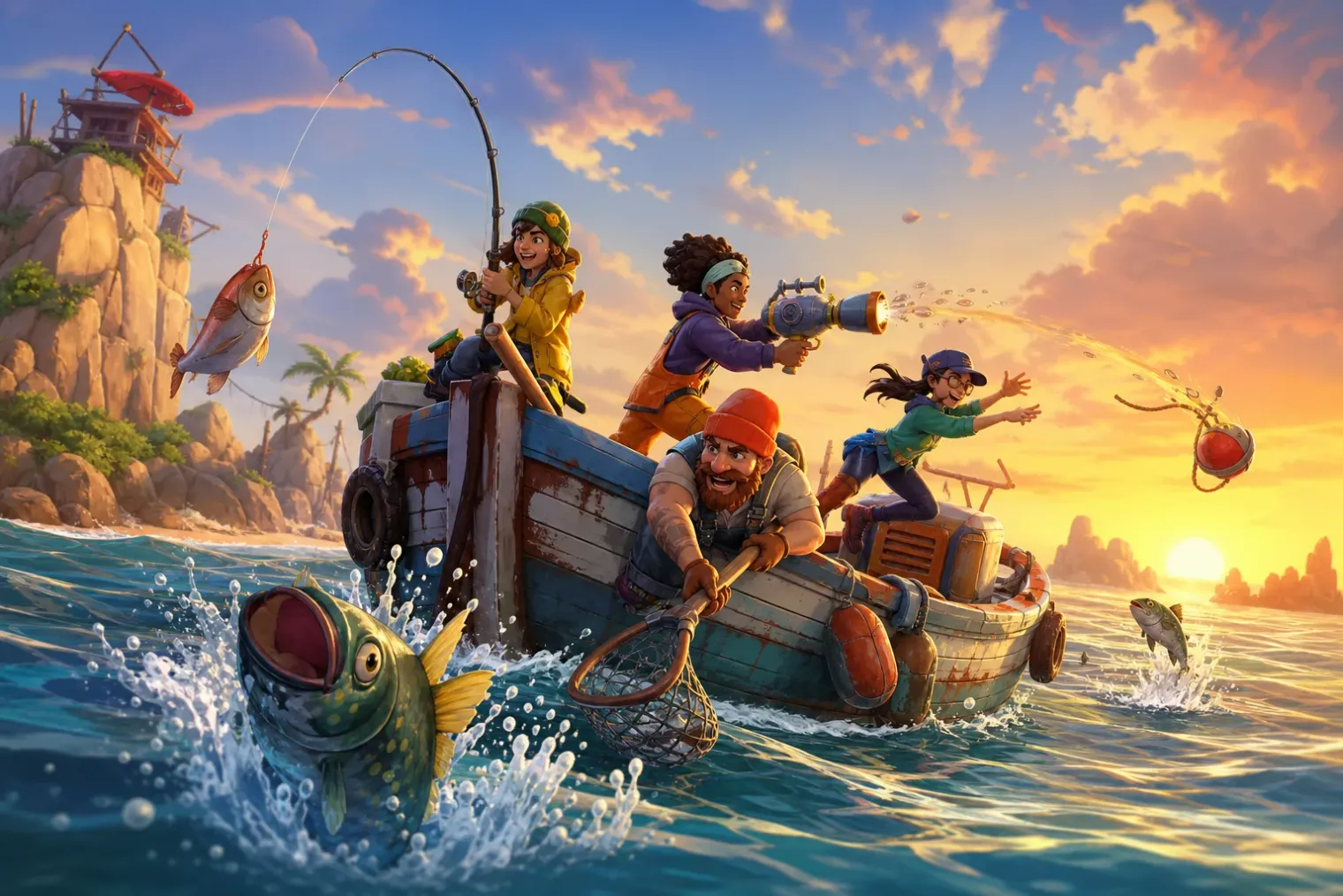
A rapid start for a small Steam release
How to Fish, the physics-driven co-operative game from Swedish developer Dazed Games, has reached one million sales on Steam within two days of release, according to the studio. The game launched on 20 August 2026 and the developers announced the milestone on 23 August, while also saying that further content and bug fixes are planned.
The result is striking less because fishing games are a new commercial force than because How to Fish deliberately bends that familiar theme into something far less sedate. Its basic setup involves up to four players stranded after a boating accident. They catch aquatic creatures, turn the catch into money, buy equipment and weapons, complete quests, defeat bosses and move to increasingly dangerous islands.
A conventional fishing rod is only one of the available tools. The Steam description makes clear that firearms, explosives, trick shots and a fictional gambling mechanic are part of the progression loop. That mixture has made the game easily legible in short videos and streams: it begins with an everyday activity, then quickly turns into a shared physics comedy with action-game escalation.
Low price, simple proposition
The game launched at a standard price of $7.99 in the United States, with a 38% introductory discount lowering the price to $4.95 through 27 August. A low entry price alone does not create a hit, but it reduces the friction for a group of friends deciding whether to try a new co-operative title together. That matters particularly on Steam, where games that work best in a single evening can spread rapidly through friends lists, live streams and short-form clips.
How to Fish also keeps its core explanation unusually concise. Players do not need to learn a deep fictional universe or master a lengthy competitive ruleset before they can participate. Catching, selling and upgrading are recognisable goals, while the weapons and exaggerated physics add novelty. The game supports solo play, but its one-to-four-player design puts social play at the centre of its appeal.
That format has become a durable part of the PC market. Small co-operative games can build momentum when they give groups a reason to improvise, fail amusingly and create stories worth sharing. Their popularity is often less dependent on finishing a long campaign than on whether a session produces repeatable moments of surprise. In How to Fish, the contrast between its placid title and its more chaotic mechanics is a central part of that pitch.
Player numbers underline the visibility
Sales figures come from the developer and should be treated as a reported milestone rather than a platform-certified public total. Steam does not normally disclose unit sales for every game. Even so, public player-tracking data provides a separate indication that the release achieved unusually broad reach: SteamDB recorded an all-time concurrent-player peak above 268,000 during the launch weekend.
Concurrent players and copies sold measure different things. The former shows how many people are playing at once; the latter is an accumulated commercial figure that can include people who are not currently online. In this case, the combination is meaningful. A very large peak suggests that the game was not merely being purchased on curiosity, but was being actively played during its opening days.
Early user feedback has also been strongly positive on Steam. That does not settle questions about the game’s long-term depth, technical stability or update cadence, but it can help sustain storefront visibility at the moment a new release needs it most. For a small studio, that visibility can be more consequential than an expensive marketing campaign: recommendation systems, chart placement and social discovery reinforce one another when a game attracts a large number of players quickly.
The challenge moves from discovery to delivery
The first major test for Dazed Games is now sustaining an audience created at exceptional speed. The developers have said they intend to add content and address bugs, but they have not set out a detailed public roadmap in their sales announcement. Players will therefore look for practical signals: reliable multiplayer sessions, quick responses to major issues and updates that give groups reasons to return.
The game’s mechanics offer several possible routes for that retention. New islands, creatures, gear, quests or unusual challenges would fit its existing structure without requiring a complete reinvention. At the same time, the studio will need to preserve the directness that helped the launch spread. Adding systems indiscriminately could make a game valued for spontaneity feel more complicated than its audience expects.
The one-million mark is nevertheless a major achievement for Dazed Games, whose website identifies How to Fish as the studio’s second released game after the party title Out of Hand: Deluxe. It also reinforces a broader lesson from Steam’s independent market: a modestly priced game with a clear co-operative hook can break through beside much larger releases when its premise is easy to understand, entertaining to watch and inexpensive to share with friends.
How to Fish has already won discovery. Its next phase will determine whether it becomes a brief viral success or a lasting fixture in co-operative PC gaming.
Sources
- How to Fish one million sales Steam — Eurogamer
- How to Fish on Steam — Steam
- How to Fish Steam Charts — SteamDB
- Dazed Games — Dazed Games


