
A mid-season update with an unusually practical headline
Marvel Rivals is preparing a Season 9.5 update for 7 August, bringing Parker Robbins, better known as The Hood, into its playable roster. New characters and cosmetics are routine ingredients for a live-service shooter, but the more consequential part of this release may be an effort to reduce the game’s storage demands substantially.
The developer has described the change as a broad texture-compression overhaul. Its stated target is a reduction of about 40 GB on PC and 15 GB on PlayStation 5 and Xbox Series X|S, without a loss of visual fidelity. If those figures translate consistently to live installations, the update would be a meaningful reversal for a game whose asset library has expanded rapidly alongside its roster, maps, effects and cosmetic catalogue.
The exact result will still vary by platform and installation choices. On PC in particular, the size displayed by a storefront, the amount downloaded during an update and the actual disk space occupied after files are unpacked are not necessarily the same figure. Language packs and optional high-resolution assets can also materially change the total.
The Hood broadens the Vanguard role
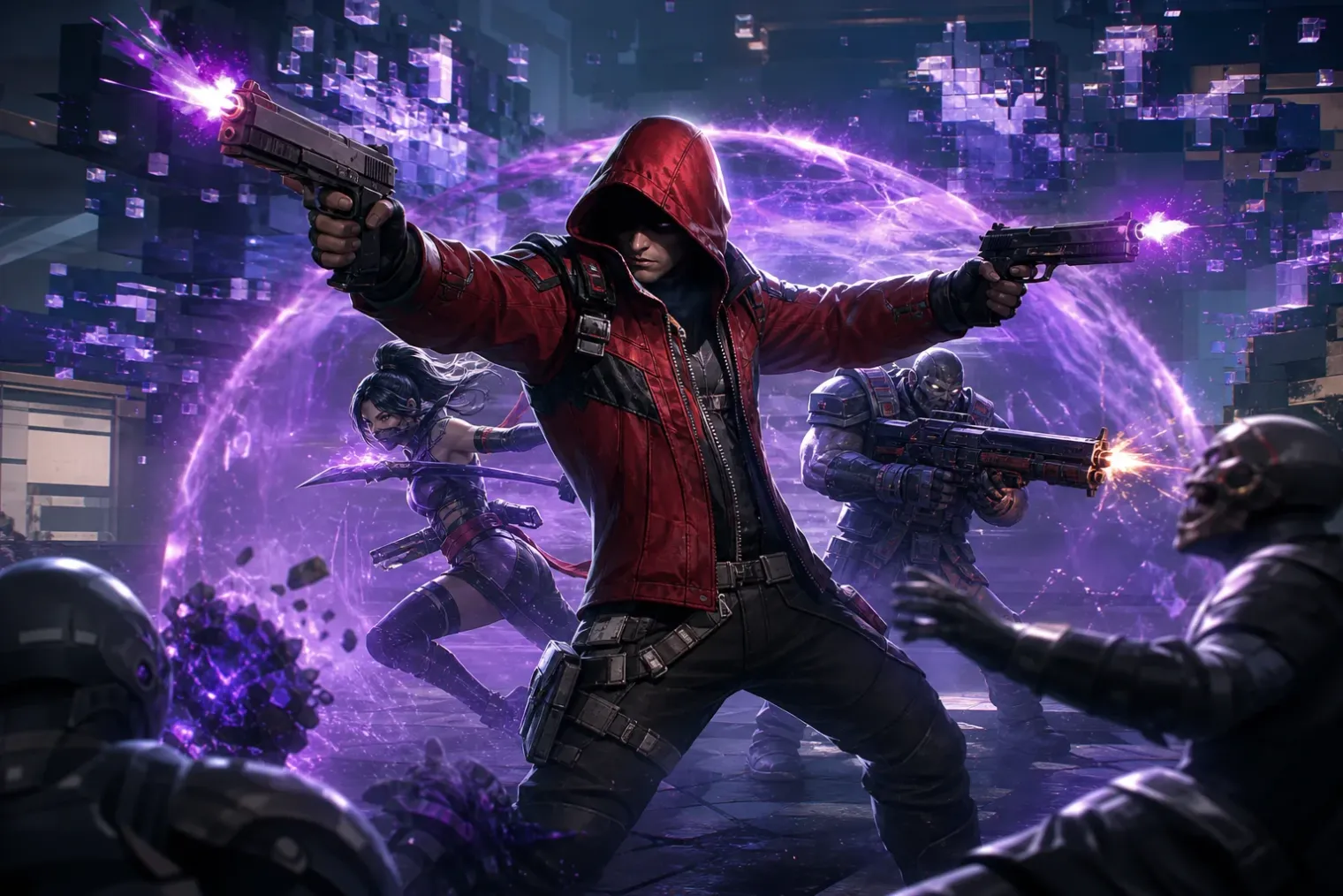
The Hood joins Marvel Rivals as a Vanguard, the game’s frontline-oriented class. The character’s design combines a human form using dual pistols with demonic and magical elements associated with the comic-book antihero. The announced kit emphasises protection as well as pressure: shields and barriers are intended to help allies, while his ultimate transformation shifts him into a more aggressive demonic state.
That positioning matters because Marvel Rivals has often used its mid-season additions to alter team-building rather than merely add another damage specialist. A Vanguard who can create space, protect teammates and threaten opposing barriers could create new combinations with the game’s support and flanking characters. The game’s existing material has already signalled a planned Cloak & Dagger and Hood Team-Up ability, suggesting that the new hero is being introduced with at least one direct roster interaction in mind.
Whether The Hood becomes a regular competitive selection will depend on numerical tuning, survivability and how reliably his barriers support coordinated teams. The basic concept, however, adds a more supernatural take on the class at a time when Marvel Rivals is continuing to expand its range of playable archetypes.
Compression is more significant than a smaller download
Storage requirements have become a practical friction point for contemporary multiplayer games. Players frequently keep several large live-service titles installed at once, while console storage remains limited and expansion options add cost. A reduction measured in tens of gigabytes can therefore affect whether a game stays installed, not merely how tidy a drive looks.
Texture data is a logical target. Textures occupy a large share of modern games because they must cover characters, maps, costumes, visual effects and interface assets at multiple quality levels. Improving how those files are encoded or packaged can lower storage use while preserving the data that the graphics hardware needs at runtime. The developer’s claim is specifically about texture compression rather than a removal of content, which is important: the goal is a leaner delivery method, not a smaller game world.
The announced savings also need to be read as reductions from players’ existing installations rather than a universal new install size. Steam depot data illustrates why a single headline number cannot fully describe PC storage: the game’s base files, regional depots and optional high-resolution package are recorded separately. Adding every depot together would overstate what an individual player installs, while omitting optional content can understate the footprint for players using the highest-quality asset pack.
An earlier option already addressed part of the issue
Marvel Rivals introduced separate high- and low-resolution resource packs in May. On Steam, the high-resolution pack is enabled by default for a new installation, but players can disable it through the game’s DLC settings and switch to the lower-resolution resources. The company said that option can reduce the installation size, with potential visual compromises in some circumstances.
Season 9.5 appears to be a different and broader initiative. The earlier option asked users to choose between asset tiers; the new compression work is intended to make the game itself smaller while retaining image quality. That distinction is central to the update’s value. Players should not have to trade sharpness for storage simply to keep a regularly updated competitive game installed.
There is still a useful reason for players to review their optional packages after the patch. Those prioritising free storage may find that the lower-resolution resources remain the most efficient configuration, while those with fast storage and higher-resolution displays may prefer to keep the high-resolution pack. The new optimisation should make either choice less demanding than before, but it will not make all configurations identical.
A test of live-service maintenance
Season 9.5 also includes further cosmetics and event content, continuing the game’s normal cadence of additions. That makes the compression work more notable: NetEase is attempting to reduce the installed footprint while still expanding the product. For long-running multiplayer games, that is a maintenance challenge rather than a one-off launch optimisation. Every new character, costume, animation and map adds assets that must be delivered across multiple platforms.
The true measure of the change will come after the update is live. Players will be able to compare their installed size before and after the patch, and the developer will need to maintain the gains as later seasons add more content. If the 40 GB PC and 15 GB console reductions are widely realised, Marvel Rivals will offer an example of a live-service game treating storage efficiency as a continuing player-experience feature.
For now, The Hood is the visible new attraction. Yet the technical work behind him may have the wider impact: a smaller installation reduces an obstacle for both returning players and regulars managing increasingly crowded libraries.
Sources
- Marvel Rivals – Official Season 9.5 Dev Vision Vol. 20 Video — Marvel Rivals
- HD Texture Pack Feature Optimization — Marvel Rivals
- Marvel Rivals Depots — SteamDB
- Marvel Rivals pridáva Hooda a zmenší inštaláciu o desiatky gigabajtov — Sector.sk


