
A process review, not a finding on climate science
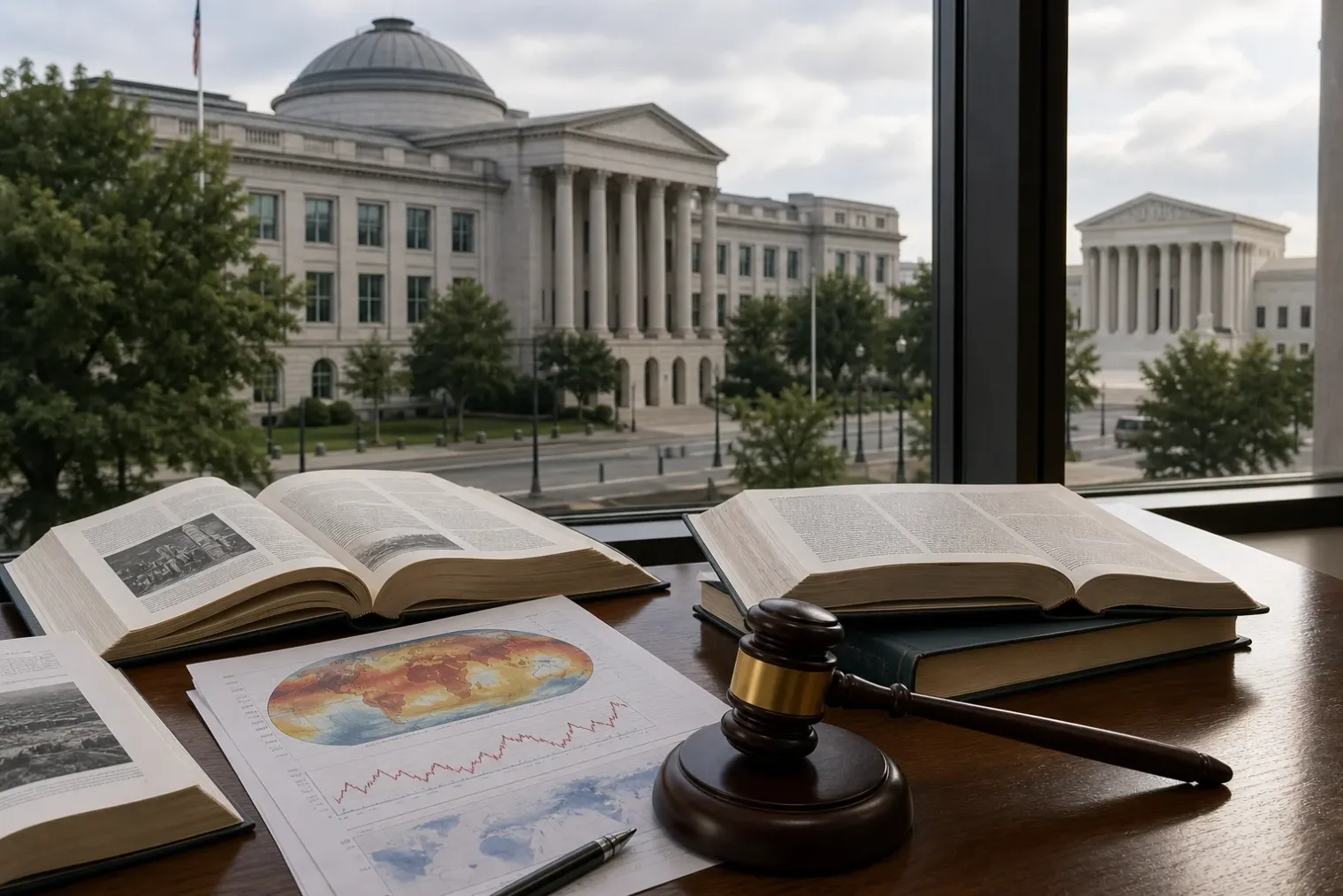
The National Academy of Sciences (NAS) has removed a climate-science chapter from its website and said it will commission an independent review of the process used to produce it. The move, announced on 7 August 2026, concerns the “Reference Guide on Climate Science”, a chapter prepared for the fourth edition of the Reference Manual on Scientific Evidence, a major resource intended to help US judges assess complicated scientific and technical testimony.
The NAS has drawn an important distinction: its review concerns the procedures used to develop the chapter, including whether they met the institution’s standards for objectivity and management of possible bias or conflicts of interest. It is not an assessment of the validity of climate science itself.
That distinction matters because the chapter was not a court ruling, an evidentiary standard or a direction to judges on how to decide cases. The manual is designed to outline scientific fields, explain methods and identify recurring questions that arise when expert evidence is presented in litigation. Its stated purpose is to help judges make informed assessments while remaining within the legal rules governing evidence.
The chapter had already been omitted from the federal version
The Federal Judicial Center (FJC), which produced the manual jointly with the National Academies, had already removed the guide from the version it distributes to the federal judiciary. The FJC’s updated manual records that the climate chapter was omitted on 6 February 2026.
The fourth edition was released on 31 December 2025. It revised earlier material and added subjects including eyewitness identification, computer science and artificial intelligence. Climate science was also included as a new subject, reflecting the increasing role of climate-related evidence in disputes involving regulation, property, insurance, public nuisance and alleged damages.
The guide was written by Jessica Wentz, a legal scholar affiliated with Columbia University’s Sabin Center for Climate Change Law, and Radley Horton, a climate scientist at Columbia University. According to the authors, it addressed the greenhouse effect, radiative forcing, observed changes in the climate system, scientific uncertainty, detection and attribution research, and ways climate evidence may arise in court.
The removal therefore does not mean that federal judges lack access to scientific evidence in individual cases. Judges still assess the testimony and material submitted by the parties, apply the relevant rules of evidence and decide disputes case by case. But the omission means they no longer have this particular consolidated guide within the current federal manual.
Objections focused on neutrality and litigation
The immediate pressure for withdrawal came from a 29 January letter led by West Virginia Attorney General John McCuskey and signed by 27 state attorneys general. The letter argued that the guide went beyond explaining science and risked influencing litigation involving climate-related claims.
The attorneys general objected particularly to the chapter’s discussion of scientific consensus, its reliance on institutions such as the Intergovernmental Panel on Climate Change, and its treatment of attribution science. Attribution research examines the extent to which human-caused warming has affected particular events, trends or losses. Critics argued that the guide’s discussion of those subjects could be seen as taking positions on questions central to active climate litigation, including causation and damages.
They also questioned the selection of authors and reviewers, saying the process had not adequately represented contrary views. Their central concern was institutional: a judiciary-facing publication should not appear to prejudge matters that litigants may contest before federal courts.
Those objections are not equivalent to a finding that the chapter was inaccurate. They instead frame the dispute around the boundary between an educational account of a scientific discipline and material that could be perceived as shaping the treatment of evidence in politically and financially consequential cases.
Authors defend the guide’s methodology
Wentz and Horton have rejected the allegation that their work was advocacy. In a February response, they said the guide was intended to give judges foundational scientific information for evaluating the reliability and credibility of expert testimony, rather than to resolve legal claims.
They said the chapter explained both well-established findings and areas where confidence or uncertainty differs across climate detection, attribution and projection. The authors also said it received external peer review from scientists and judges, as well as review by staff from the National Academies and the Federal Judicial Center.
This disagreement highlights an enduring difficulty for courts. Scientific knowledge often develops through assessment of accumulated evidence, replication, uncertainty ranges and expert consensus. Litigation, by contrast, is adversarial: parties contest the relevance, reliability and interpretation of evidence in a specific factual setting. A reference guide can describe mainstream methods without dictating a legal result, but its language and framing may nevertheless acquire unusual significance when the subject is already at the centre of high-profile lawsuits.
What the independent review must clarify
The NAS has not specified the reviewer, timetable or the precise questions that will be put to the independent assessment. Its eventual findings will be important for more than the climate chapter alone.
First, the review should clarify how authors were selected, what conflict-of-interest procedures were used and how reviewers were chosen. Second, it should establish whether the review process adequately tested whether the chapter distinguished scientific explanation from legal guidance. Third, it could set a clearer precedent for future chapters dealing with contentious areas where science, policy and litigation overlap.
The manual covers many subjects in which expert evidence can be decisive, from epidemiology and toxicology to engineering and artificial intelligence. A transparent account of how its chapters are commissioned and reviewed is therefore vital to its credibility across disciplines.
For now, the institutional position is narrow but consequential. The climate guide is unavailable from both the NAS website and the FJC’s current edition while scrutiny of its development continues. The NAS has expressly avoided treating the withdrawal as a judgment on the underlying science. The next test will be whether its process review can offer a sufficiently detailed explanation to restore confidence among judges, scientists and litigants with sharply different stakes in climate cases.
Sources
- NAS to Conduct Process Review of Chapter in Reference Manual on Scientific Evidence — National Academies of Sciences, Engineering, and Medicine
- Reference Manual on Scientific Evidence, Fourth Edition — Federal Judicial Center
- Letter Requesting Withdrawal of Climate Science Reference Guide — Office of the Attorney General of West Virginia
- Defending the Climate Science Reference Guide — Columbia Climate School
- National Academy of Sciences pulls climate chapter from judges’ manual — Scientific American


