
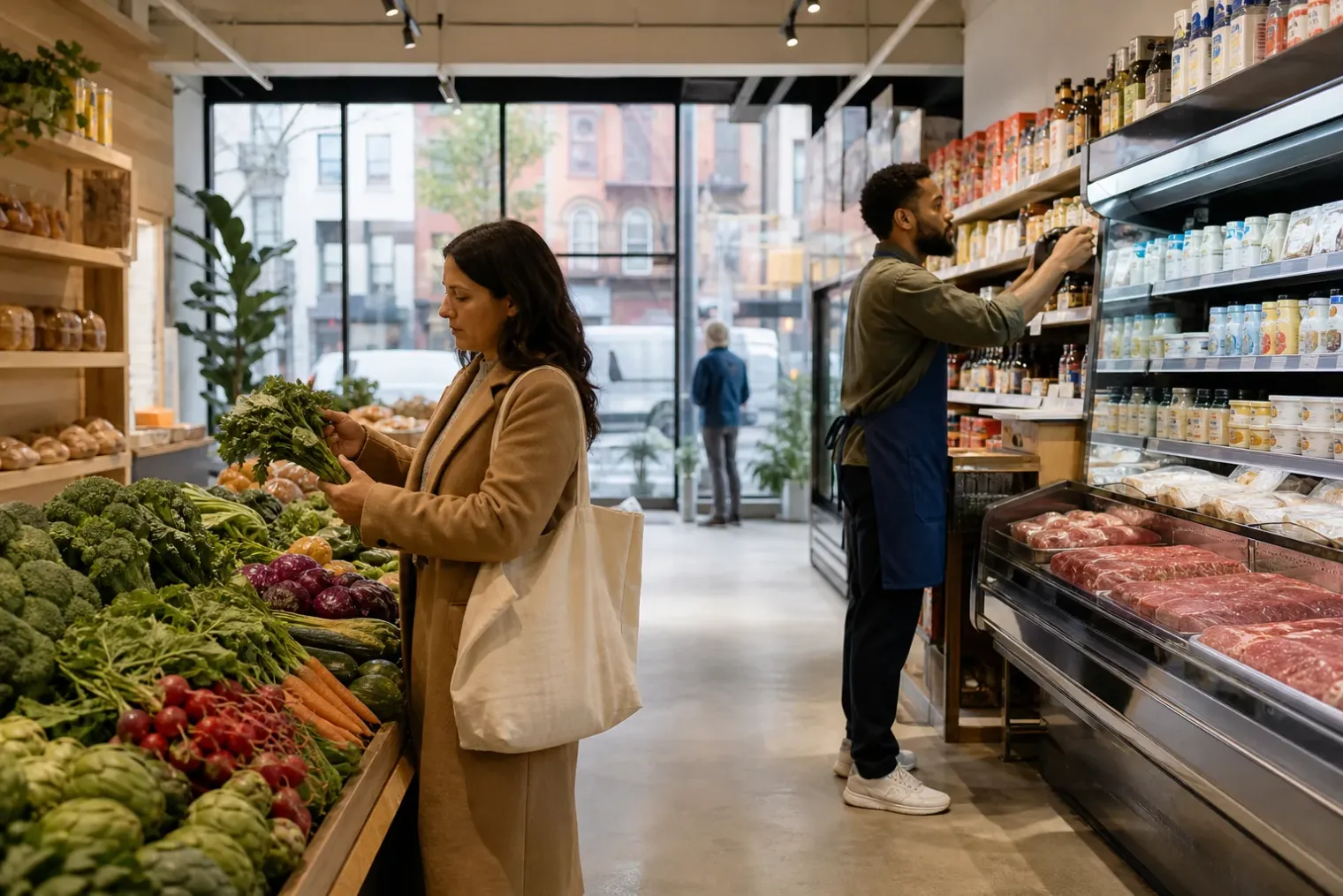
New York City has added a concrete consumer promise to its planned municipal grocery programme: a core basket of staples at five stores is to cost 30% less than comparable market prices. The announcement on July 27 turns an affordability proposal into a procurement and delivery challenge, with the city now seeking private operators to run the shops.
The initiative, branded N.Y.C. Groceries, is designed as a hybrid rather than a conventional city-run retail chain. The city will establish the mission, standards and sites, while third-party grocery operators will manage purchasing, merchandising, staffing, food safety, security and daily operations. That division of responsibility is central to the plan. It seeks to use public assets and contractual conditions to shape prices and labour standards without requiring City Hall to build a supermarket-management operation of its own.
What shoppers are being promised
The 30% reduction will apply to all fresh produce, meat and seafood, as well as about 20 categories of pantry, dairy and refrigerated goods. The administration says prices for the designated items will be set monthly and adjusted periodically for market conditions, rather than changing as frequently as promotions at private supermarkets.
The offer is universal: it will not be restricted by income, residency documentation or membership. City Hall projects that the discounted basket would reduce a typical New Yorker’s total grocery bill by 15%, equating to roughly $90 a month or $1,000 a year. That distinction matters. A 30% reduction applies to selected essential purchases, not necessarily to every item in a household’s trolley.
The promise arrives after a prolonged period of food-price pressure. US food-at-home prices rose 2.7% in the year to June 2026, according to the Bureau of Labor Statistics, while fruit and vegetable prices increased 5.3%. The city says grocery costs nationally are 33% higher than in 2019. For households already balancing rent, transport and food, predictable discounts on high-frequency purchases could therefore have a meaningful practical effect.
A five-borough rollout, with two sites identified
The city plans one store in each borough, with all five expected to be operating by the end of 2029. Two locations have been announced. The first operational store is planned for The Peninsula development in Hunts Point, the Bronx, by the end of 2027. The site is expected to occupy 20,000 square feet and sit within a wider mixed-use redevelopment of the former Spofford juvenile detention facility.
La Marqueta in East Harlem is the other confirmed location. The city is still seeking suitable sites in Brooklyn, Queens and Staten Island through an online submissions portal. Eligible proposals generally need at least 10,000 square feet of contiguous, accessible retail space and a timetable compatible with a 2029 opening.
This geography is more than a real-estate question. The administration says it is prioritising places where affordability and access pressures are greatest. Hunts Point is also a strategically important test case because the Bronx is closely linked to the city’s wholesale food distribution network, even though proximity alone will not determine retail prices or store performance.
The economics are not yet fully visible
Mayor Zohran Mamdani’s administration has allocated $70 million in capital funding for the five locations. That is an investment in developing sites, but it does not by itself explain the full, recurring economics behind a 30% discount. The plan relies in part on reducing overhead: the city will provide storefronts and cover rent and property-tax costs, according to the administration.
Yet a grocery store’s ability to sustain lower prices also depends on wholesale purchasing, delivery, refrigeration, spoilage, labour, technology, insurance and security. The forthcoming operator proposals will be a key indication of whether experienced grocers believe that a price-controlled essential basket can work within the city’s commercial terms.
The city’s procurement notice requires operators to establish reliable and cost-effective supply chains, maintain stock across standard grocery departments and explore a N.Y.C. Groceries private label. Those requirements recognise that price guarantees are only credible if shelves remain stocked and quality remains consistent. They also make clear that the programme’s success cannot be assessed from its headline discount alone.
The public has not yet seen a complete operating budget, a formula for measuring the market prices against which the 30% discount will be judged, or a detailed explanation of how losses, if any, would be covered. Those details will be important for judging the programme’s fiscal transparency as well as its affordability impact.
Labour standards and the neighbourhood retail question
The city is seeking to combine savings for shoppers with employment requirements. Operators will be expected to provide family-sustaining wages and benefits and enter into a labour-peace agreement, under which workers who choose to organise may do so without employer interference. This could distinguish the stores from a model built solely around cutting costs, but it may also narrow the number of operators willing and able to bid.
A separate issue is the effect on independent food businesses. Bodegas and smaller grocers have expressed concern that publicly supported discounts could divert customers from stores with thinner margins and fewer public advantages. The administration says the municipal outlets will not sell hot food, alcohol or cigarettes, categories that can be important sources of revenue for corner stores. That limitation is intended to focus the programme on groceries rather than duplicate the full bodega business model.
The balance will need monitoring in practice. A municipal store may improve access and lower a household’s food bill, but its local benefits will be stronger if it complements nearby businesses rather than simply shifts sales between them.
An experiment whose measures of success should be clear
N.Y.C. Groceries is a significant policy experiment because it uses public control over property, procurement and standards to intervene directly in food affordability. The approach is neither a traditional private supermarket nor a means-tested food benefit. It is a public-backed retail service open to all shoppers.
The next milestones are immediate: an operator information session is scheduled for August 5, and proposals are due on October 16. The first store is still more than a year away. Before it opens, the city can strengthen public confidence by publishing clear basket definitions, price-comparison methods, operating support assumptions, performance targets and neighbourhood-impact measures.
If the programme delivers dependable quality food at the promised prices while maintaining fair jobs and avoiding damage to surrounding retailers, it could provide a model for municipal action on everyday costs. If it does not, the same clarity will be needed to identify whether the problem lay in site selection, supply chains, subsidy design or the limits of public retail itself.
Sources
- Mayor Mamdani Unveils 30% Discount at New Municipal Grocery Stores — NYC Mayor's Office
- N.Y.C. Groceries — New York City Economic Development Corporation
- Mayor Mamdani Announces The Peninsula as the Second Site for City Public Grocery Stores — NYC Mayor's Office
- Mamdani plans to offer 30% discount on meat and produce at city-owned grocery stores — Associated Press
- Consumer Price Index News Release, June 2026 — US Bureau of Labor Statistics


