
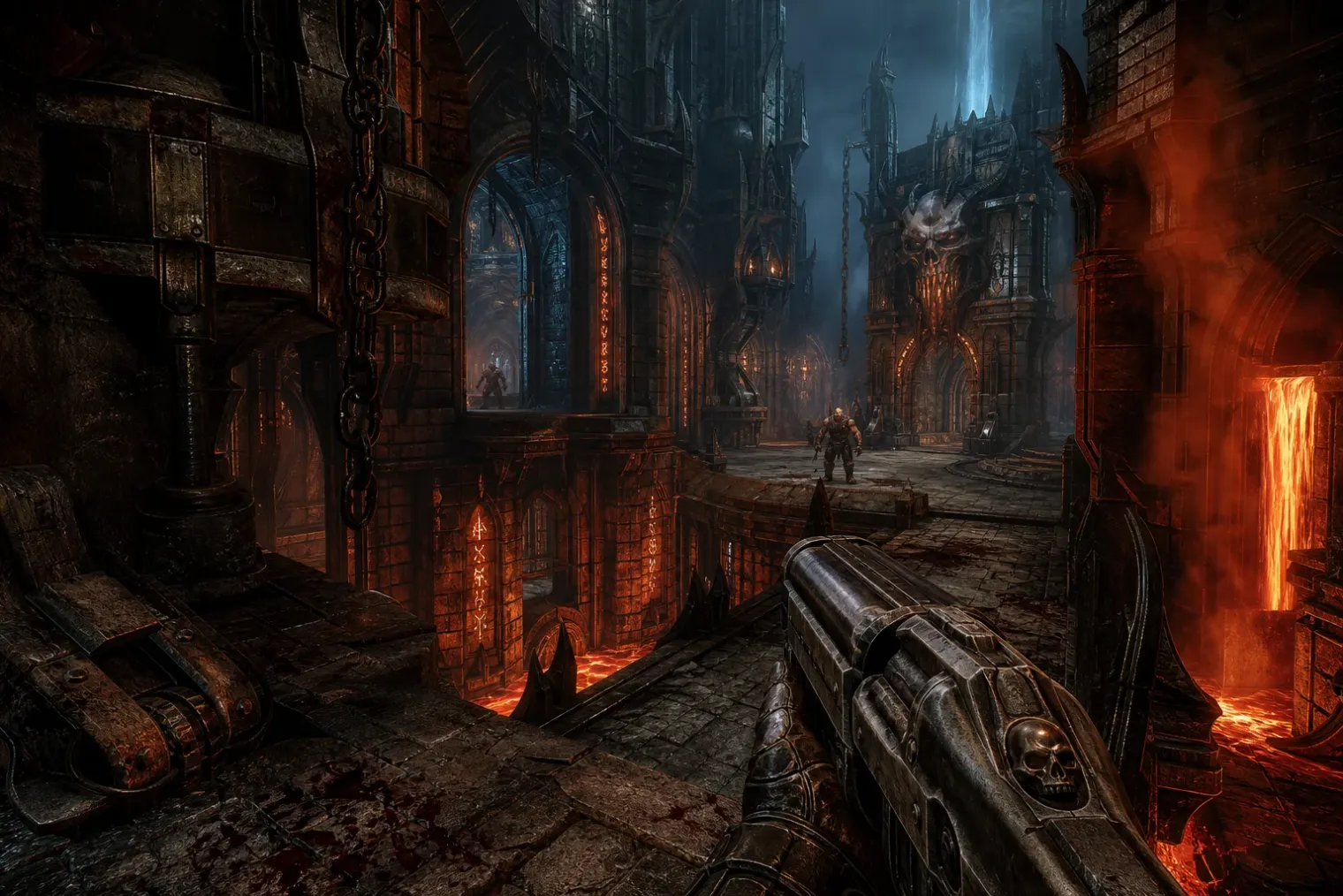
A new chapter for a foundational shooter
Quake turned 30 on 22 June 2026, three decades after id Software’s original first-person shooter established a distinctive blend of industrial horror, dark fantasy, speed and networked competition. The anniversary has now been marked with Dawn of the Machine, a new episode developed by MachineGames in collaboration with id Software for the enhanced edition of Quake.
The update is notable less because it attempts to reinvent Quake than because it treats the original game as a live platform for new authored content. Dawn of the Machine is a 19-map campaign, supplied as a free update to supported versions of the remaster. It also includes a new soundtrack and a separate Deathmatch map, extending both the single-player and competitive sides of the 1996 game.
That approach follows the pattern established by the enhanced release. The remaster did not merely make Quake easier to run on modern systems; it presented the original campaign alongside historic mission packs and later MachineGames material. Dawn of the Machine makes that editorial approach more explicit: a legacy game can be preserved while still receiving a new episode designed around its original weapons, movement and visual language.
Progression inside Quake’s familiar combat loop
The central design change is a progression structure that goes beyond the base game’s largely linear episode format. Players again control Ranger, but the campaign takes place in a dimension affected by repeating time. Returning to places can alter their later form, making revisitation part of the episode’s structure rather than a simple return journey.
Runes are used to open routes, areas and secrets. The campaign also introduces persistent improvements to health and ammunition capacity. These systems place a modest layer of character advancement around Quake’s established fundamentals: rapid movement, arena combat, key hunting and the careful management of weapons and resources.
The decision is significant because Quake has often been valued for its directness. Its original levels present goals quickly and make much of their identity through architecture, enemy placement and combat rhythm. Dawn of the Machine appears designed to preserve that immediate action while giving exploration more durable consequences. Rather than replacing the classic formula with a modern shooter structure, it uses small persistent rewards to encourage players to examine levels more closely.
For returning players, that should make secrets more than optional diversions. For newcomers, the progression systems may offer clearer incentives to understand the campaign’s spaces and to revisit paths that initially appeared exhausted. The result is an experiment in how far a 1990s shooter can be extended without losing the sharp, self-contained character of its encounters.
MachineGames’ continuing role in Quake
MachineGames has become closely associated with the modern stewardship of Quake’s single-player legacy. The studio previously created Dimension of the Past and Dimension of the Machine for Quake, and also built Call of the Machine for the Quake II enhanced edition. Its involvement has given Bethesda and id Software a way to add new campaigns that are compatible with classic games yet benefit from decades of accumulated level-design practice.
This work is different from creating a full sequel. It operates within the original technology, arsenal and artistic vocabulary, where constraints become part of the appeal. The player still reads compact spaces, seeks ammunition and keys, and learns the danger of every enemy through repeated combat. But the designers can use more elaborate interconnections, broader pacing and a much stronger understanding of how players discover secrets than was generally possible in the mid-1990s.
Dawn of the Machine’s title also directly positions it beside Dimension of the Machine. That continuity matters: it frames the new episode as another expansion of the remaster’s version of Quake, rather than evidence that the series is abandoning its past or announcing a wholly new mainline game.
An anniversary that prioritises playable preservation
Quake’s influence is often discussed in terms of technical advances and multiplayer history, but the anniversary episode foregrounds another part of its legacy: the endurance of a particular style of campaign design. Quake remains effective because its movement is fast, its weapons have clear roles and its levels make combat spatial. Players are asked to read elevation, doorways, ambushes and sightlines continuously.
A new official episode can demonstrate why those principles still work more clearly than a retrospective alone. Dawn of the Machine does not need to reproduce 1996 level design exactly to be useful as preservation. Instead, it preserves the essential interaction between player movement, combat and place, then applies contemporary design sensibilities to it.
The free distribution is equally important. By adding the campaign to the existing enhanced game rather than selling it as a separate product, the update keeps the anniversary material close to the edition many players already own or access through subscription services. It lowers the barrier for returning players and gives the remaster a stronger claim to being a long-term home for Quake.
What the update does — and does not — signal
Dawn of the Machine is substantial as a campaign, but it should not be confused with a new Quake sequel. Its announcement is a celebration of the original game and its continuing community rather than confirmation of a larger franchise revival. The distinction is useful: the episode has a clear purpose on its own terms, without asking a 30-year-old classic to carry expectations intended for a new blockbuster release.
For Quake, that may be the most fitting anniversary gesture. The series remains relevant not simply because it was historically important, but because its core design still supports new, demanding and imaginative places to play. Dawn of the Machine extends that legacy through a format Quake understands well: a new route into darkness, built for speed, secrets and repeat visits.
Sources
- Quake oslavuje 30 rokov novou kampaňou Dawn of the Machine — Sector.sk
- Quake: Dawn of the Machine Available Now — Bethesda
- Quake — Bethesda


