
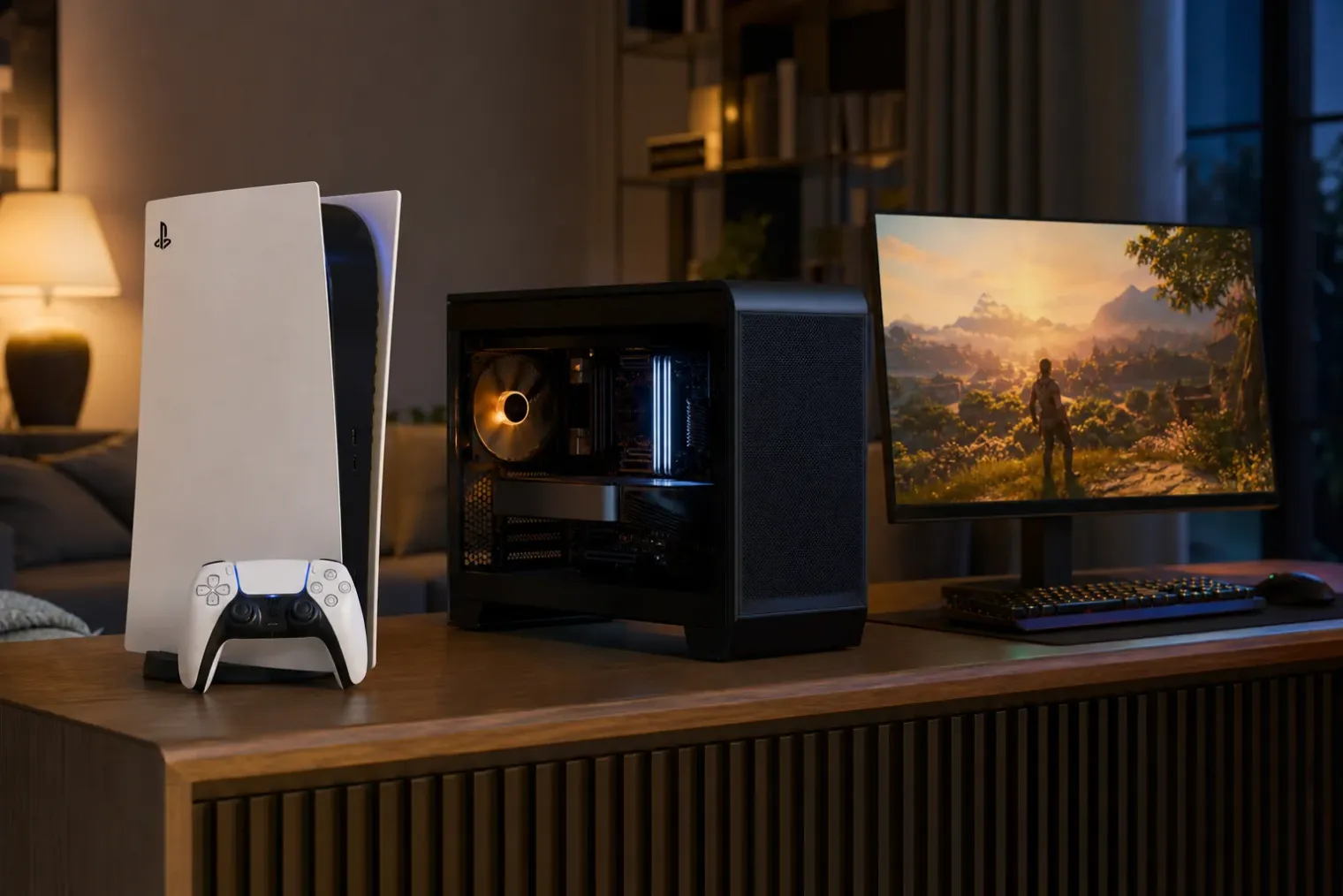
Sony’s argument: a console is more than a disc drive
Sony’s latest defence of its all-digital PlayStation strategy rests on a familiar console proposition: lower upfront cost, predictable performance and a controlled gaming environment. In its financial-results Q&A for the quarter ended June 30, 2026, the company said physical discs are not the principal distinction between PlayStation and gaming PCs. Instead, it identified curated content, a standardised gaming environment and a more affordable price point than high-end PCs as PlayStation’s core advantages.
That position matters because Sony has committed to ending physical-disc production for all new PlayStation games from January 2028. New titles will still be sold by retail partners, but in digital formats, including packages containing download codes. Games released before that date are unaffected by the change.
The company is therefore asking players to separate two questions that have become closely linked in the debate: whether consoles remain a cheaper way to enter modern gaming, and whether digital-only distribution provides the same value over a console’s lifetime as discs. Sony’s answer to the first is affirmative. The second is more complicated.
The price comparison has important limits
Sony’s claim is specifically framed against high-end gaming PCs, not every PC capable of playing games. That distinction is significant. A current PlayStation 5 Digital Edition has a recommended US retail price of $599.99, while the standard PS5 is $649.99 and the PS5 Pro is $899.99, following price increases that took effect on April 2, 2026.
At those prices, assembling or buying a new PC with comparable convenience, a current operating system, storage, peripherals and the ability to run demanding games at similarly stable settings can cost more, especially at the high end. Consoles also avoid the work of selecting components, configuring software and troubleshooting incompatibilities. For players who primarily want to connect one device to a television and play major releases with minimal setup, that simplicity has an economic value of its own.
But “cheaper than a high-end PC” is not the same as proving that a PS5 is the best-value gaming purchase for every customer. PCs span a far wider range of prices and capabilities, and their value is not confined to games. A PC can serve as a work, study and creative device, can generally be upgraded in stages, and gives users access to several competing game stores. The appropriate comparison depends on whether a buyer needs a dedicated game machine or a general-purpose computer that also plays games.
Sony’s argument is therefore strongest as an entry-cost comparison, rather than a full assessment of lifetime ownership costs.
Digital distribution changes the cost equation
Moving new games to digital-only distribution does not raise the price of the console itself. It does, however, alter the ways players can manage the cost of software.
Physical games have traditionally supported retail competition, used-game purchases, lending and resale. Those options can make a substantial difference for players who buy many full-price releases or who finish games and sell them on. A digital-only purchase generally cannot be resold or lent in the same way. Its ongoing availability also depends on the platform holder maintaining the relevant store and account infrastructure.
Sony says it will continue to give customers a choice of where to buy new games by working with both PlayStation Store and retailers. Retailers selling digital download codes may preserve some competition in distribution, including gift-card promotions and store-specific deals. Yet the download itself remains tied to PlayStation’s digital ecosystem, and the range of practical consumer options is narrower than when a player can choose between a downloadable licence and a tradable disc.
This does not mean that all players will pay more. Digital storefronts run frequent promotions, subscriptions can reduce the cost of accessing selected catalogues, and many players already buy almost exclusively online. Sony’s reporting shows why it sees the transition as commercially defensible: digital downloads accounted for 85% of PS4 and PS5 full-game software unit sales in the final quarter of fiscal 2025. The figure demonstrates a strong shift in purchasing behaviour, although it does not show that the remaining physical buyers are unimportant or that they have identical needs to digital customers.
A standardised platform remains Sony’s differentiator
Sony’s wider message is that PlayStation’s identity does not depend on physical media. The company sees the platform as a managed hardware-and-services ecosystem in which players know what level of compatibility and performance to expect. That differs from PC gaming, where flexibility is a strength but hardware configurations, drivers, graphics settings and storefronts vary considerably.
The company is also seeking to preserve retail relationships rather than remove retailers from the sales chain. Its plan to offer code-based packages recognises that stores remain useful for visibility, gifting and local distribution. Whether that model provides enough economic incentive for retailers will vary by country and by the margins attached to digital products.
Sony’s quarterly results underline why it is focused on sustaining the ecosystem rather than hardware sales alone. PlayStation monthly active users reached 125 million accounts in June 2026, a record for that month, while Sony said game-and-network-services operating income increased year on year. Network services, add-on content and digital sales make an installed base valuable long after the original console sale.
The test will be long-term value
The shift will not take effect until January 2028, leaving time for Sony to clarify its retail arrangements, pricing policies and preservation commitments. The company has said it is listening to feedback, but it does not expect the change to harm business performance because digital distribution already represents a substantial share of sales.
Sony can reasonably argue that a PS5 remains less expensive than a high-end gaming PC at purchase. It can also point to convenience and a standardised experience as real differentiators. However, the end of new physical releases removes a source of flexibility that has helped some console owners keep gaming affordable.
The decisive question is consequently not whether a disc-less PlayStation resembles a PC. It is whether Sony can maintain attractive software prices, meaningful retail choice and confidence in long-term access to purchased games. If it does, the console’s simplicity and lower entry cost may continue to outweigh the loss of discs for most buyers. If it does not, the comparison with PC gaming will become less about hardware price and more about ownership, competition and consumer choice.
Sources
- FY2026 Q1 Earnings Announcement Q&A (Summary) — Sony Group Corporation
- Physical disc production ending in January 2028 for new games releasing on PlayStation consoles — PlayStation Blog
- New Price Changes for PS5, PS5 Pro, and PlayStation Portal remote player — PlayStation Blog
- Q1 FY2026 Consolidated Financial Results — Sony Group Corporation
- Supplemental Information for the Consolidated Financial Results — Sony Group Corporation


