
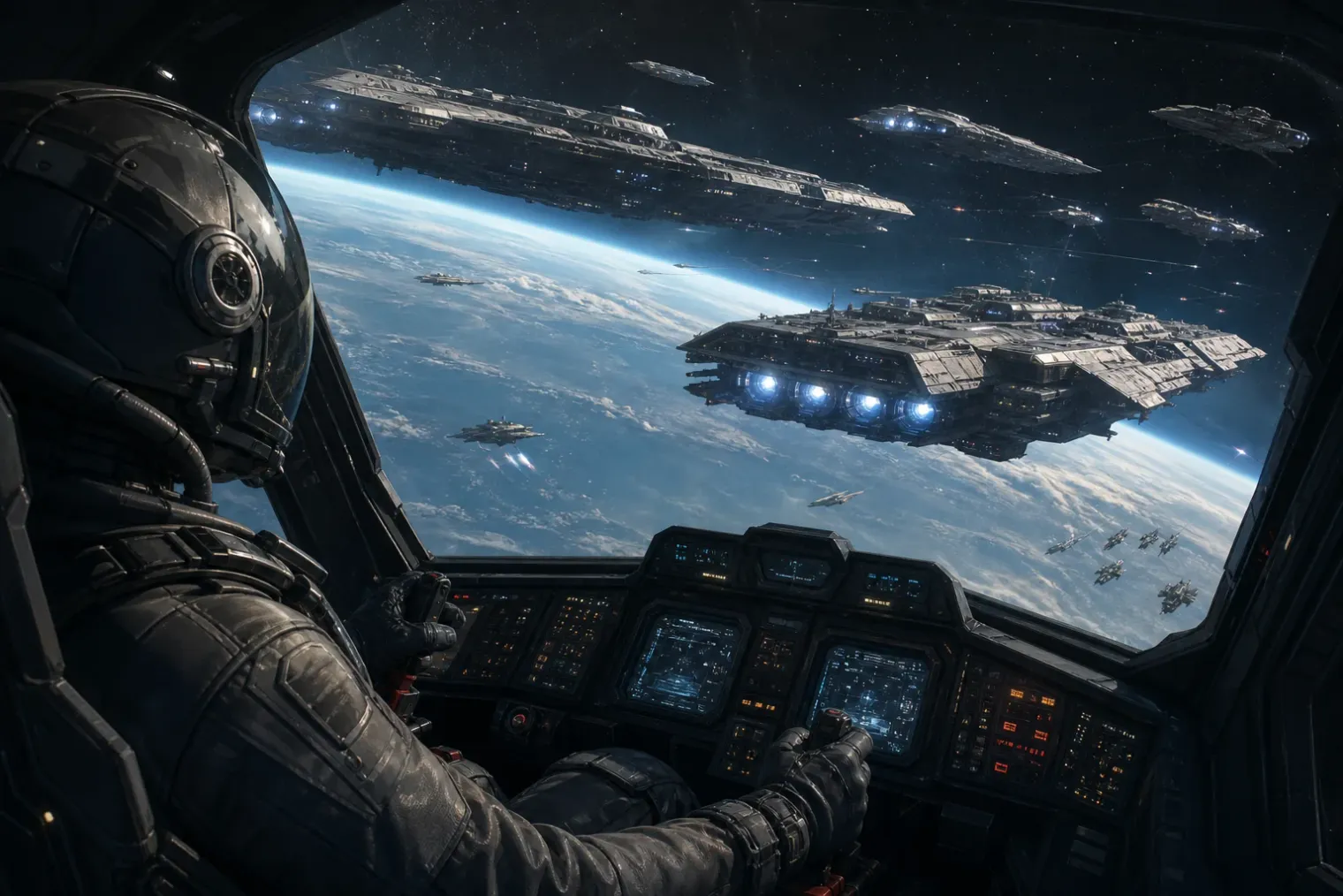
A delay framed as a launch-window decision
Cloud Imperium Games has moved Squadron 42 into the second quarter of 2027, abandoning the 2026 release window it announced at CitizenCon in October 2024. In a new letter, founder and game director Chris Roberts said the studio had previously aimed for the fourth quarter of 2026, around its annual Intergalactic Aerospace Expo period.
Roberts’ stated reason is unusually direct: the studio does not want its single-player space-combat campaign to launch into the media and creator frenzy expected around Grand Theft Auto VI. Rockstar Games is scheduled to release GTA VI on PlayStation 5 and Xbox Series X|S on November 19, 2026. Although Rockstar has not announced a PC version, Roberts argued that games media, streamers and creators will focus on the blockbuster regardless of platform.
The rationale is not that the two games are interchangeable. GTA VI is an open-world crime game, while Squadron 42 is a narrative-led, cinematic science-fiction campaign set in the Star Citizen universe. The overlap instead lies in the limited capacity of advertising budgets, editorial coverage, video recommendations and audience attention during a major release period. For a company seeking to turn a long-running crowdfunded project into a broad consumer launch, that distinction matters.
GTA VI’s gravitational pull
Publishers commonly avoid releasing new games near the largest annual franchises. GTA VI, however, is expected to be an exceptional case because it arrives after more than a decade without a new numbered Grand Theft Auto entry. Take-Two Interactive has repeatedly positioned its November launch as central to its financial outlook, while Rockstar has opened pre-orders and begun the game’s main promotional cycle.
Moving Squadron 42 to Q2 2027 gives Cloud Imperium distance from the first wave of reviews, streaming and public discussion around GTA VI. It also avoids the particularly crowded late-year retail season, when major games compete for marketing inventory and consumer spending.
That is a defensible commercial calculation. A new intellectual property or a smaller sequel can be lost in a busy month even when it is well reviewed. Squadron 42 is neither small nor unknown among Star Citizen followers, but it still needs to introduce itself to an audience beyond its existing backers. Its publicity challenge is heightened by the project’s scale: Cloud Imperium has presented it as a premium, story-driven experience with an established screen cast and a length closer to a full-scale campaign than a short add-on.
The decision also gives the studio time to build a clearer release campaign. Reports indicate that a limited group of early backers and long-standing creators will receive hands-on access in October 2026, with a final release date expected afterwards. If that plan proceeds, the studio can use feedback and preview coverage while maintaining the more spacious 2027 window.
The credibility problem behind the strategy
Yet scheduling is only part of the story. Squadron 42 has accumulated an unusually long history of missed targets. It was part of the original Star Citizen crowdfunding vision in 2012 and was once associated with a 2014 or 2015 arrival. Roberts says development on the campaign began in 2014, meaning its planned 2027 debut would come roughly 13 years later.
The long wait changes how this latest delay will be received. Backers have heard the project described as feature complete and in a polishing phase before, and the 2026 target itself followed earlier postponements. The studio’s current explanation is principally about visibility rather than a claim that the game requires fundamental production work. That may sound commercially sensible, but it also invites a simple question: if the campaign was ready for a 2026 launch window, why is the delay large enough to move it into the following year?
Roberts’ answer is that a project receiving more than a decade of work should be given the chance to command the wider gaming world’s attention. That is an understandable ambition, but it establishes a high bar. A strong Q2 2027 release would validate the decision as a deliberate positioning move. Another broad postponement, by contrast, would reinforce doubts that external market conditions were only one factor in a more complex production schedule.
Cloud Imperium has a different relationship with its audience from that of a conventional publisher. Star Citizen’s ongoing funding model has kept the wider project in active development through player purchases and pledges, while its playable alpha continues to receive updates. The company’s own funding materials describe the project as crowd-funded and say pledges go directly to development. That structure provides continuing resources, but it also leaves the studio answerable to customers who have waited for both the multiplayer game and its single-player counterpart.
A clearer separation from Star Citizen
The postponement also reinforces Squadron 42’s position as a distinct product rather than simply a component of Star Citizen. Cloud Imperium’s current support material still lists the campaign as in development and unavailable to players, while Star Citizen remains the part of the universe that customers can install and play.
This separation is strategically useful. Squadron 42 can be marketed as a self-contained campaign with a beginning, story and release event, rather than as another update to a continually evolving online platform. It may reach players who have little interest in an unfinished online space simulation, but who are receptive to a scripted space opera in the tradition of Wing Commander.
At the same time, expectations will be shaped by the technical state of the broader ecosystem. Star Citizen’s development has attracted intense scrutiny over performance, stability and the delivery of planned systems. Squadron 42 will be judged on its own campaign design, pacing and presentation, but its launch cannot be wholly detached from public perceptions of Cloud Imperium’s execution.
What the new window must achieve
A second-quarter release avoids the immediate GTA VI launch period, but it does not remove the need for precision. Cloud Imperium now has to establish a firm date, show a near-final build to independent press and creators, and set clear expectations about what the first Squadron 42 release contains. It must also explain how the campaign will relate to later episodes, which have been discussed but remain without announced launch schedules.
The extra time could make the eventual launch more coherent: a tested campaign, a concentrated marketing message and a date unencumbered by the year’s largest release. But timing can only improve the visibility of a finished product. After years of changing expectations, the most important signal will not be the decision to avoid GTA VI. It will be whether Squadron 42 arrives in Q2 2027 as promised.
Sources
- Squadron 42 delayed to 2027, with Star Citizen dev blaming GTA 6 — Eurogamer
- Letter From The Chairman — Roberts Space Industries
- Grand Theft Auto VI is Now Set to Launch November 19, 2026 — Rockstar Games
- Take-Two Interactive Software, Inc. Reports Results for Fiscal First Quarter 2027 — Take-Two Interactive
- Stretch Goals and Funding Stats — Roberts Space Industries


