
Eleven named destinations, not the whole map
Star Wars Zero Company is set to take players across a broad cross-section of the Star Wars galaxy when it launches on August 27, 2026. A newly reported list names 11 planets associated with the game: Anaxes, Brentaal, Kaller, Ryloth, Serolonis, Sullust, Vandor, Dantooine, Florrum, Lothal and Mapuzo.
The list is useful because it gives a clearer picture of the locations expected to host the game’s hand-crafted campaign content. However, it should not be read as a complete list of every place represented in Zero Company. EA has said the game’s changing galaxy map contains more than 150 planets. Those worlds are tied to the strategic layer, where players select missions and operations, while the number of locations built for tactical encounters appears to be much smaller.
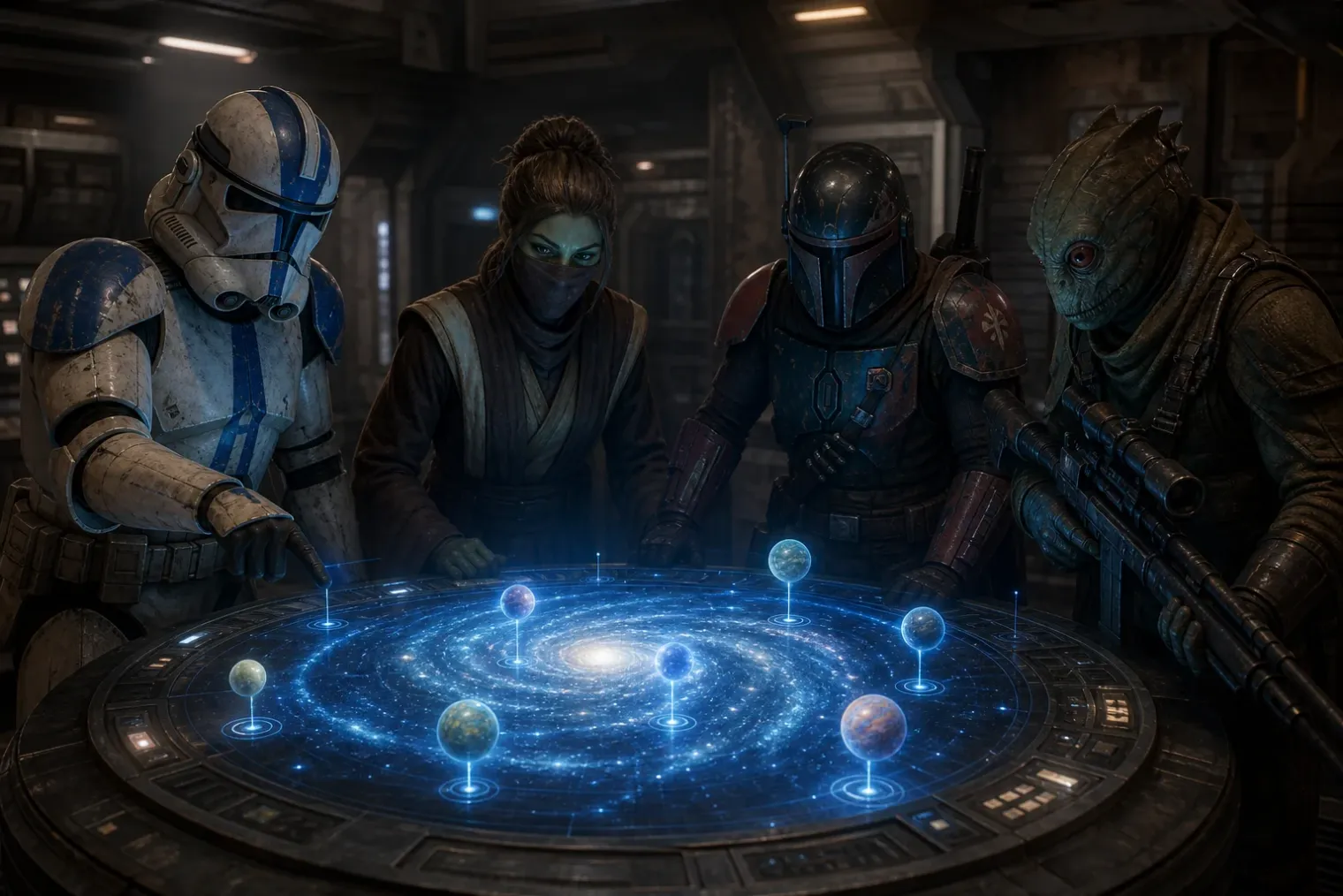
That distinction fits the structure described by Bit Reactor and EA. Players lead Zero Company from its base, the Den, choosing assignments from a holotable and managing a squad between missions. The galaxy map is intended to make time and choice matter: some operations and tactical missions have limited availability, so pursuing one objective can mean allowing another to lapse. The 11-world report therefore offers a snapshot of prominent destinations rather than a boundary on the game’s scale.
A deliberately varied Star Wars itinerary
The reported worlds span several distinct strands of Star Wars storytelling. Sullust is a long-established location connected with the Rebel Alliance’s preparations in Return of the Jedi. Ryloth, the Twi’lek homeworld, has featured heavily in stories about the Clone Wars and later rebellion-era conflicts. Lothal is closely associated with Star Wars Rebels, while Vandor is known from the train heist sequence in Solo: A Star Wars Story.
Other choices are less routinely used in major games. Dantooine has a notable place in Star Wars history through its mention in the original film and its much larger role in earlier role-playing games. Mapuzo comes from Obi-Wan Kenobi, and Serolonis was previously identified by Lucasfilm as a location Zero Company would visit. Anaxes and Florrum draw more directly on Clone Wars-era material, making them natural fits for a story taking place late in that conflict.
The selection suggests that Zero Company is not relying primarily on the franchise’s most frequently revisited planets. There is no indication that players will be confined to the galaxy’s best-known film locations. Instead, the game appears to use a mixture of recognisable destinations and settings with relatively limited screen history. That approach gives a tactics game practical variety as well: volcanic, urban, rural, industrial and frontier environments can support different battlefield layouts without requiring every mission to be built around a famous landmark.
Why the locations matter to the tactics format
Zero Company is a single-player, turn-based tactics game developed by Bit Reactor in collaboration with Lucasfilm Games. Players control Hawks, a former Republic officer who leads an irregular group of operatives against Kundri Fathom and the Separatist-aligned Infinite Coil. The squad includes authored characters who enter through the story as well as player-created recruits.
For a game in this genre, planets are more than scenery. They can establish the tactical conditions surrounding a mission and make the campaign’s strategic decisions feel grounded in the wider Star Wars setting. EA has described missions as a mix of tactical battles and operations, while recent developer discussion has also pointed to limited exploration segments before some encounters. These sections can provide intelligence and advantages that influence the combat to follow.
The announced systems also place importance on team composition. Operatives have specialisations, equipment, abilities and relationships that develop over time. Pairing characters can unlock support effects and cross-training benefits, meaning that a mission choice is partly about the destination and partly about which relationships a player wants to develop or protect.
This creates a natural link between the galaxy map and the battlefield. Selecting an assignment is not simply choosing the next combat arena; it may determine which squad members gain experience, which opportunities disappear, and what resources are available when the campaign reaches a critical story mission.
A focused campaign inside a large galaxy
The combination of a 150-plus-planet strategic map with a more selective set of combat destinations is a measured way to convey the scale of the Clone Wars. A tactics game needs missions that are authored closely enough to support readable layouts, cinematic scenes and consequential encounters. At the same time, a galaxy map gives the campaign room to present pressure from multiple fronts.
That balance is especially relevant to Zero Company’s premise. The game is not positioned as a conventional military campaign following the largest battles of the war. Its story centres on a clandestine conflict operating beneath the wider Republic–Separatist struggle. Moving through worlds such as Lothal, Ryloth, Mapuzo and Vandor can therefore frame the squad as an itinerant unit following leads rather than an army holding territory.
The reported 11 planets give fans a preliminary sense of where that pursuit may lead, but more destinations may emerge before release. EA has cautioned that the game remains in development and that details can change. For now, the strongest conclusion is not that Zero Company has only 11 planets, but that it is building its key missions around a notably broad and less predictable mix of Star Wars settings.
Sources
- Star Wars Zero Company will take players to 11 planets — Sector.sk
- Command the Clone Wars’ Most Cunning Operatives in Star Wars Zero Company, Launching August 27 — Electronic Arts
- Lead Zero Company To Victory on August 27 — Electronic Arts
- Star Wars Zero Company Game Announce — StarWars.com
- Star Wars: Zero Company – planets, meta-game and cameos — PC Games


