
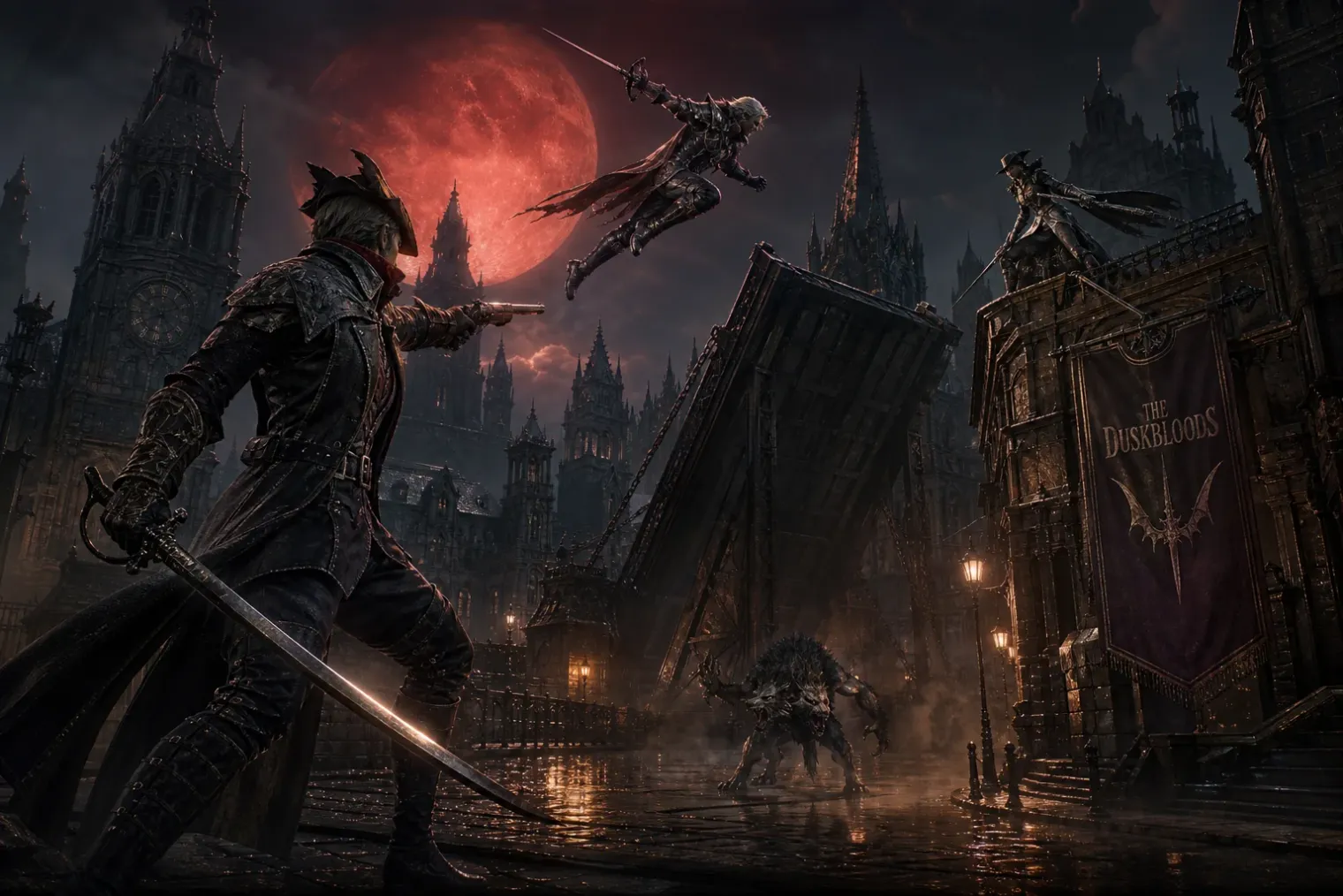
A leak that quickly became a broader reveal
Gameplay said to have emerged ahead of The Duskbloods’ closed network test offered an unusually early look at FromSoftware’s next project: a Gothic multiplayer game in which firearms, melee weapons, extreme mobility and transformations occupy the same combat space. Reports surrounding the footage highlighted tense player-versus-player encounters, animal forms including a wolf, and a character able to take on a dinosaur-like appearance.
Those details should still be approached cautiously when they stem from redistributed pre-release footage. A leak can show a genuine build while remaining incomplete, stripped of context or subject to changes before launch. In this case, however, official information and hands-on reports published on August 20 substantiate the central picture: The Duskbloods is built around up to eight online players competing and cooperating in the same match, rather than following the mostly solitary action-RPG format most associated with FromSoftware.
The timing also matters. The closed network test begins on August 21, giving selected Nintendo Switch 2 players their first chance to test the game’s online structure. That makes the circulation of footage less significant as a source of basic confirmation than it might otherwise have been; the more useful question is what the newly visible mechanics indicate about the game’s design.
Eight players, three survivors
The Duskbloods uses a player-versus-player-versus-environment framework, but that label only partly describes the structure reported by those who have played it. Eight Bloodsworn enter a match, explore a vertical city environment, fight computer-controlled enemies and bosses, seek objectives and clash with one another. Players earn a score known as Virtue through these actions, while the lowest-scoring participants are removed between phases.
The match eventually narrows to a three-player free-for-all. This structure changes the purpose of combat. Eliminating an opponent is valuable, but it is not necessarily the sole route to success in the opening stages. Hunting enemies, contesting objectives, pursuing character-specific goals and deciding whether to assist another player can all contribute to a stronger position.
That makes the game less like a simple arena brawler and more like a competitive scenario with shifting incentives. A player who commits too heavily to an early duel may lose ground elsewhere; another may benefit from allowing rivals to exhaust themselves against a boss before intervening. The final confrontation then rewards the player who has converted those earlier choices into a viable character build, enough resources and a favourable position.
Alliances are part of the combat system
The most unusual element is the explicit role of temporary alliances. Players can apparently cooperate in boss encounters and, in some circumstances, form bonds through in-game social actions. Personal objectives, assigned through Sigils, may encourage a player to seek a particular relationship or target. This introduces motives that need not align neatly with immediate survival.
For FromSoftware, whose games have long included invasions, co-operative summons and player-made etiquette around duels, this is a more deliberate attempt to turn unpredictable player behaviour into a formal system. The studio is not merely placing combatants in an arena. It is creating conditions in which players must read intentions, calculate the value of a partnership and anticipate betrayal.
The approach could give matches a distinctive narrative quality. Memorable outcomes may come from an opportunistic rescue, a mutually beneficial truce or a last-minute reversal, rather than solely from mechanical mastery. It also creates a potential clarity challenge. A game with score systems, objectives, alliances, boss events and eliminations must communicate priorities cleanly enough that players understand why they succeeded or failed.
Mobility and ranged pressure reshape familiar combat
The leaked clips drew attention because they did not resemble the measured pace often associated with the studio’s fantasy action games. Hands-on accounts similarly describe high movement options, including major vertical leaps and aerial manoeuvres. Every character has a ranged weapon alongside their main combat tools, giving players a way to interrupt healing, pressure opponents at distance or punish escape attempts.
That combination gives The Duskbloods a different rhythm from a traditional duel. Melee exchanges still matter, but opponents can rapidly break line of sight, traverse rooftops or force a response with gunfire. The ability to move through the map quickly should also make information valuable: spotting a vulnerable boss fighter, an isolated opponent or a contested objective can be as important as winning a direct encounter.
Character distinction appears central to this design. Reports point to individual weapon sets, abilities and transformations, with familiar archetypes such as heavily armed fighters sitting beside more eccentric options. The dinosaur-like transformation is particularly eye-catching, but its importance is less the novelty itself than what it signals: characters are intended to produce different tactical identities, not just alternate visual styles.
What the network test will reveal
The forthcoming test is designed to assess server load, multiplayer performance and balance under real conditions. It will also be the first meaningful measure of whether the game’s systems remain intelligible when players are no longer learning them in a controlled press session.
Several questions will be especially important. Can the Virtue system reward diverse strategies without feeling arbitrary? Are temporary alliances compelling rather than frustrating? Does the verticality create exciting escapes and pursuits without making fights difficult to follow? And can each Bloodsworn feel distinctive while avoiding dominant combinations that narrow the game’s competitive possibilities?
The early footage has succeeded in establishing that The Duskbloods is an ambitious departure for FromSoftware. The more substantial previews suggest the studio is combining its established strengths in combat, atmosphere and hostile worlds with a match structure shaped by social uncertainty. The network test will determine whether that ambitious mixture produces strategic drama for players, rather than confusion.
Sources
- The Duskbloods gameplay leaks ahead of tomorrow's closed beta, showing tense PvP battles with guns, wolves, and velociraptors — Eurogamer
- The Duskbloods Network Test — Nintendo Support
- Learn how to apply for the Duskbloods Network Test — Nintendo
- The Duskbloods: the best of FromSoftware fights in a frantic multiplayer battleground — The Guardian
- The Duskbloods closed network test set for August 21 to 23 — Gematsu


