
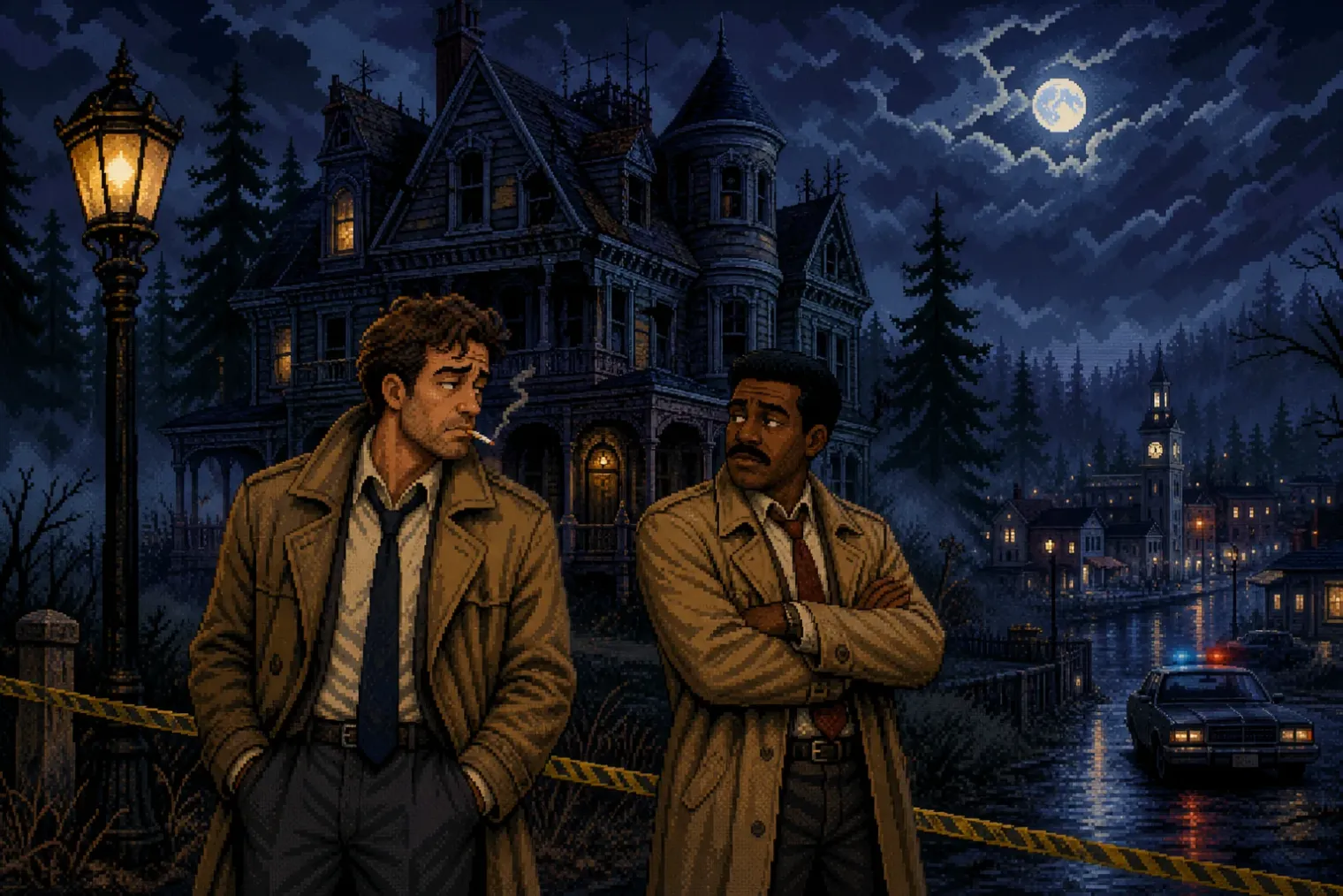
A return to an unlikely setting
Thimbleweed Park 2 is officially in development, bringing Ron Gilbert and several prominent members of the original team back to the fictional town almost a decade after the first game launched. Gilbert announced the project on 30 July 2026, saying production had begun and setting an early 2028 target.
The timing is notable because the sequel had previously appeared financially improbable. In January 2026, Gilbert wrote that the original Thimbleweed Park had cost about $1.1 million, funded through a mixture of crowdfunding and private investment. He also argued that crowdfunding for digital games was no longer a realistic route to raising the required budget and expressed reluctance to accept conventional publishing arrangements that would reduce creative and financial control.
The new project appears to resolve that dilemma through a different structure. It will be self-published with support from a private investor, according to Gilbert. That arrangement matters beyond the financing itself: it allows the team to retain direct control over a property created outside the traditional publisher-led model, while still attempting a game of greater scope than the small projects Gilbert had said he intended to pursue.
Familiar detectives, deliberately uncertain continuity
The Steam description positions the game as a point-and-click murder mystery centred on the Edmund Mansion. Agents Ray and Reyes, who led the original investigation, return to examine a new body, with the story framed as a comic take on a classic whodunit.
Yet the developers are deliberately resisting a straightforward description of its continuity. The official store page calls it neither fully a sequel nor a prequel, instead presenting it as another excursion into the same surreal world. That wording is more than marketing ambiguity. The first Thimbleweed Park used increasingly self-aware storytelling and an ending that makes a conventional follow-up difficult to define without reducing its impact or simply repeating its premise.
By treating the new game as “more Thimbleweed Park” rather than promising a linear continuation, the team leaves room to revisit its characters and atmosphere without committing to a literal resolution of every previous narrative thread. It also establishes an expectation that the new mystery may use the familiar setting as a framework for another tonal experiment rather than a conventional detective story.
The announced premise offers a useful contrast to the original. A mansion full of suspects is among the most recognisable structures in crime fiction, while Thimbleweed Park is built around absurd locations, strange personalities and escalating uncertainty. The tension between a tightly defined whodunit and an intentionally unruly fictional town could give the sequel a clearer initial hook while preserving the series’ capacity to undermine genre expectations.
The original team is a central part of the announcement
Gilbert has named Mark Ferrari, Gary Winnick, David Fox, Octavi Navarro and Robert Megone among the returning contributors, while composer Steve Kirk is also set to return. The group connects the project both to the 2017 game and to the wider history of graphic adventures associated with Gilbert, Winnick and Fox.
That continuity should be important to the sequel’s identity. Thimbleweed Park was not merely styled after late-1980s and early-1990s adventure games; it was made by creators closely associated with that period’s design traditions. Its five-character structure, pixel-art presentation, inventory puzzles and comic dialogue offered a modern production built around older genre grammar.
However, the first game was not simply an exercise in imitation. Its mystery and meta-fictional turns divided some players precisely because they pushed beyond nostalgia. The sequel’s early materials suggest that the team intends to retain the visual and mechanical language of a traditional point-and-click adventure, but the final balance between accessibility, puzzle complexity and narrative experimentation remains unknown.
A long development window sets expectations
An early 2028 launch leaves roughly a year and a half for development from the public announcement. That is a substantial but not excessive window for a narrative game with bespoke art, puzzle design, writing and music, especially for a small independent team. It also means that the currently available details should be treated as a foundation rather than a full specification.
Terrible Toybox is listed as both developer and publisher. Windows, macOS and Linux versions are planned, alongside releases on Steam and GOG; Gilbert has also said that a Nintendo Switch version is intended. Steam currently lists English support, but further languages, pricing, a precise release date, physical editions and gameplay systems have not been confirmed.
Gilbert has said a dedicated development blog will document the work, echoing the public-facing development process used for the first game. For followers of classic adventure games, that may be nearly as significant as the announcement itself: it offers a chance to observe how an established creative team approaches a sequel whose very premise challenges the usual meaning of a sequel.
For now, Thimbleweed Park 2 is a firm production announcement rather than a near-term release. Its most consequential promise is not simply another visit to the town, but an attempt to make a larger independent adventure on terms that preserve the creators’ ownership and unusual voice.
Sources
- Thimbleweed Park 2 — Grumpy Gamer
- Thimbleweed Park 2 — Steam
- Making New IP — Grumpy Gamer


