
A new intervention in vaccine policy
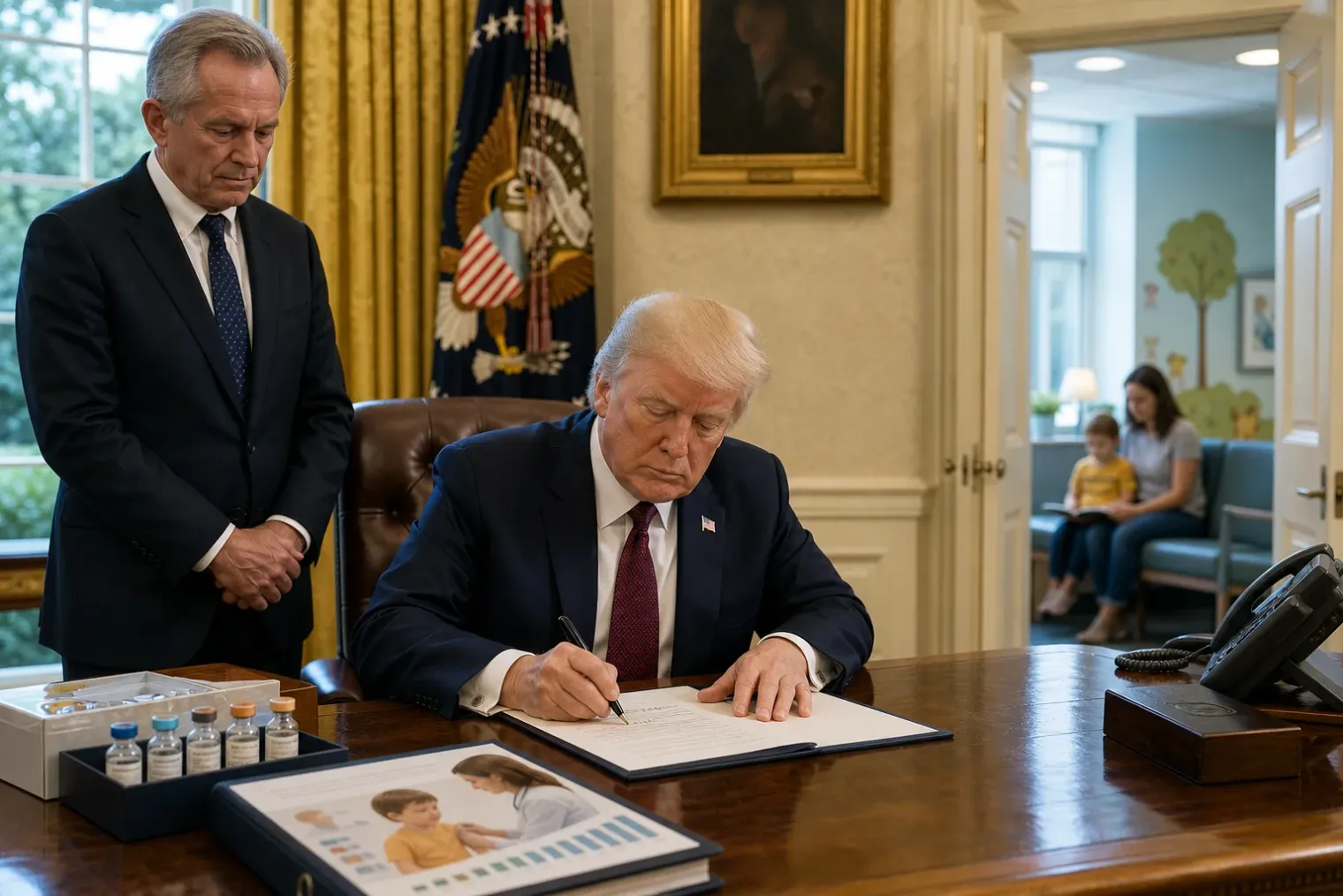
President Donald Trump has signed an executive order calling for a substantial reworking of U.S. childhood vaccine recommendations. The order promotes separating the combined measles, mumps and rubella vaccine into three single-disease products once they are available domestically, and says childhood immunisations should, where feasible, be given at separate medical visits.
It also directs the Department of Health and Human Services to prepare plans related to the separate vaccines and puts fresh political weight behind a broader effort to reduce or reorganise the routine schedule. The move brings an issue that had been partly constrained by litigation back to the centre of the administration’s health agenda.
The immediate practical effect is less clear than the political signal. The individual measles, mumps and rubella vaccines envisioned by the order are not currently an option for routine use in the United States. Developing, testing, licensing, manufacturing and distributing them would take time. Meanwhile, the existing combined MMR vaccine remains part of the federal schedule currently displayed by the Centers for Disease Control and Prevention.
What the order seeks to change
The order reflects Trump’s longstanding preference for fewer injections per appointment and greater flexibility for parents. It frames that approach in terms of parental choice, physician discretion and the administration’s view that U.S. recommendations should be reconsidered against the practices of other developed countries.
Its most visible proposal concerns MMR. The combined vaccine is generally administered in childhood to protect against three viral diseases. Splitting it into individual shots would not reduce the number of diseases covered; it would instead require separate products and, under the order’s preference for separate appointments, could require more clinical visits.
The order also renews attention on the classification of vaccines. Earlier administration actions had sought to distinguish vaccines recommended for all children from those recommended for specified risk groups or through shared clinical decision-making. That model would materially alter how families, clinicians, insurers and public-health systems interpret federal guidance, even where access to vaccines is formally retained.
The administration argues that the changes would make immunisation more individualised. Critics contend that recommendations based on broad evidence are being replaced by policy preferences that may be difficult for families to follow in practice.
The scientific disagreement
The dispute is not principally about whether vaccines can cause side effects. Like all medical products, vaccines have recognised risks that clinicians discuss with families. The policy question is whether separating combination vaccines or spacing routine immunisations provides a health advantage large enough to justify delayed protection and additional appointments.
CDC guidance states that there is no published scientific evidence showing a benefit from separating the MMR vaccine into three individual shots. It also states that extensive studies have found no link between MMR vaccination and autism. The agency notes that common MMR side effects can include soreness, fever and a mild rash, while more serious adverse events are rare.
The established schedule is designed around the age at which children are vulnerable to specific infections, the immune response expected at different ages and the need to complete multi-dose series. Public-health authorities have long argued that giving vaccines at the recommended time protects children before exposure, rather than after an outbreak or a known contact creates urgency.
The proposed approach therefore raises a practical concern: families who agree in principle to vaccination may not complete a longer sequence of appointments. Extra visits can mean more time away from work or school, more transport costs and more opportunities for missed or postponed care. Those burdens may be particularly significant in rural areas and for families facing shortages of paediatric providers.
A policy already shaped by the courts
The executive order arrives after a federal court intervened in earlier changes to the childhood schedule. In March, a judge in Massachusetts issued a preliminary injunction that stayed the January 2026 CDC decision memorandum revising the schedule and halted actions taken by a reconstituted Advisory Committee on Immunization Practices.
The CDC’s current online schedule says that, as a result of that preliminary order, the July 2025 schedule remains the applicable federal child and adolescent schedule. It continues to list routine vaccination timing for illnesses including hepatitis B, rotavirus, diphtheria, tetanus, pertussis, polio, MMR, varicella and others.
That legal backdrop limits the assumption that a presidential order alone can swiftly rewrite medical guidance. Federal recommendations normally depend on agency procedures, the work of expert advisory bodies and formal adoption by the CDC. The litigation has focused on whether the administration complied with those processes when pursuing earlier revisions.
There is also an important division of responsibility between Washington and the states. States, rather than the federal government, generally set school-entry vaccination requirements. The order can encourage states to reconsider their laws or align programs with federal preferences, but it does not automatically rewrite state mandates.
The wider consequences
For parents, the most immediate result may be uncertainty rather than a new appointment schedule. Families will need to distinguish between an executive order, recommendations published by the CDC, guidance from professional medical organisations, vaccine availability and the rules applied by schools or childcare providers in their state.
For clinicians, the proposal could increase counselling demands. Paediatricians may be asked to explain why combination products have been used, what evidence exists on spacing doses and whether alternatives are available. If separate products are eventually introduced, practices would also face questions about supply, reimbursement, record-keeping and insurance coverage for additional visits.
The order has reopened a fundamental debate about how public-health policy should be made. The administration presents a more flexible schedule as an expansion of parental autonomy. Medical organisations and vaccine researchers argue that flexibility without evidence of improved outcomes can weaken timely protection against serious but preventable disease.
The central test will be whether the administration can translate its directive into legally durable, clinically supported policy. Until then, the current federal schedule remains in place under the court order, and the combined MMR vaccine remains the standard U.S. option for protection against measles, mumps and rubella.
Sources
- Trump issues executive order aimed at rewriting childhood vaccine schedule — Scientific American
- Trump signs executive order on childhood vaccine schedule — Associated Press
- Measles, Mumps, Rubella (MMR) Vaccine Safety — Centers for Disease Control and Prevention
- Child and Adolescent Immunization Schedule by Age (Compliant) — Centers for Disease Control and Prevention
- AAP's historic victory in vaccine lawsuit a critical step in restoring science to federal policy — American Academy of Pediatrics


