
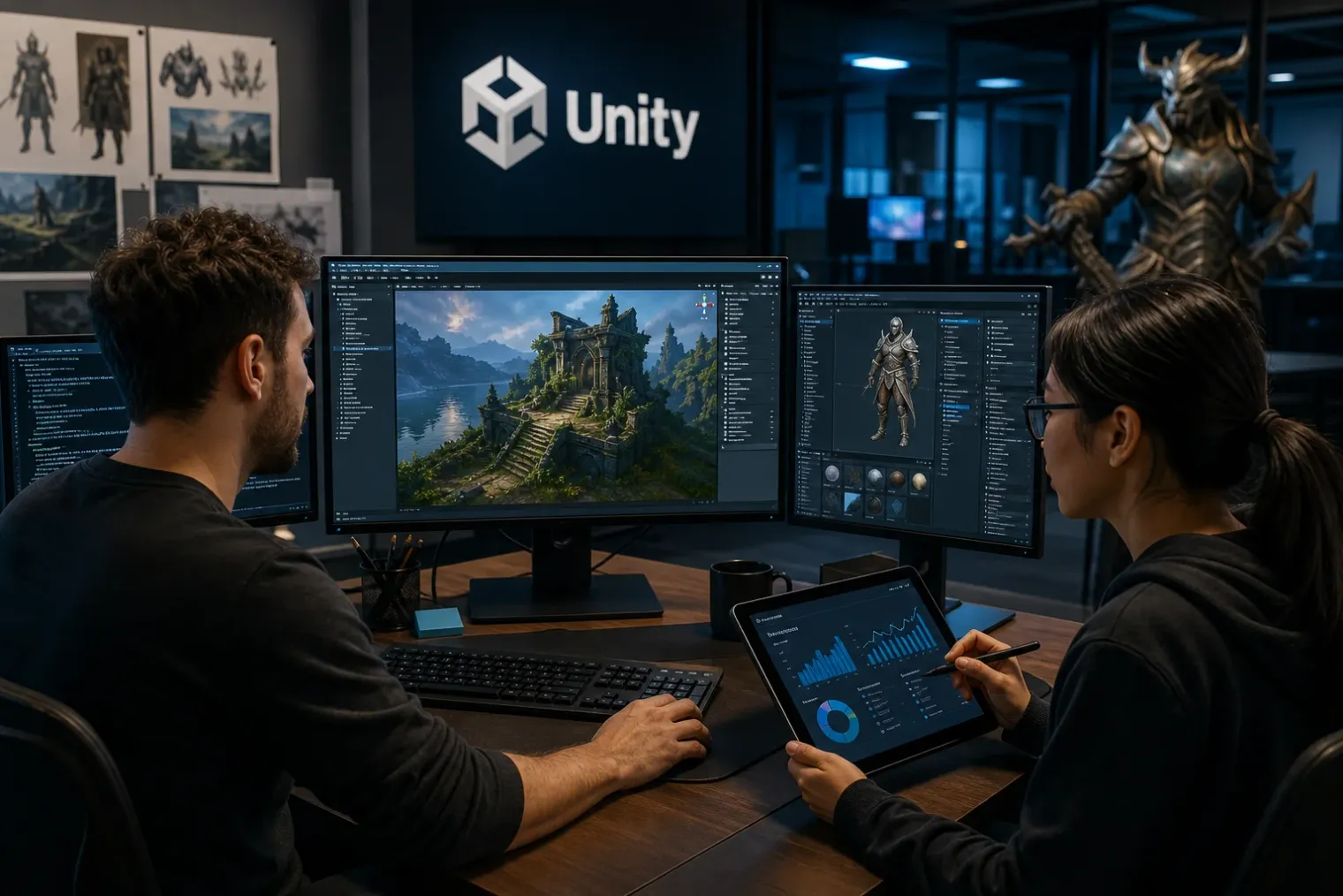
Unity has outlined Unity 7 as the next major version of its game-development platform, framing the release less as a disruptive engine replacement than as the continuation of work already under way in Unity 6. The company announced the roadmap around Unite Seoul, held on July 21, 2026; its news post is dated July 20, likely reflecting its publication timing and time-zone handling.
The schedule remains prospective. Unity says an early beta is planned for December 2026, followed by a full release in the first quarter of 2027. That makes the announcement important principally as a direction of travel: studios can begin assessing the architecture and workflow changes, but should not treat every promised capability or performance figure as shipping product.
A compatibility-first major release
The central message is continuity. Unity says projects, code and skills from Unity 6 will carry into Unity 7 without a conventional rebuild or a new programming language. That is a notable positioning choice for a major version, especially for teams with long-lived games, extensive Asset Store dependencies and carefully maintained build pipelines.
The technical basis is a modernised runtime built around CoreCLR. Unity links this foundation to quicker iteration through a near-instant Play Mode, reloads intended to affect only changed code, and shader-build improvements it says can be as much as 90% faster. The practical value is not merely a shorter wait after pressing Play. Faster iteration affects how often developers test gameplay changes, diagnose defects and review visual work during a production day.
However, performance gains will depend on a project’s codebase, packages, shaders and target platforms. Unity’s own material places much of the transition groundwork in the Unity 6.x series, while its event guidance says CoreCLR work will bring .NET 10, C# 14 and MSBuild support to Unity 7. For studios, the sensible near-term task is therefore to keep current Unity 6 projects healthy and identify packages or custom tooling that may need validation before the beta arrives.
The editor becomes more programmable
Unity 7’s more consequential shift may be its treatment of the engine as an automation target rather than solely a desktop editor. The roadmap promises a new command-line interface, public API and a free Model Context Protocol connection for coding agents. Unity’s recently released experimental CLI already provides a clearer indication of the intended working model.
The CLI can install and manage editors and modules without the Unity Hub interface, and it supports structured output, predictable exit codes and service-account authentication for automated environments. Alongside the experimental Unity pipeline package, it can communicate with a running editor on a local machine. Developers can expose project-specific commands, drive testing and tooling tasks, and evaluate C# in a live development environment.
This is relevant to AI-assisted development because an agent needs more than a text box in which to write code. It needs controlled ways to inspect a project, invoke a task, receive machine-readable results and confirm whether a change worked. Unity’s proposal could reduce the amount of manual hand-off between an external coding tool and the editor.
That does not remove the need for safeguards. A programmable editor can make build, test and content-validation workflows more reproducible, but it also increases the importance of permissions, source control, review gates and separation between development and production systems. Unity notes that the current CLI and pipeline features are experimental, and the broader Unity 7 agent framework is still a roadmap commitment.
Graphics ambitions extend across device classes
The roadmap also ties the new platform to rendering improvements. Unity has highlighted Surface Cache GI, a real-time global-illumination approach, alongside AI-assisted graphics optimisation and scaling across high-end PCs and mobile hardware. Its Unity 7 overview additionally points to a single renderer and neural upscaling as part of the effort to deliver stronger visuals across devices.
This is an ambitious promise because cross-platform graphics are usually shaped by hard trade-offs: visual fidelity, memory budgets, battery life, thermal limits and development time do not move in lockstep. The strongest potential benefit is not a single rendering feature, but a more unified path for teams trying to maintain visual consistency while supporting several device tiers.
Some enabling work is scheduled before Unity 7. Unity’s Unite Seoul material says Surface Cache GI is previewed in Unity 6.7 alpha and expected to be broadly available with Unity 6.7 LTS, while neural technologies are planned to begin arriving in that release. This staged approach could let studios trial parts of the graphics roadmap before deciding whether to adopt the major version quickly.
Monetisation moves into the same platform story
Unity is also using Unity 7 to connect authoring more explicitly with acquisition and commerce. The roadmap highlights Unity Vector, Unity’s AI-driven advertising and player-acquisition system, plus direct-to-consumer in-app purchases, no-code webshops and unified product catalogues. Unity says purchase data from those commerce systems can feed back into Vector.
For mobile and live-service developers, the significance is organisational as much as technical. Game teams often work across separate authoring, analytics, advertising and store-management systems. A more integrated platform could reduce operational friction, especially for smaller studios without dedicated commerce engineering teams. Unity already documents an Admin API for programmatically configuring webshops, including integration into project setup and deployment pipelines.
The trade-off is greater reliance on one vendor’s connected services and data flows. Studios will need to weigh convenience against commercial terms, platform policies, privacy obligations and the flexibility to use alternative tools. Direct-to-consumer commerce may widen options, but it does not eliminate the constraints that console, mobile and regional storefront ecosystems impose.
What studios should watch next
Unity 7 is best understood as a platform strategy built around faster feedback loops: quicker code and shader iteration, more automation, agent-accessible tooling, device-spanning graphics and closer links to monetisation. Its promise of no breaking changes is designed to make that strategy easier to adopt than a clean-slate engine migration.
The key proof points will arrive before the full release. Developers should watch the December 2026 beta for upgrade reliability, package compatibility, CoreCLR behaviour in production-scale projects, the maturity of the CLI and API, and practical performance across target hardware. They should also distinguish what is available in Unity 6.x from what is specific to Unity 7.
For now, Unity has delivered a detailed roadmap rather than a finished platform. If it meets its compatibility and automation goals, Unity 7 could make the engine less dependent on a single editor-centric workflow and more useful as a shared, programmable foundation for developers, artists, producers and automated tools.
Sources
- Unity 7 Roadmap Revealed at Unite Seoul — Unity
- Unity 7: The Next Generation of Unity Is Coming — Unity
- Meet the Unity CLI: manage Unity from your terminal — Unity
- Unity command-line interface (CLI) — Unity Documentation
- Webshop Admin API reference — Unity Documentation


