
A supply chain that is public only in fragments
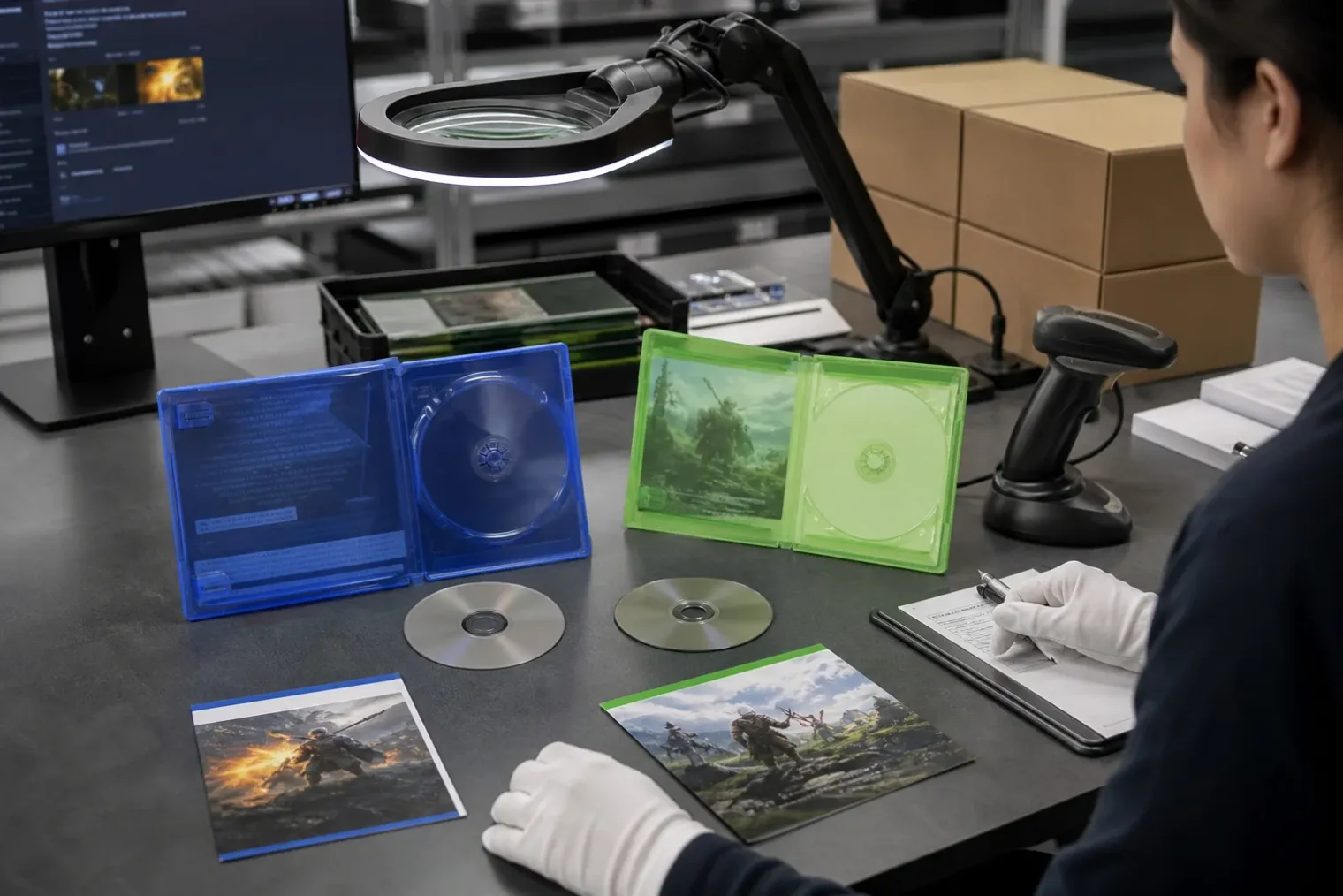
A physical console game looks simple at retail: a disc, a case and a printed cover. The route to that shelf is considerably more controlled. Recent reporting by Game File, subsequently summarised by Sector.sk, describes disc production for PlayStation 5 and Xbox Series consoles as a process about which industry participants were unwilling to speak publicly by name. Sony and Microsoft reportedly declined to comment on the account.
That lack of public detail does not mean that every part of the system is unknowable. Microsoft’s developer documentation lays out important elements of the Xbox workflow, including certification, disc requests, test manufacturing and media validation. But the documentation is aimed at approved partners, not consumers, and it does not disclose commercial terms, unit costs, approved manufacturing arrangements or the internal security procedures that protect unreleased software.
The distinction matters. Platform holders need to protect both their technical security and their commercial control over a licensed format. A retail disc has to authenticate as a legitimate product, install reliably, work with the correct version of the game and, increasingly, handle cross-generation content and online updates without confusing players. A bad digital upload can generally be replaced. A bad production run can leave a publisher with unusable inventory in warehouses and stores.
Certification comes before replication
For Xbox publishers, a disc cannot simply be ordered once a build exists. Microsoft says products must be submitted for certification before disc creation can be requested. A Microsoft representative reviews the request and authorises test-disc printing; the publisher then has an opportunity to verify the game from the binaries and media intended for mass production.
The testing requirements illustrate why physical distribution remains a specialised operation. Xbox documentation says discs undergo checks at multiple points in manufacturing. Publishers must validate security checks, ensure that the intended package version is on the media, and test installation and play on offline as well as online consoles. These tests are designed to prevent situations in which a customer receives an outdated or corrupted disc that immediately demands a large download.
That workflow also explains why the disc version of a game may lag behind its final launch build. There is a practical cut-off between sending an approved master into replication and delivering subsequent patches through the network. Developers can continue to improve a game after the manufacturing deadline, but every late change increases the importance of a day-one update. The disc can still be a functional product, yet it may no longer represent the most current build.
Physical media also introduces design constraints that downloads avoid. Microsoft’s current guidance supports 25 GB and 50 GB Xbox discs, and documents multi-disc configurations. It also notes that ordinary physical manufacturing and packaging logistics support two discs per retail package, even though the platform can accommodate more complex sets through additional arrangements. Content size, installation sequence, language assets and the need to support more than one console generation can therefore affect the disc layout as well as the customer experience.
The reported 15% figure needs careful reading
The central cost claim in the recent reporting is that the base cost of a physical release can amount to roughly 15% of a game’s manufacturer’s suggested retail price. Applied to a $70 title, that implies a little more than $10 per copy. The reported estimate rises for larger games and multi-disc releases.
It should not be read as the price of a blank optical disc. The figure is an industry estimate attributed to unnamed people familiar with the process, rather than a published Sony or Microsoft price list. Nor is it a universal margin calculation. A physical-release cost stack can include mastering, replication, disc printing, case and cover production, ratings and packaging compliance, freight, warehousing, retail distribution and the financial exposure created by ordering stock before demand is certain.
The largest uncertainty is inventory. Digital distribution lets a publisher supply another copy at the point of purchase without producing or storing a unit in advance. Physical publishing requires forecasts: too few copies can mean missed sales around launch, while too many lead to markdowns, returns and write-downs. This is particularly difficult for games with uncertain demand or narrow audiences, even when collectors strongly value boxed editions.
The estimate also does not establish that discs are the dominant cost in a physical game’s economics. Development, marketing, retailer terms, platform royalties and shipping can each be material, depending on the publisher and market. What the estimate does show is that physical distribution is a bundle of irreversible commitments, not merely a low-cost alternative packaging format.
Digital demand changes the calculation
The commercial backdrop strongly favours digital delivery. Sony’s financial reporting for the year ended March 31, 2025 recorded a 76% digital-download ratio for full PlayStation 4 and PlayStation 5 game software. In the same year, Sony reported ¥121.2 billion in physical-software revenue and ¥949.8 billion in digital-software revenue, although these categories measure revenue rather than a direct count of physical and digital copies.
That gap does not mean physical games have no role. Discs remain useful for gifting, lending, resale and players with slow or capped broadband connections. They can also provide a more durable starting point for preservation, particularly when a complete playable build is included on the media. Yet the practical value of a disc is reduced when substantial content, patches or activation requirements remain online-only.
For publishers, the appeal of digital distribution is less about eliminating plastic than about removing friction across the chain: no forecasting of individual units, no physical stock holding, no costly replenishment decision and no production deadline that must be met weeks before release. For platform holders, controlled media also remains relevant to anti-counterfeiting and licensing. Microsoft, for example, identifies a hologram around the centre hub and a certificate of authenticity on authorised Xbox game packaging.
A controlled process in a shrinking market
The reported secrecy around console-disc production is unsurprising when viewed through this lens. The system combines proprietary platform security, confidential commercial arrangements and a supply chain that can create expensive mistakes. Public developer materials reveal a carefully staged workflow, but they intentionally stop short of exposing its economics or its security-sensitive details.
The result is a paradox. Physical games are becoming less central to the mass market, yet producing them remains operationally demanding because the remaining releases must meet the same standards for authentication, certification and retail readiness. As digital sales grow, the fixed expertise and infrastructure behind discs may become harder to justify for smaller print runs. That makes the economics of physical games more consequential precisely as their share of the market declines.
Sources
- Výroba PS5 a XBOX diskov je prekvapivo stráženým tajomstvom, zároveň je výroba drahá — Sector.sk
- How PlayStation and Xbox disc games are made — Game File
- Discs overview — Microsoft Learn
- Media Validation Test Steps — Microsoft Learn
- FY25.2Q Supplemental Information — Sony Group


