
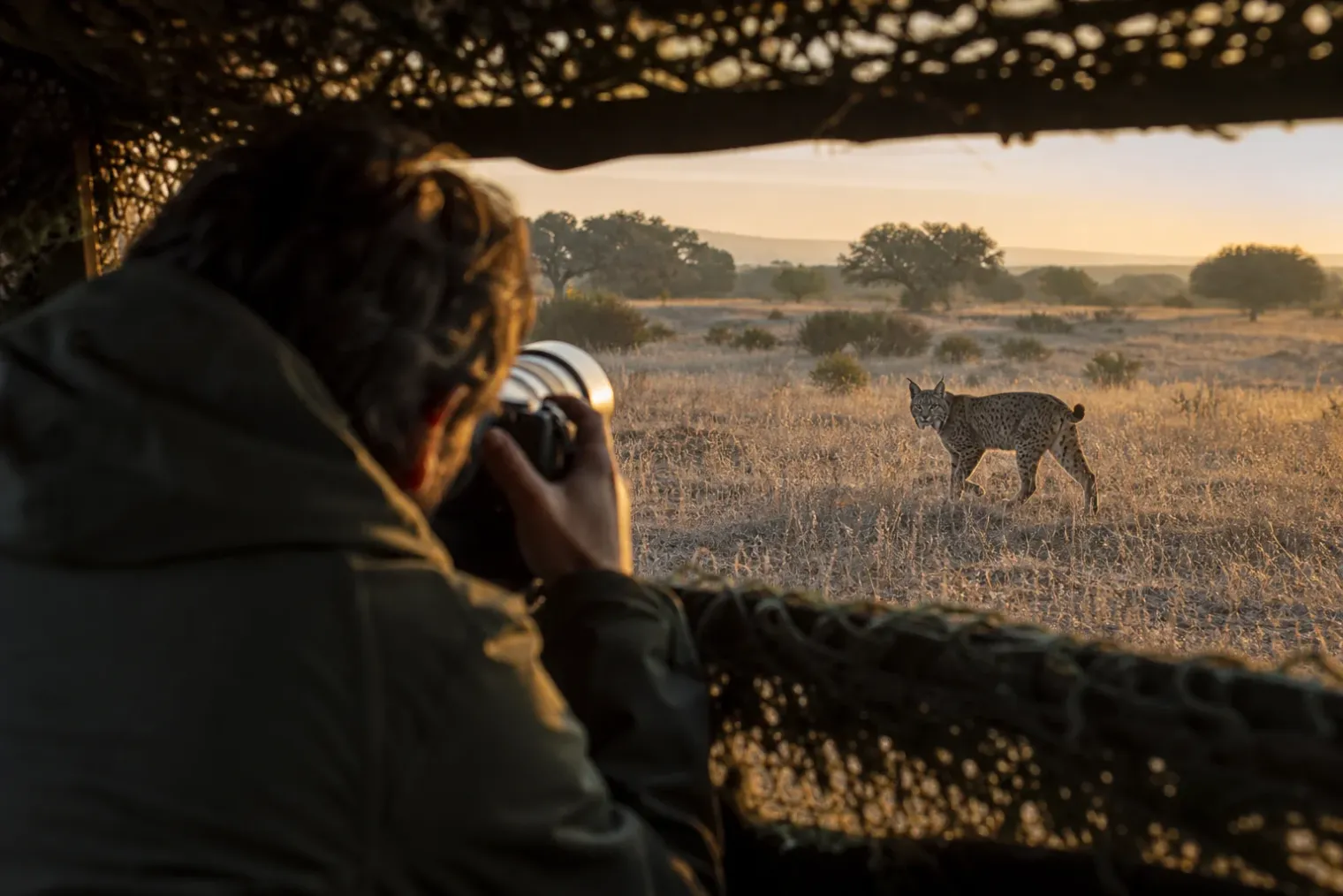
A shortlist built for both wonder and unease
When the Natural History Museum in London unveiled 24 contenders for its 2026 Wildlife Photographer of the Year Nuveen People’s Choice Award, it offered more than a gallery of technically accomplished animal portraits. The selection ranged from intimate family scenes and extraordinary behaviour to images in which roads, power lines, industrial structures and a changing climate were impossible to ignore.
The competition’s public vote has now concluded, but the shortlist remains a useful snapshot of what makes wildlife imagery travel beyond specialist photography circles. A successful image must first stop a viewer: a young lynx tossing a rodent into the air; a crab riding on a jellyfish; a vast gathering of dolphins spiralling through the sea. Yet the most resonant pictures also ask what lies outside the frame. Is the animal secure? Is its habitat intact? What role do people play in the scene?
The 24 photographs were selected from 60,636 entries submitted from 113 countries and territories. That scale matters. It means the People’s Choice nominees were not simply a sequence of appealing images, but a tightly edited group chosen from a global record of encounters between people and the natural world.
A public vote with a clear winner
Austrian photographer Josef Stefan won the 2026 People’s Choice Award with Flying Rodent, made in Ciudad Real, Spain. The photograph captures a young Iberian lynx throwing a rodent into the air shortly before eating it. Its title has an immediate, slightly comic quality, while the image itself records an ordinary aspect of predatory behaviour observed at a rare moment.
The public response was substantial: 85,917 votes were cast. The winning picture prevailed against the other 23 shortlisted works, showing the advantage of an image that is readily legible even at speed. There is movement, a recognisable mammal, an unusual action and an underlying conservation context. The Iberian lynx has long been associated with severe population decline, so a photograph of a young animal at ease in its environment can also be read as an image of recovery.
That combination is central to the People’s Choice format. Specialist judging can reward technical complexity, long-term documentation or subtle ecological detail. Public voting tends to favour pictures that establish an emotional connection immediately. Neither approach is inherently superior; together, they recognise that photography serves both expert observation and broad public engagement.
The strongest images connected wildlife to human pressures
Several nominees made the human presence explicit. Alexandre Brisson’s Beauty Against the Beast placed flamingos against electricity pylons in Walvis Bay, Namibia. The contrast between the birds’ colour and the hard geometry of infrastructure gave the image its force. It did not depict wildlife as separate from development, but as living amid it.
Will Nicholls’ Dancing in the Headlights similarly placed two bear cubs on a road in Jasper National Park, Canada. The silhouetted animals appear almost theatrical as they rear up to play-fight, but the approaching headlights change the meaning of the scene. The apparent charm carries a reminder that transport routes can divide habitat and create danger.
Other photographs focused on the consequences of environmental disruption more directly. Christopher Paetkau’s Family Rest showed a polar bear with three cubs resting on land during summer heat on the Hudson Bay coast. The underlying story is that less sea ice can make hunting and feeding more difficult for polar bears during the warmer months. Nima Sarikhani’s The Final Portrait, meanwhile, paired a close view of a polar bear cub with a narrative of a family pushed away from human settlement after an unsuccessful hunting trip.
These works show why wildlife photography has become closely linked to photojournalism. A photograph cannot on its own explain changing ecosystems, resolve conflicts over land use or demonstrate a population trend. It can, however, make abstract issues personal. The animal’s face, posture or proximity to human infrastructure gives viewers a point of entry into questions that might otherwise feel distant.
Intimacy, rarity and the appeal of the small
The shortlist was not confined to familiar large mammals. Its range was one of its strengths. Dvir Barkay’s Hold Me Tightly showed a brown-throated three-toed sloth sheltering its young from rain. Thomas Hunt’s Precious Cargo focused on a cellar spider carrying a ball of eggs. Joseph Ferraro’s Ready to Pounce revealed an ambush bug nymph waiting on a flower.
Such images broaden the definition of charismatic wildlife. They suggest that nature photography need not rely on dramatic predators or remote landscapes. Careful attention can turn a small invertebrate or an everyday species into a compelling subject, particularly when the image reveals behaviour that is easily missed.
The collection also included records of rarity. Daniela Anger photographed a pale, leucistic otter feeding in Brazil, while Prasenjeet Yadav documented a tiger with pseudo-melanism in India’s Similipal reserve. These images are visually striking because of their unusual subjects, but they also require restraint from viewers. Rarity can attract attention without necessarily being a measure of ecological health. The wider setting, population status and threats to habitat remain as important as the singular animal in front of the lens.
Why the contest still matters
Wildlife Photographer of the Year has been running since 1965, and its continuing relevance lies partly in this ability to bring art, natural history and public communication together. The annual exhibition transforms photographs into a shared civic experience rather than leaving them confined to scientific reports, personal archives or social-media feeds.
The 2026 People’s Choice nominees illustrate the format’s limits as well as its potential. Public voting inevitably rewards accessibility and emotion. A lynx in motion, bear cubs in headlights or a parent cradling its young are likely to make a deeper immediate impression than a visually restrained study of habitat loss. But the shortlist’s wider range prevented the award from becoming a simple popularity contest built around cute animals.
Its most effective images contained a second layer: behind the spectacle were questions about trade in threatened species, industrial expansion, the fragmentation of habitat and the changing conditions facing animals at the poles. That is a significant achievement for a photographic award. The pictures invite people to look, but also leave them with reasons to look again.
The 2026 London exhibition closed on 12 July. The next, sixty-second Wildlife Photographer of the Year exhibition is scheduled to open at the Natural History Museum on 16 October 2026, continuing a cycle in which a new set of images will again test how photography can turn attention into concern for the living world.
Sources
- See the stunning contenders for the Wildlife Photographer of the Year — New Scientist
- Wildlife Photographer of the Year reveals shortlisted photographs for highly anticipated Nuveen People’s Choice Award 2026 — Natural History Museum, London
- Wildlife Photographer of the Year announces winner of prestigious Nuveen People’s Choice Award following record-breaking number of global votes — Natural History Museum, London
- Wildlife photographer of the year – people’s choice 2026 — The Guardian


