
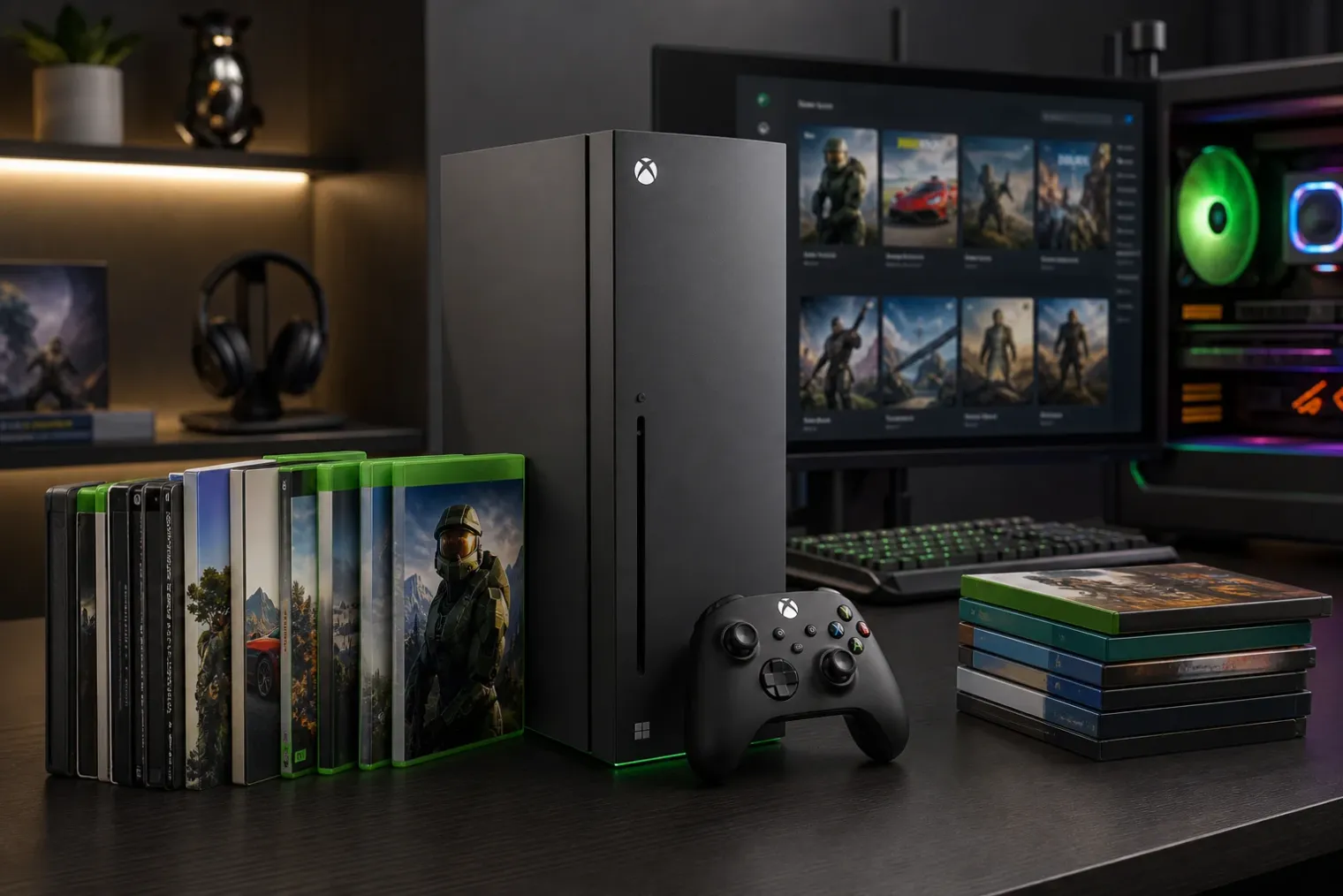
An ambition larger than conventional backwards compatibility
Microsoft’s reported plans for its next-generation Xbox, codenamed Project Helix, point to an unusually broad definition of compatibility. A leaked presentation obtained by The Verge says the company wants the platform to run titles from the original Xbox, Xbox 360, Xbox One and Xbox Series generations, alongside new Helix releases and PC games.
That would make Helix less a conventional successor to the Xbox Series consoles than a single access point for a long-running software catalogue. It is a potentially important shift: hardware generations have often fractured game libraries, while Microsoft’s broader Xbox strategy increasingly treats consoles, Windows PCs, handhelds and cloud streaming as connected places to play.
The central qualification is that this is not yet a public promise that every previously released Xbox game will work. Microsoft has officially described Helix as a next-generation console designed to play Xbox console and PC games, but it has not formally committed to universal compatibility across its historical catalogue. The more expansive claim comes from the reported internal material, which is directed at publishers rather than consumers.
Microsoft appears ready to handle the technical work
The reported proposal places much of the operational burden on Microsoft. For original Xbox and Xbox 360 games, the company would provide emulation, testing, certification and support, allowing publishers to decide whether their games participate rather than requiring them to rebuild old code.
This approach reflects the fact that running legacy games is not simply a matter of providing faster hardware. Older Xbox software was designed around different processors, graphics systems, operating-system assumptions and online services. Reliable compatibility requires a combination of emulation, quality assurance and platform-specific fixes. It also needs a system that respects the original game’s behaviour while fitting current account, save-data and store infrastructure.
Microsoft already has relevant experience. Its Xbox One and Xbox Series backwards-compatibility programme made a substantial selection of original Xbox and Xbox 360 titles available, often with features such as improved resolution, Auto HDR, FPS Boost and faster loading. But in November 2021, Xbox said its final batch of additions had reached the practical limits imposed by licensing, legal and technical constraints.
The Helix proposal suggests Microsoft believes it can revisit that challenge with a more scalable model. Rather than adding compatible titles only to a console catalogue, it would potentially use common technical foundations across console, PC and other Xbox devices.
PC compatibility gives the plan a wider purpose
Helix is also notable because Microsoft has publicly said that it is intended to play both Xbox console and PC games. That makes it a more direct bridge between the Windows and Xbox ecosystems than previous home consoles.
The company has begun putting that idea into practice. In July, Xbox introduced an early release of backwards compatibility on PC, initially making four original Xbox games playable on Windows PCs and supported handhelds. Existing digital licences for those titles can carry over to PC, while the games receive optional modern features including graphics settings and resolution scaling.
That launch is modest in scale, but strategically useful. It provides evidence that Microsoft is developing the tooling needed to carry legacy Xbox software beyond the living room console. It also establishes a model in which old games can be sold, included in subscriptions or recognised as part of a player’s existing digital library.
For players, the appeal is continuity. A collection built over decades could become more portable, with cloud saves and purchases following an account across form factors. For Microsoft, a deeper catalogue could give Helix a differentiator in a market where the practical value of a new console is increasingly measured by the software and services it can access, not only its graphical performance.
Publishers, not processors, may set the limit
The greatest obstacle is likely to be rights management. The leaked presentation reportedly makes participation opt-in: publishers would retain control over whether a title is offered, its price and whether it appears in Game Pass. That means technical compatibility would not guarantee commercial availability.
Older games frequently contain rights that were negotiated for a limited period or for a particular platform. Music, vehicle brands, sports leagues, celebrity likenesses, middleware and other licensed content can all complicate a re-release. A game may also have changed ownership, or its original publisher may no longer exist. These problems are particularly common in racing, sports and music-driven games, but they can affect almost any catalogue title.
The same issue applies to the reported disc-to-digital programme. The proposal would allow owners of Xbox One and Xbox Series discs to receive digital access that could work on other supported Xbox devices, including hardware without an optical drive. However, such a conversion appears to require publisher participation even if Microsoft can implement the technical process itself. A disc may establish that a customer bought a game, but it does not automatically resolve the rights needed to distribute a new digital version indefinitely.
A preservation opportunity, not a guarantee
If Microsoft can win broad publisher support, Helix could make a meaningful contribution to game preservation. A large playable legacy library would reduce the risk that older games become inaccessible as ageing consoles fail, physical media becomes harder to use and storefronts change.
Still, the realistic outcome may be a growing, uneven catalogue rather than literal compatibility with every Xbox release. Microsoft-controlled franchises should be easier to support, while games dependent on complex third-party licences may remain unavailable. Availability could also vary by country and change over time if rights expire or publishers withdraw consent.
That does not make the reported plan unimportant. It frames compatibility as a continuing platform service rather than a fixed checklist of supported titles. The eventual test for Helix will be whether Microsoft can turn that ambition into a clear consumer proposition: which games carry forward automatically, which require a new purchase, which are available through subscription, and which cannot return at all.
For now, the broadest claims should be treated as a reported goal rather than a finished product specification. Microsoft’s official messaging supports the direction of travel — a high-performance Xbox platform spanning console and PC libraries — while the leaked publisher proposal shows how much commercial negotiation remains between that vision and a truly comprehensive Xbox archive.
Sources
- The next Xbox could play every Xbox game ever made — The Verge
- Play More of the Games You Love, Wherever You Play with XBOX Backward Compatibility on PC — Xbox Wire
- March Xbox Update: New Console Updates Available to Insiders, Xbox at GDC, and More — Xbox Wire
- Celebrate 20 years of Xbox with over 70 new Backward Compatible Games — Xbox Wire


