
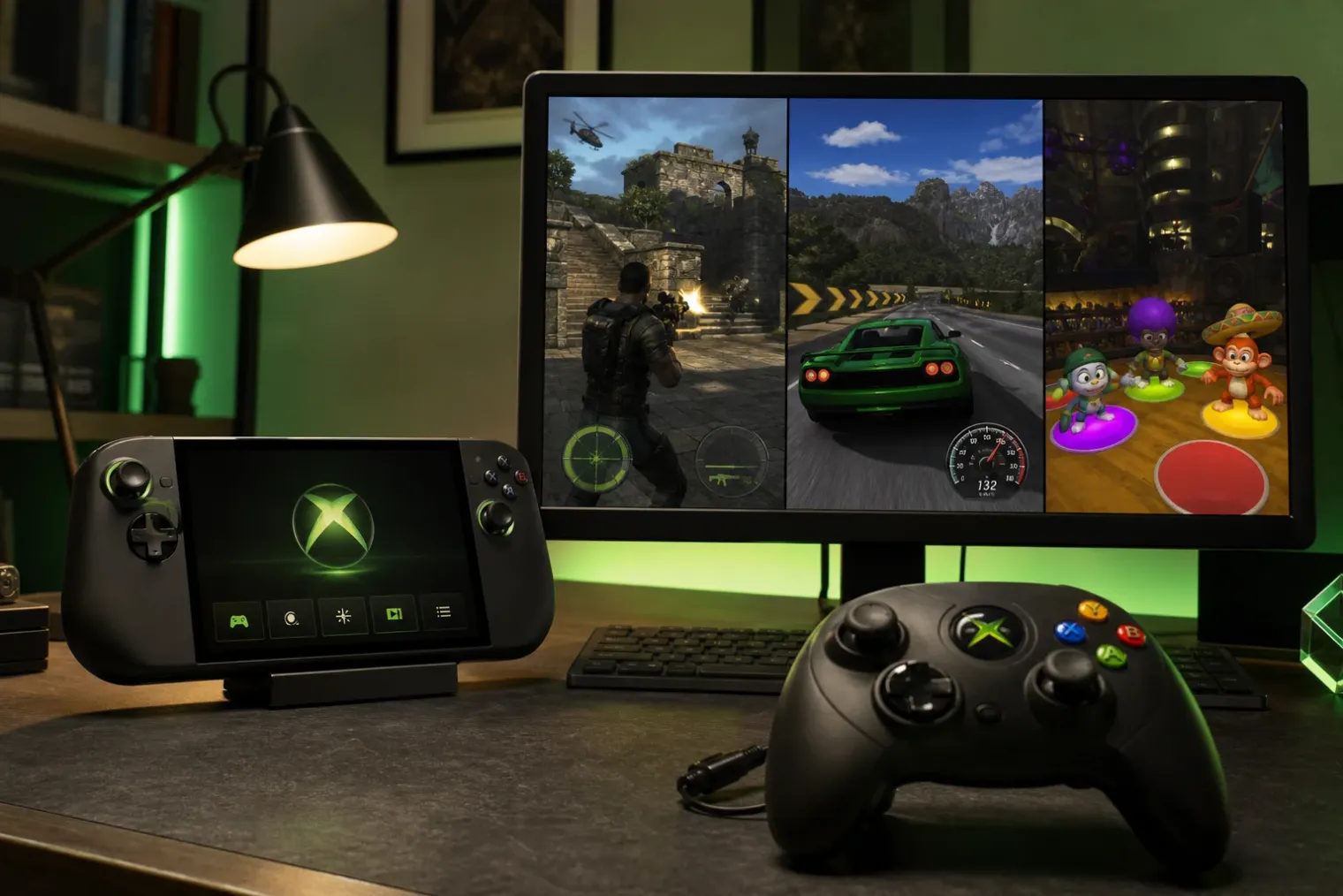
Microsoft has begun bringing selected original Xbox games to Windows PCs and compatible handhelds through a new Xbox Backward Compatibility on PC programme. Launched on 22 July 2026 in supported regions, the initiative starts small but carries broader significance: it treats a subset of the original Xbox catalogue as software that can travel with a player’s Xbox account rather than remain tied to ageing console hardware.
The first four games are BLiNX: The Time Sweeper, Conker: Live and Reloaded, Crimson Skies: High Road to Revenge and Fuzion Frenzy. They can be bought through Xbox on PC and are included with all Xbox Game Pass plans. Most importantly for existing customers, Microsoft says a digital console licence for any of the four carries over to PC and supported handhelds.
More than a conventional re-release
This is not a series of separately commissioned remasters or native PC ports in the usual sense. Xbox is framing the launch as backward compatibility: a platform capability designed to make earlier console releases playable in a contemporary Windows-based environment.
That distinction matters. A traditional PC port usually requires a publisher to allocate development, testing and release resources to a single title. A compatibility programme instead seeks to build reusable technical and distribution foundations. If Microsoft can extend this system to further games, it could make releases from earlier Xbox generations accessible on PCs without requiring each one to be rebuilt as a new product.
For now, the scope should be kept in perspective. Xbox has announced only four launch titles and describes the service as an early release. All four are Microsoft-published games, a logical starting point because rights management is comparatively straightforward. The announcement does not amount to a commitment that every original Xbox game, or every game already compatible on Xbox consoles, will arrive on PC. Legacy catalogues often involve music, publishing, technology and regional licensing constraints that vary game by game.
A portable digital licence is the central change
The practical change for players is not merely that these games now run on a PC. The launch connects them to Xbox Play Anywhere, cloud saves and Xbox Cloud Gaming. A player with an eligible digital licence can use the same entitlement across Xbox console, PC, cloud and supported handheld devices, while saves can follow the account between those environments.
That approach pushes Xbox further towards an account-centred model. The value proposition is increasingly built around access to a library and social profile across several device categories, rather than access to a game only on the machine for which it was first purchased.
It also gives the PC version a clearer role than a straightforward addition to a store catalogue. A player may begin an older game on a television-connected console, resume it on a Windows desktop, then continue on a handheld. For older local multiplayer games such as Fuzion Frenzy, portability may be as relevant as visual upgrades: a handheld PC connected to a display can become another way to bring the game to a social setting.
The programme is nevertheless focused on digital ownership. Microsoft’s announcement refers to existing digital licences; it does not establish a route for an original Xbox disc to be inserted into a PC and converted into a PC entitlement. That boundary is important in a preservation discussion. The initiative improves access to specific digital purchases, but it does not resolve the wider challenge of preserving and validating physical libraries.
PC enhancements without redesigning the games
Xbox has added options intended to make the original titles better suited to modern displays and Windows hardware while retaining their original gameplay. These include rendering up to four times the original resolution, VSync, fullscreen and windowed modes, anisotropic filtering, enhanced anti-aliasing, and adjustable language and audio settings.
The upgrades are meaningful because games designed for early-2000s televisions can look limited on large contemporary monitors. Resolution scaling and filtering can improve image clarity, while display modes and VSync address basic expectations for PC use. At the same time, the company has not positioned the releases as wholesale remakes. Their appeal lies partly in preserving the original games’ design, structure and character rather than refashioning them around current conventions.
Microsoft also plans to add Xbox achievements to select original Xbox backward-compatible titles later in 2026. The four launch games are expected to receive them in the coming months. Adding a modern progression layer may help integrate these games with the current Xbox service, though it also underlines that the initial release is still developing rather than feature-complete.
Handhelds make the strategy more tangible
The programme explicitly supports compatible Windows handhelds, including ROG Xbox Ally and Xbox Ally X devices. That is strategically important because handheld PCs turn the idea of a cross-device Xbox library into a visible use case rather than an abstract ecosystem promise.
The minimum requirements also show that compatibility is not aimed at every old computer simply because the source games are old. Xbox specifies Windows 11, 8GB of RAM, 4GB of video memory, a four-core/eight-thread processor and a supported entry-level GPU. Recommended specifications rise to 16GB of RAM, 8GB of video memory and a stronger six-core/twelve-thread CPU and graphics hardware. The requirements reflect the additional work of running legacy software through a modern compatibility stack and providing enhanced rendering options.
A modest launch with a larger test ahead
The first wave is deliberately narrow, but it tests several questions at once: whether technical compatibility is dependable across varied PC hardware, whether entitlements migrate cleanly between console and PC, and whether players will value older Xbox titles as part of a subscription and digital-library ecosystem.
For Microsoft, success is unlikely to be measured only by sales of four early-2000s games. The more consequential outcome would be a dependable framework that allows carefully selected legacy titles to remain commercially available, playable and connected to current Xbox services. That would strengthen the company’s preservation credentials while giving its ecosystem a library advantage that is not limited to new releases.
The immediate result is more limited but still notable. Four original Xbox games have crossed from console compatibility into official PC availability, with shared licences and saves as part of the package. The next measure of the programme will be its pace: more games, broader rights coverage and a clear record of how well the platform maintains them over time.
Sources
- Play More of the Games You Love, Wherever You Play with XBOX Backward Compatibility on PC — Xbox Wire
- Buy BLiNX: The Time Sweeper — Xbox
- Buy Conker: Live and Reloaded — Xbox
- Buy Crimson Skies: High Road to Revenge — Xbox
- Buy Fuzion Frenzy — Xbox
- Xbox brings back compat to Windows: Microsoft pledges 4 games on PC for the first time, soon with achievements — with more to come — Windows Central


