
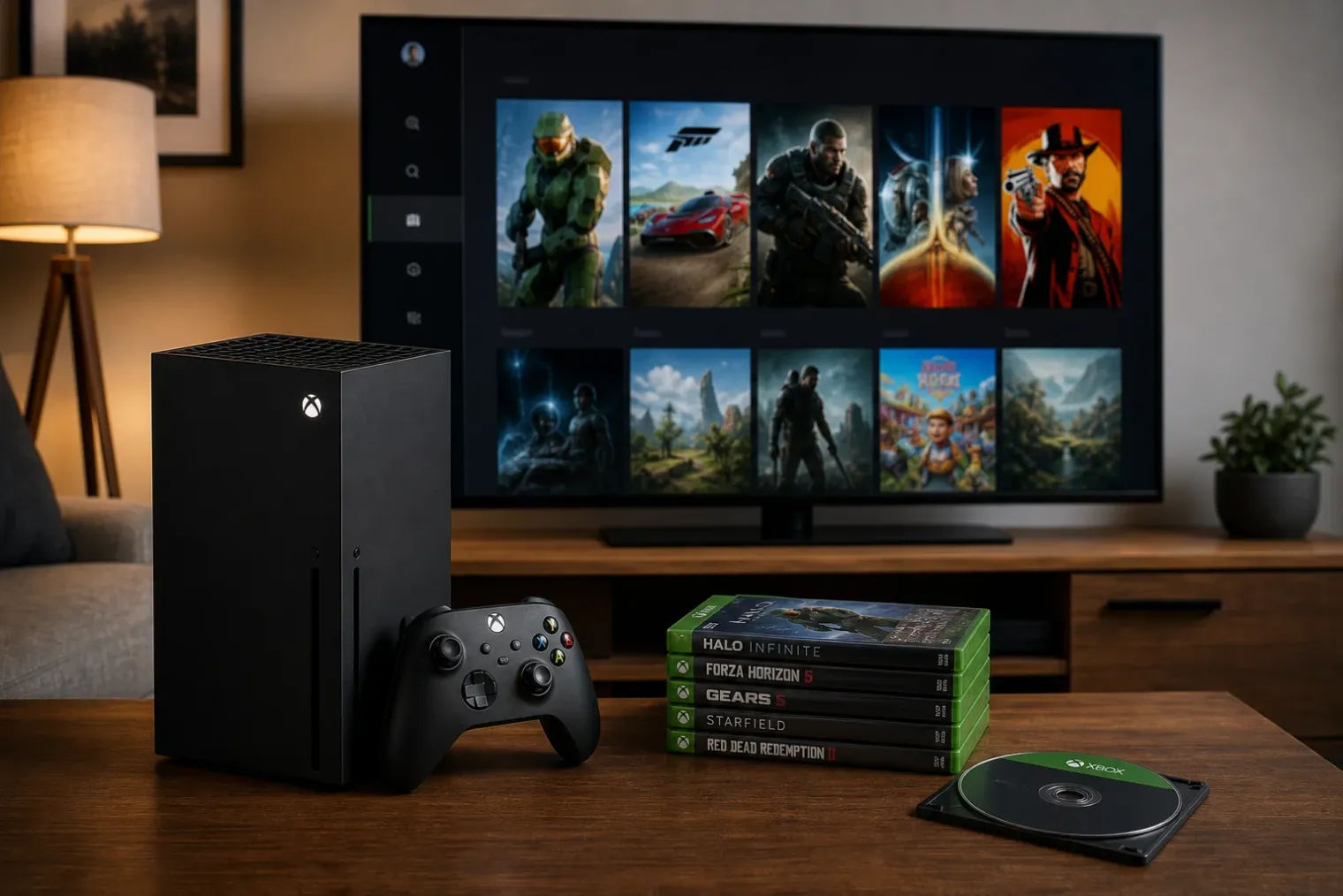
A bridge between physical libraries and digital access
Xbox has announced a disc-to-digital feature intended to give owners of eligible physical games access to selected digital benefits without requiring them to abandon their discs. Testing is scheduled to begin for Xbox Insiders on August 31, 2026, following the announcement on August 26.
The feature applies to most Xbox One and Xbox Series X disc-based games, according to Xbox, with thousands of titles expected to be available in the initial group. To claim access, a player inserts a supported disc into an Xbox One or Xbox Series X console and launches the game. Xbox then grants a digital entitlement for that copy.
That wording matters. This is not simply a programme that exchanges a disc for a separate, permanent digital licence in the conventional sense. Xbox says the physical game continues to work as before, while reporting on the feature indicates that the digital entitlement is connected to the individual disc. If that disc is used by another account, the entitlement can move with it.
The approach is therefore better understood as a way to make a physical purchase more usable across the Xbox ecosystem, rather than a wholesale conversion of a boxed game into an independent download code.
What players may gain
For eligible games, the entitlement can unlock the advantages normally associated with Xbox digital ownership. These include Xbox Play Anywhere and Xbox Cloud Gaming where the particular title supports them. In practical terms, that could make a game bought on disc accessible through compatible PC and cloud services without requiring the player to buy the same game again digitally.
The value will differ by game. Play Anywhere support is not universal, and cloud access depends both on a title’s eligibility and on the player’s access to the relevant Xbox service. A disc that successfully activates the new feature therefore does not automatically mean that every Xbox platform or streaming option becomes available.
Even so, the feature addresses a long-standing divide in console libraries. A physical Xbox game has traditionally been installed to a console but has needed the disc for authentication when played. A digital purchase, by contrast, can be downloaded from an account library and can potentially travel more easily between supported devices. Xbox’s new system attempts to combine aspects of both models.
The disc remains the key to the licence
The transfer behaviour reported for the entitlement is the crucial limitation and also the programme’s most unusual feature. Rather than severing the relationship between the disc and the licence, the system appears to retain it. Lending, selling or giving away an eligible disc may also shift the associated digital access to the person who next activates it.
That preserves an important characteristic of physical media: it can still change hands. A player is not asked to surrender or disable a disc in exchange for digital access, and the recipient of a used game may be able to receive the relevant entitlement as well.
But it also means collectors should be cautious about treating the programme as a one-way digitisation tool. Someone who sells a game disc should not assume they will retain cloud, PC or download privileges forever. Conversely, someone buying a used eligible game may need to activate it on a compatible disc-drive console before expecting its digital benefits to appear.
Xbox has not yet published a detailed consumer guide explaining every situation, such as account-sharing arrangements, disc replacement, resale timing or what happens when a title later leaves the programme. Those operational details will be important to assess during the Insider testing phase.
Support will not be universal
Xbox says that most, rather than all, Xbox One and Xbox Series X disc titles will be supported at launch. The company has not published a complete compatibility list alongside the announcement. That leaves several practical questions for owners with large collections, especially for older releases, special editions and games published by companies whose licensing arrangements have changed.
Rights management is likely to be a major constraint. A game’s music, branded content, distribution agreements and publishing ownership can all complicate the ability to offer a digital entitlement years after a disc was pressed. The initial commitment to thousands of games is substantial, but it should not be read as a guarantee that every Xbox disc in circulation will qualify.
The feature also requires an Xbox One or Xbox Series X to initiate the process. Owners of an Xbox Series S, which has no optical disc drive, cannot insert a physical game into that console to claim the entitlement. For players who have already moved to a digital-only console, access to a compatible disc-drive Xbox remains necessary at least for activation.
Preservation promise, digital caveat
Xbox frames the initiative as part of its game-preservation work. There is a clear preservation benefit in allowing a supported game to be associated with an online account and used on more than one form of hardware. Physical media can be damaged, lost, or become hard to use as disc drives disappear from future devices; account-linked access can reduce those barriers.
However, digital availability is not identical to long-term preservation. Digital entitlements depend on platform infrastructure, licensing terms and continued support for services such as downloads and cloud streaming. Physical discs also have limitations, particularly where modern games rely on patches or online services, but their ability to be resold and independently retained remains significant.
Xbox’s design acknowledges that neither format entirely replaces the other. Instead of asking players to choose between a disc collection and a digital library, it creates a model in which the disc acts as the transferable anchor for wider digital access.
A meaningful test for Xbox’s platform strategy
The Insider rollout will show whether the system is simple enough for ordinary owners and robust enough for a used-game market built around physical transfer. It will also reveal how broad publisher participation will be and whether Xbox can communicate the limits of disc-linked licences clearly.
If it works as described, the programme could reduce the friction of moving an existing library between console, PC and cloud play while preserving the usefulness of discs. Its success will depend less on the headline idea of turning physical games digital than on the finer question of ownership: who holds access after a disc changes hands, and how consistently that rule is applied across thousands of games.


