
A narrowly defined experiment
Xbox has begun a limited test of ad-supported game streaming for members of the Xbox Insider programme. The test lets participants with an Xbox account stream selected games from their own digital libraries for free, subject to advertising before play and a one-hour limit on each session.
The boundaries matter. This is not an announcement of a permanent free cloud-gaming service, nor is it a free catalogue of Xbox games. Eligibility depends on the player already owning a supported title, and availability is confined to supported devices and regions. Xbox has also presented the feature as optional, leaving users able to choose other ways to play.
The company says advertisements will run before a session starts rather than interrupting gameplay. That design choice is central to the proposal: a disruptive mid-game break would be particularly difficult to reconcile with action games, online matches and longer story-driven sessions. By placing ads at the point of entry, Xbox is testing a model closer to a pre-roll video than to conventional in-game advertising.
A potential new route into cloud gaming
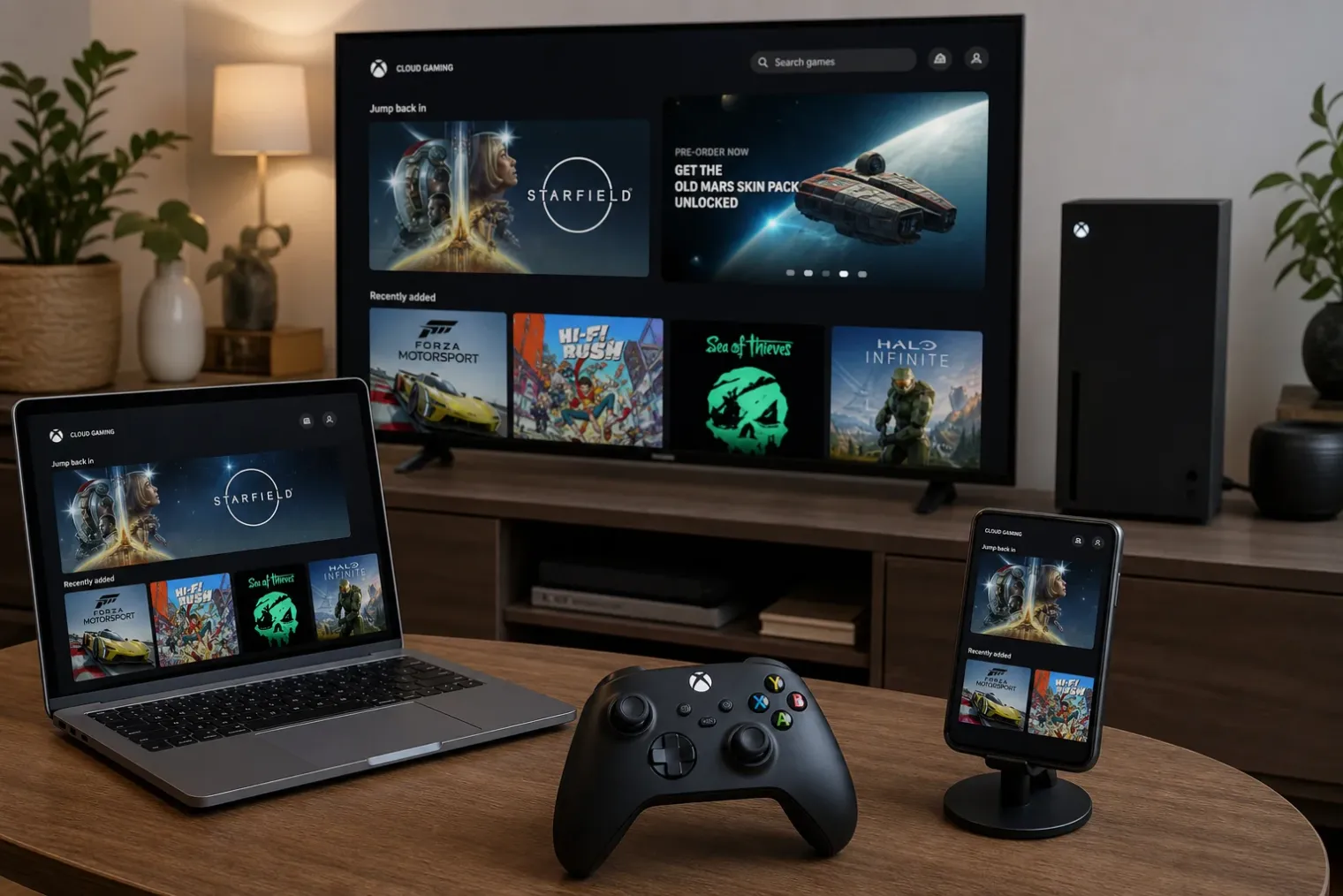
The experiment expands on Xbox’s existing “Stream your own game” approach. Before this test, cloud access to owned games was tied to eligible Game Pass subscriptions, even though players had already bought the titles themselves. Xbox has steadily enlarged that supported library, saying in April that subscribers could stream more than 1,000 owned games across supported devices.
The Insider test therefore separates two parts of the transaction that are usually bundled together: game ownership and access to cloud infrastructure. A player still needs a licence for the game, but may not need a paid subscription to use Xbox’s remote hardware for an hour at a time. Advertising becomes the proposed contribution towards the cost of that delivery.
That distinction could be commercially useful. It gives Xbox a lower-commitment way to introduce cloud streaming to people who own games but do not subscribe to Game Pass, or who want to play on a device without sufficient local storage or processing power. It also supports Xbox’s longer-running effort to make its games available across consoles, PCs, browsers, TVs and mobile devices.
For owners of older Xbox hardware, cloud delivery can offer access to games designed for newer systems without an immediate console upgrade. For players using a compatible TV, laptop, tablet or phone, it can reduce the barrier to trying a game away from their primary machine. Those benefits still depend on connection quality, regional availability and the particular game being supported for cloud play.
Why the one-hour cap is important
The session limit makes this test more than a straightforward ad-for-access proposition. It limits each uninterrupted period of play, which may help Xbox manage demand for cloud capacity while giving participants a clear exchange: watch advertising, then play for a defined time.
For players, however, the cap may be more consequential than the pre-session ad. One hour can accommodate a short session, a casual game or a trial of a newly purchased title. It is less convenient for multiplayer sessions, longer quests or games where stopping at an arbitrary point is disruptive. The practical experience will depend on what happens at the end of the hour, including whether a player can easily resume progress and how quickly a new session can begin.
Xbox has not committed to a wider launch, specified a final catalogue, or set out a long-term advertising load. The test should therefore be treated as research rather than as a settled service tier. Its value to the company lies partly in the data it produces: how often people choose the option, which devices they use, whether they return after a session ends, and whether advertising changes their willingness to buy games or subscriptions.
Advertising without changing the game itself
Xbox’s public principles for the test stress that advertising should not interrupt the flow of play, should be clearly identified, and should meet an appropriate quality standard for the platform. Those commitments address a sensitive issue for players: the difference between an optional, free access route and ads becoming a standard feature of paid gaming.
The present design is relatively conservative because it places ads outside the core game experience. It does not alter the game world, insert commercial messages into a match, or make progress contingent on watching a video. This should make the trial easier to assess on its own terms. It also leaves Xbox room to decide whether the model can be expanded without applying it to subscription customers.
Microsoft already operates a substantial advertising business and has been building gaming-focused advertising products across its wider portfolio. That makes an ad-funded cloud option a plausible extension of the company’s capabilities. Yet cloud gaming presents a different economic and reputational challenge from mobile advertising: each streamed session consumes computing and network resources, while players may expect console-style experiences with minimal interruption.
The test is consequently a measurement of both revenue potential and goodwill. If the advertising is brief, relevant and clearly separated from play, the offer could become a useful entry point for people who do not want another monthly subscription. If the session cap, queueing or advertising burden feels too restrictive, it may instead reinforce the appeal of paid tiers and local hardware.
What to watch next
The key question is not whether advertising can subsidise a cloud session; many digital services already use that trade-off. It is whether the exchange is compelling for games that players have purchased and expect to access on their own terms.
Xbox will need to balance four variables: the size and quality of the supported owned-game catalogue, the length and frequency of advertising, the one-hour session rule, and the performance of the streaming service at busy times. Changing any of those would materially alter the offer.
For now, the programme is limited to Xbox Insiders and is explicitly framed as a learning exercise. Its significance is strategic rather than immediate. Xbox is testing whether cloud gaming can have a third path alongside hardware purchases and recurring subscriptions: paid game ownership paired with free, advertising-funded access to remote hardware.


