
A large download with little evidence behind it
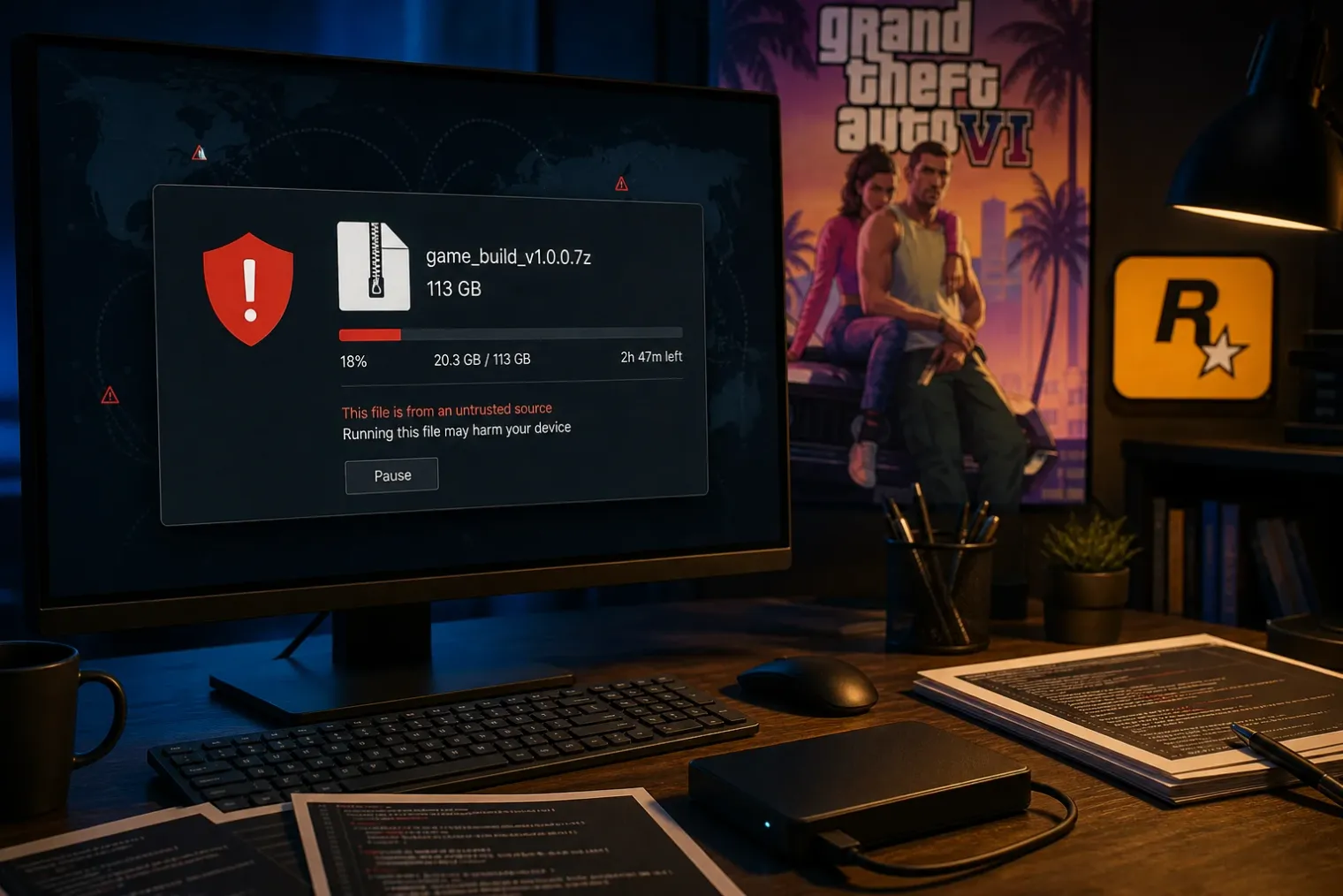
A file presented online as a leaked Grand Theft Auto VI build has reportedly been circulating through torrent-oriented channels, advertised as a 113 GB ISO image. Reports based on community inspection of the file say that almost all of its apparent size consists of zero-filled or otherwise empty padding, while a small embedded program contains commands intended to weaken Windows security controls.
The key qualification is important: the technical claims originate in social-media posts and reporting about those posts, rather than a published analysis from an established incident-response firm or Rockstar Games. The precise file, its origin, its cryptographic hash and its full behaviour have not been independently established in public. It would therefore be premature to state with certainty that every file using this name has the same payload, or to attribute it to a particular actor.
That uncertainty does not make the download safe. It is the opposite: a supposed pre-release game build distributed outside authorised channels is a high-risk file by definition, particularly when it is designed to exploit an active leak story and the anticipation surrounding a major launch.
Padding creates a plausible-looking trap
A file size of more than 100 GB can make an alleged game build appear credible. Modern games commonly require substantial storage, and potential victims may interpret a lengthy download as evidence that the material is genuine. Padding a file with empty data is a simple way to imitate that scale without supplying the claimed content.
The reported analysis of this ISO alleges a far smaller malicious component within a mostly empty container. The claimed commands would add the system drive to Microsoft Defender exclusions and attempt to terminate security software. If accurate, that behaviour would be consistent with a downloader or infostealer seeking to avoid detection rather than with a legitimate game installer.
File size should never be treated as proof of authenticity. Nor should the presence of familiar visual elements, game artwork, installer windows or a well-known repack brand. Threat actors can copy branding, reuse metadata and construct archive layouts that are convincing enough to turn curiosity into an execution decision.
The practical danger also extends beyond the original executable. A fake installer may direct users to provide Rockstar, platform-store, email or Discord credentials; switch off antivirus protection; paste commands into a terminal; or install additional components under the guise of a crack, activation fix or performance patch. Each added step increases the opportunity to take over accounts or deploy further malware.
Leaks have created an unusually effective lure
Recent clips attributed online to a source calling itself Cyberleek have generated intense interest and competing claims about access to an unfinished build. That attention gives criminals a ready-made social-engineering theme. A victim does not need to believe every aspect of the leak story; they only need to believe that someone else might have uploaded a playable copy.
Rockstar’s official information provides a clear reason to reject offers of an early PC download. As of August 23, 2026, the company lists Grand Theft Auto VI for PlayStation 5 and Xbox Series X|S, with a release date of November 19, 2026. It has not announced an official PC version, public beta programme or pre-release download of the kind promised by the circulating ISO.
That does not resolve questions about the authenticity of all footage or development materials shared online. It does establish a simple consumer-safety test: an unknown site or torrent cannot legitimately provide an authorised playable release ahead of the announced launch. Any offer framed as a leaked, free or exclusive PC build should be treated as hostile until proven otherwise.
This pattern is not unique to games. Fraudsters routinely use desirable software, major news events and familiar brands to encourage people to bypass their normal caution. A large entertainment release is especially useful bait because prospective victims are likely to search for unofficial links, tolerate suspicious download sizes and accept technical instructions they would otherwise question.
What users should do
The most effective protection is not to download, mount, extract or run an alleged Grand Theft Auto VI build from a torrent, file-hosting page, Discord server or link shared in social media. Deleting an unopened download is preferable to attempting to test it. Malware can be concealed in installers, archives, scripts and accompanying “fix” files, while deceptive pages may capture credentials even without a successful download.
Users who have already opened a suspicious file should act on the assumption that their device or accounts may have been exposed:
- Disconnect the computer from the internet if a file was executed or if the installer requested elevated permissions.
- From a known-clean device, change passwords for email, gaming, payment and social accounts, beginning with the email account used for password resets.
- Enable multi-factor authentication and review recent account sessions, recovery details and payment activity.
- Update security software and run a full anti-malware scan; an offline scan can be useful where malware may try to hide while Windows is running.
- Do not reuse a potentially compromised password, and seek professional support if there are signs of unauthorised access, ransomware or financial fraud.
A security alert should not become an invitation to obtain the sample for personal investigation. The safe response is to wait for authorised distribution through Rockstar and recognised console storefronts. In this case, the alleged 113 GB size is not evidence of an early game build. It is better understood as part of the lure: enough apparent substance to make an implausible offer look real.
Sources
- Fake "Leaked" GTA VI Build Hides Malware in 113 GB of Empty Code — TechPowerUp
- Fake GTA VI ISO circulates on the internet a few days after leak — Tom's Hardware
- Grand Theft Auto VI — Rockstar Games
- Virus and Threat Protection in the Windows Security App — Microsoft Support
- How to spot a CAPTCHA scam — Federal Trade Commission


