
A public-art problem became a production-policy question
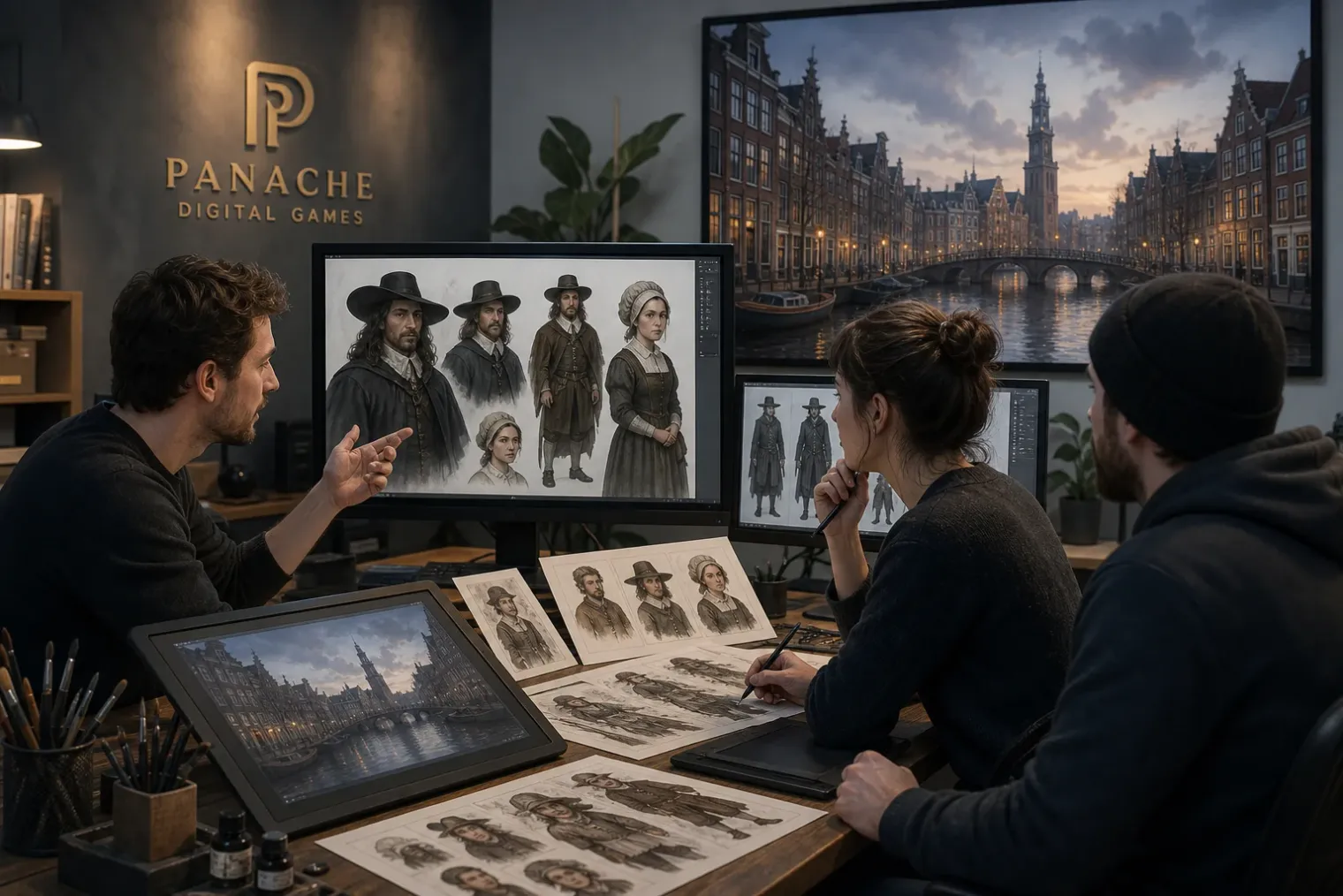
The dispute around 1666: Amsterdam began with an issue that was highly visible to prospective players: illustrations in the game’s free Prologue and in promotional material that appeared to be generated with AI. After community members raised concerns, developer Panache Digital Games acknowledged on 9 June that some early versions of assets had reached the public release. The studio said these included in-game portraits and external marketing images, apologised for the oversight and promised human-made replacements.
The initial pledge was narrowly framed around what players would see. Panache said that its Early Access release and eventual full game would not contain AI-generated assets. That distinction mattered, because it separated the presence of public-facing images from the broader question of whether generative systems had contributed to the game’s development.
In August, studio head Patrice Désilets gave a more expansive account of the process. He said generative AI had been used during conception and pre-production, and described how rapid variations created by such tools could become normalised within a small team’s workflow. He also said the technology had now been removed from the project and would not be used again. Panache subsequently reiterated on Steam that content entering the game was being made by human hands.
Why the response did not immediately settle the issue
The studio’s latest position is clearer than its first statement: it is not only promising to replace particular assets, but says it is ending generative-AI use on 1666: Amsterdam altogether. Yet this clarification also explains why some players remained dissatisfied.
For critics, the central concern was never solely whether a final build would display a specific AI-generated portrait. It was that the project’s early public presentation contained material produced through a process the studio had not initially disclosed. A promise to swap those images addresses the immediate content problem, but cannot reverse the fact that they were used in the game’s introduction to its audience.
Désilets’ explanation added a second concern. If a team can lose track of which early visual material originated with generative tools, audiences may question how confidently a developer can audit a production pipeline afterwards. That is a governance problem as much as an aesthetic one. It concerns asset tracking, approval procedures, external contractors and the standard of review applied before marketing or a playable demo reaches the public.
The reaction therefore reflects a wider divide in games development. Some creators see generative systems as a fast way to test visual directions during early ideation, particularly where budgets and headcount are limited. Critics argue that concept-stage use still has consequences: it can shape the artistic direction of a project, obscure authorship and create commercial pressure to substitute automated output for commissioned work.
Disclosure is part of the commercial relationship
Digital storefront rules have made the question more practical. Steam requires developers to provide information about certain uses of generative AI, including pre-generated material that appears in a game and live-generated content. Those policies do not decide whether AI is artistically acceptable, but they establish a baseline expectation that buyers should have meaningful information about what they are purchasing.
For 1666: Amsterdam, the relevant issue is not simply whether an AI disclosure label appears on a store page at a particular moment. Panache’s own statements have established that AI-generated material made its way into the Prologue and marketing. Its subsequent commitments are consequently judged against a higher threshold: the studio must demonstrate that replacements are complete and that its new policy is applied consistently across future updates, trailers and promotional campaigns.
That is especially important for an Early Access game. Players are not merely buying a finished artefact; they are being asked to follow an evolving development process and, often, to provide feedback that helps shape it. Clear boundaries about tools and content become part of the trust required for that relationship.
A difficult test for a long-running project
1666: Amsterdam carries unusual expectations. It is led by Désilets, a prominent creative figure associated with the early Assassin’s Creed games, and the project has had a long and complicated route to release. Its August 25 Early Access launch therefore invited scrutiny beyond ordinary questions of performance, content and design.
The AI controversy risks distracting from the game itself, but it also highlights why visual authorship remains important in historical fantasy. 1666: Amsterdam’s appeal rests substantially on atmosphere: a stylised seventeenth-century setting, occult themes and character-driven storytelling. In such a project, illustrative assets are not peripheral decoration. They help establish credibility, mood and a distinctive identity.
Panache has now made a categorical commitment: prior generative-AI material was removed, new content will be human-made, and AI will no longer be used in the project. The practical measure of that commitment will be less the wording of further apologies than the consistency of the game’s future builds and marketing. For developers across the industry, the episode is a reminder that fast experimentation does not remove the need for traceable asset management, candid disclosure and a clear answer to a basic question from players: who made the work they are being asked to value?
Sources
- 1666: Amsterdam Developer Drops Gen-AI Art After Community Backlash — TechPowerUp
- A number of people have raised questions or concerns to us about whether assets in our marketing and game use generative AI. — Panache Digital Games / Steam Community
- With gen AI assets cut from Assassin's Creed creator's new game demo, lead admits the team did not realise it was AI anymore — GamesRadar+
- Steamworks Content Survey documentation — Valve


