
A widening but unevenly understood incident
Cyberattacks reported at municipal water systems in the United States have prompted a renewed federal warning about the security of the technology used to operate wells, pumps and treatment equipment. The incidents have been described as affecting water utilities in at least seven states, although public detail remains incomplete and authorities have not released a comprehensive list of affected systems.
Minnesota has provided the clearest account. State officials said that more than 30 water systems were targeted in late July, principally through technology used to remotely monitor and control equipment. The scale of targeting did not mean that every utility lost service or that drinking water was unsafe. In several cases, local operators isolated affected systems, restored communications or moved to manual processes.
Michigan subsequently reported activity at nine water systems consistent with the federal warning. State officials said the systems continued to operate safely and that there were no known public-health impacts. These distinctions matter: an intrusion into operational technology can be serious even when it does not result in contamination, a service outage or physical damage. Equally, the fact that a system was targeted should not be taken as evidence that an attacker obtained sustained control of treatment processes.
The Federal Bureau of Investigation is investigating. While public reporting and the timing of the events have focused attention on Iran, the bureau has not publicly identified a culprit. The most accurate description at this stage is therefore that the incidents are under investigation amid an established and active federal warning about Iranian-affiliated activity against industrial control systems.
Why water systems are an attractive target
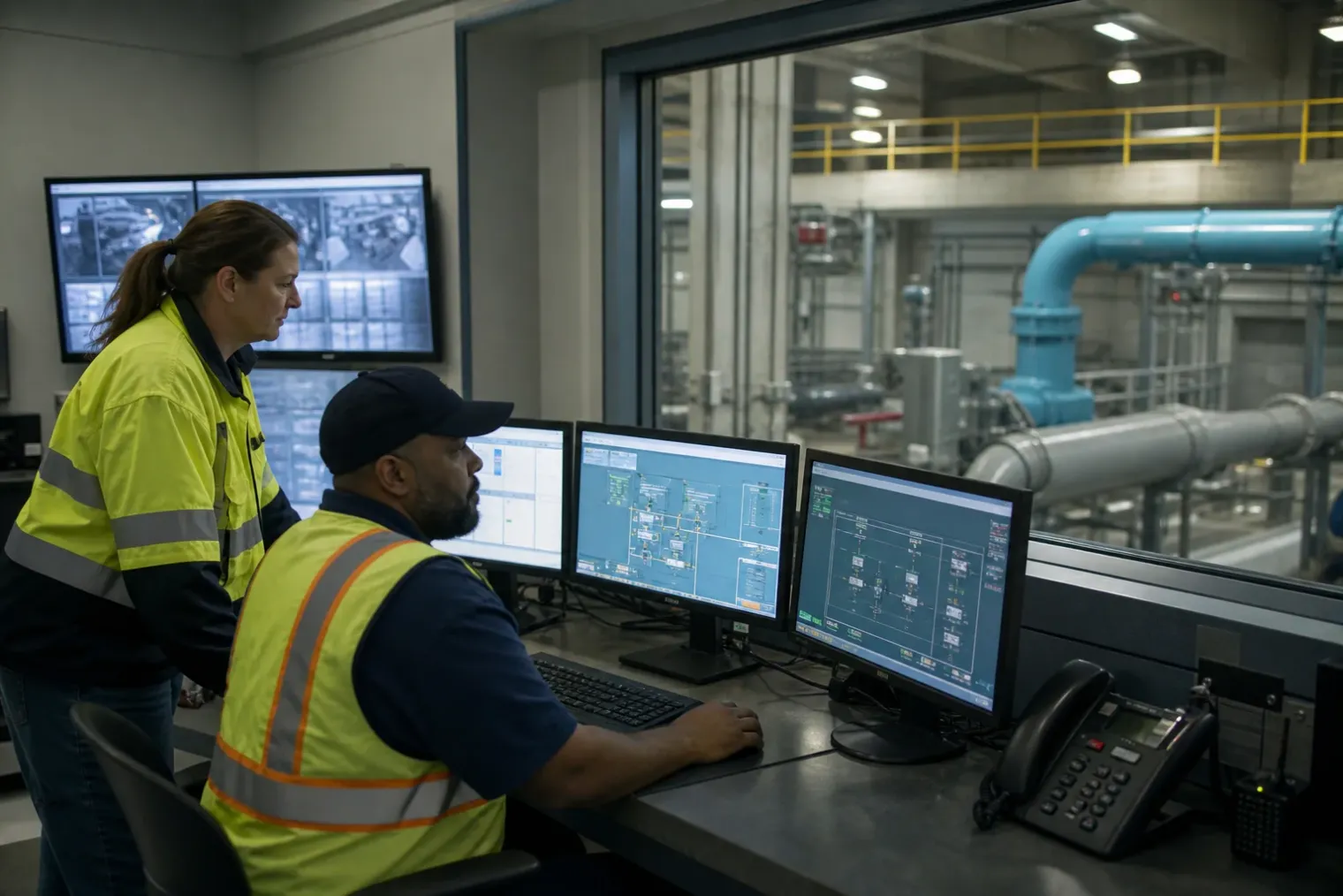
Water and wastewater utilities depend on a mix of physical processes and digital controls. Programmable logic controllers, sensors, human-machine interfaces and remote-access tools allow operators to manage pressure, pumping, chemical treatment and alarms across distributed facilities. These systems can make operations safer and more efficient, but internet exposure, weak authentication, unsupported software or poorly segmented networks can turn convenience into a route for disruption.
A successful compromise does not necessarily give an attacker the ability to alter water chemistry or immediately harm customers. Utilities normally use multiple safeguards, including physical instrumentation, operator oversight, laboratory testing and manual controls. But an attacker who can interfere with the information presented to an operator, erase configurations, disable an interface or interrupt communications can force a plant into a slower and more expensive operating mode. In a small utility with limited staffing, even a short interruption can consume scarce technical capacity.
The risk is also broader than the water plant itself. Water services are closely connected to hospitals, emergency response, housing, food production and industry. That makes visible disruption valuable to adversaries seeking coercive effect or public anxiety, even if the technical intrusion is relatively unsophisticated. Federal agencies have said recent Iranian-affiliated exploitation in several critical-infrastructure sectors has included configuration wiping, tampering with software-based mechanical sensor functions and disruption of operator interfaces.
The Iran link and the attribution threshold
The current concern is grounded in more than timing. In April, the FBI, CISA, NSA, EPA and other US partners warned of an urgent Iranian-affiliated threat targeting internet-facing operational technology in water, wastewater, energy and government facilities. The advisory described exploitation and, in some cases, operational disruption and financial loss.
That warning built on the documented history of the group known as CyberAv3ngers, which US agencies have assessed as affiliated with Iran’s Islamic Revolutionary Guard Corps. In 2023, the group targeted publicly exposed Unitronics controllers, including devices used by US water and wastewater facilities. The campaign commonly exploited default passwords, altered device names and displayed political messages. Its immediate effects were limited in many cases, but it demonstrated how a comparatively simple weakness in an internet-exposed controller could interrupt operations.
Historical association, however, is not final proof for a new incident. Attribution requires investigators to assess technical evidence, infrastructure used by attackers, malware, operational patterns, intelligence reporting and the possibility of deliberate impersonation. This is particularly important during international conflict, when false claims and opportunistic attacks can create confusion. Public discussion should distinguish between a federal assessment of an ongoing Iranian-linked threat and a confirmed attribution for each individual utility incident.
Resilience depends on practical controls
The recent cases underline that cyber resilience in water operations is not solely a matter of buying new security products. It begins with reducing unnecessary exposure: industrial controllers and interfaces should not be directly reachable from the public internet, default credentials should be removed, remote access should be tightly controlled and multifactor authentication should be used wherever feasible.
Utilities also need clear separation between business networks and operational technology. A phishing compromise of an office account should not provide an easy route to treatment controls. Asset inventories, timely patching based on operational risk, secure backups of controller configurations and logging that can be reviewed after an alert are fundamental. So are tested procedures for operating manually if remote systems become unavailable.
For smaller systems, the most important improvement may be preparation rather than advanced detection. Operators need to know whom to call, how to isolate affected equipment without jeopardising treatment, where to find clean configuration backups and how to communicate with state authorities and customers. Federal agencies have stressed that many valuable improvements are procedural and do not require major hardware investments.
A warning, not evidence of a nationwide water crisis
The incidents should be treated as a serious security warning, but they do not establish that the United States is facing a nationwide loss of safe water. The publicly confirmed examples show that local safeguards and operator intervention can limit consequences. Minnesota reported no active request for residents to change water use, while Michigan said its affected systems remained safe.
The more durable lesson is that water-sector cyber risk is no longer hypothetical or confined to large utilities. Attackers can look for exposed equipment at small, geographically dispersed facilities, where budgets and specialist staff may be limited. Maintaining safe drinking water increasingly depends on pairing traditional engineering safeguards with disciplined cybersecurity, rapid information-sharing and the capacity to continue operating when digital systems fail.
Sources
- Security News This Week: 7 States’ Water Systems Hit by Cyberattacks Likely Tied to Iran — WIRED
- FBI investigates as Michigan joins Minnesota in reporting cyberattacks on its water systems — Associated Press
- EPA, FBI, CISA, NSA Issue Joint Cybersecurity Advisory to Water System Regarding Iranian-Affiliated Cyber Attacks — US Environmental Protection Agency
- IRGC-Affiliated Cyber Actors Exploit PLCs in Multiple Sectors, Including US Water and Wastewater Systems Facilities — Cybersecurity and Infrastructure Security Agency
- Baseline Information on Malevolent Acts for Community Water Systems — US Environmental Protection Agency


