
A near-simultaneous result
Two papers posted to the arXiv preprint server on July 23 describe effectively the same advance in unclonable encryption, a specialised form of quantum cryptography. One was authored by MIT doctoral student Seyoon Ragavan; the other by Prabhanjan Ananth of the University of California, Santa Barbara, and Amit Sahai of UCLA. The submissions were made three hours and 18 minutes apart.
The coincidence is notable because both teams had pursued the same open problem after hearing it discussed earlier in July, and both used OpenAI’s GPT-5.6 Sol Ultra model. The researchers worked separately, however, and used substantially different workflows. Ragavan conducted an extended, iterative conversation with the model, checking progress and steering it toward simpler proof techniques. Ananth and Sahai used a customised research harness intended to generate, test and critique candidate approaches.
The result should not be read as two wholly unrelated discoveries that happened to converge. Both groups started from the same question, had access to the same model family and worked in a rapidly moving area with an existing body of relevant literature. Yet the outcome is still an unusually clear illustration of how powerful research tools can compress the time between an open question being identified and a plausible solution appearing.
What unclonable encryption is meant to do
Conventional ciphertext can be copied perfectly. If an attacker obtains an encrypted file, they can duplicate it indefinitely and wait for a key to become available. Quantum information changes that premise: unknown quantum states cannot in general be copied exactly. Unclonable encryption attempts to use this property to encrypt a classical message in a quantum state that cannot be split into two separately useful copies.
The usual security scenario is deliberately demanding. An adversary receives the quantum ciphertext and may process it before the secret key is disclosed. The adversary then divides what remains between two isolated recipients. After the key is revealed, the scheme is secure if both recipients cannot recover the original message with a probability meaningfully better than a trivial strategy.
This is not merely an abstract variation on ordinary encryption. It addresses a form of temporal access control: information might be usable once, or by one party, without leaving a reliably reproducible artefact for multiple future recipients. Such properties could matter in theoretical designs for quantum money, authentication and digital rights systems. Practical deployment remains distant, because the schemes require quantum states to be created, preserved and measured reliably.
Earlier work established important versions of unclonable encryption, but researchers sought an efficient construction in the ordinary, or “plain”, model with strong information-theoretic security. That formulation avoids relying on an idealised oracle and seeks security even against an adversary with unlimited computational power.
A simple construction with a difficult proof
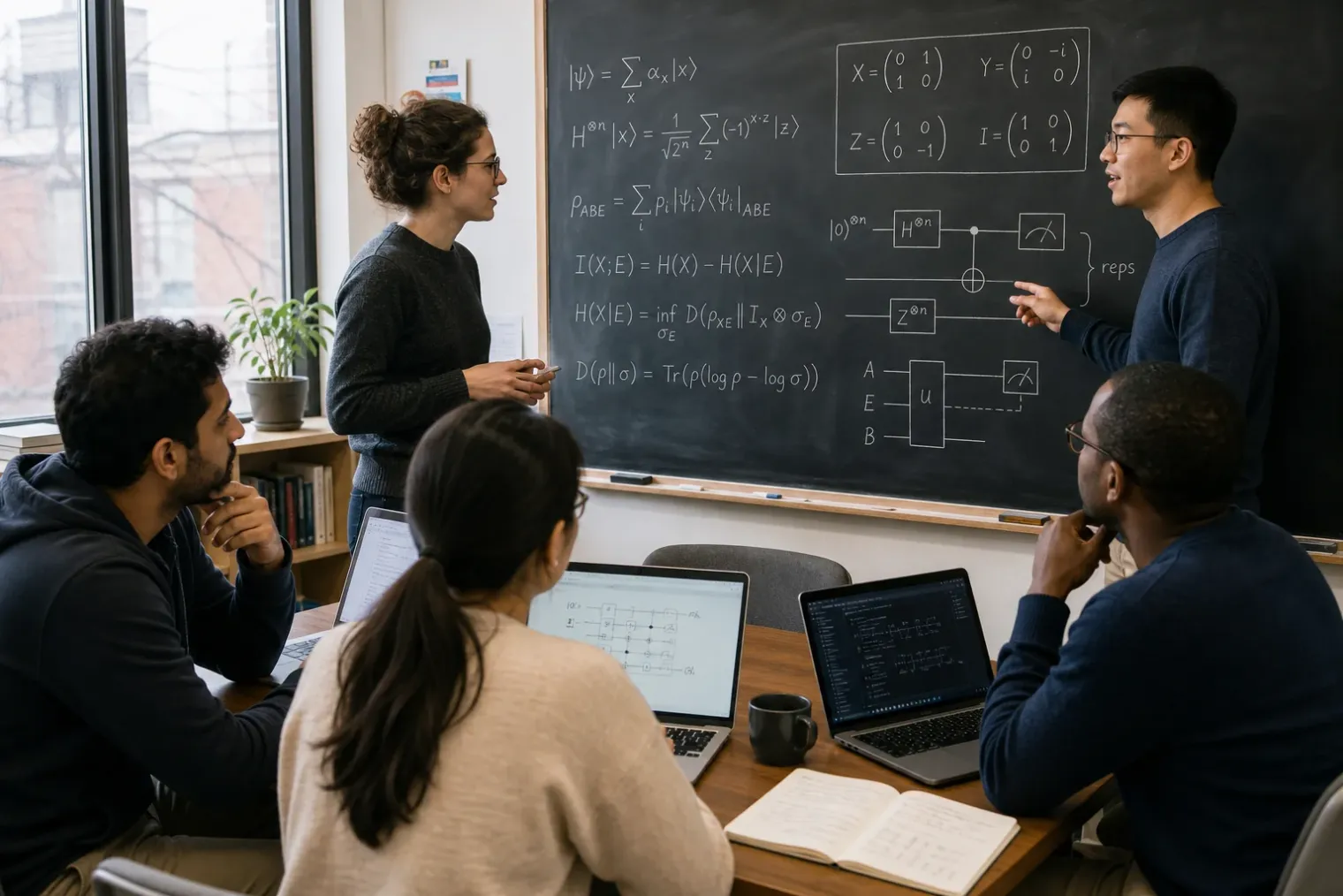
The two new papers centre on a construction based on Pauli operators, fundamental transformations used to describe qubits. A secret key selects a non-identity Pauli operator across several qubits. To encrypt a bit, the sender prepares an eigenstate whose sign encodes the bit. A legitimate recipient who later learns the key can measure the relevant qubits and recover the message.
The conceptual simplicity of the construction does not make its security automatic. The hard question is whether an attacker can manipulate the ciphertext before the key is known so that two separated recipients can later both decrypt successfully.
Both papers report an exponentially diminishing advantage above the baseline one-half probability for a one-bit message as the number of qubits rises. They also describe encryption and decryption using operations that scale linearly with the number of qubits. Ragavan’s paper additionally sets out how the one-time result can be extended, under computational assumptions, to larger messages and repeated use.
The papers differ primarily in their proofs. Ananth and Sahai derive their bound through an operator analysis involving the orthogonality of Pauli operators. Ragavan’s proof instead emphasises the balance between Pauli operators that commute and those that anticommute. Ragavan’s revised manuscript explicitly describes the results as concurrent and independent, calling the construction and main result essentially identical while identifying a substantive difference in one supporting lemma.
That distinction matters. In mathematics and theoretical computer science, a result and its proof are inseparable but not identical intellectual products. Independent proofs can improve confidence, offer techniques that transfer to later work, and reveal which aspects of a result are fundamental rather than artefacts of one argument.
AI contribution, human responsibility
The authors are unusually direct about AI involvement. Ragavan writes that the model found the proof during an extended conversation and drafted a preliminary paper, while stating that he remains accountable for the work. Ananth and Sahai say that the system generated the construction and main proof ideas, and that the human authors refined and carefully verified the claims.
These disclosures offer a more useful description than treating AI as either a passive writing aid or an autonomous researcher. In both cases, humans selected the problem, supplied research direction, judged candidate lines of reasoning, checked the resulting claims and prepared the scholarly presentation. The model nevertheless appears to have made a material contribution to the central technical work.
Ragavan’s paper also reports a formal verification effort using Lean, a proof-assistant language. The released formalisation covers the paper’s principal correctness and security claims, though not every efficiency statement or the later extension to many-time security. Formal verification is not a substitute for peer review, but it provides a machine-checkable layer of scrutiny for precisely specified mathematical arguments.
Why the episode matters beyond cryptography
Neither preprint has yet been peer reviewed, and the claims will require examination by specialists. That caution is especially important when an AI system has helped produce a proof: persuasive prose or a plausible sequence of equations is not evidence of validity. The relevant standard remains whether the argument survives independent checking.
Still, the episode points to a likely change in research practice. When the same widely accessible system can explore an open question for multiple groups, simultaneous or near-simultaneous discoveries may become more common. Priority disputes may become harder to frame around who first had an idea, particularly when a shared model proposes similar approaches from common public prompts and literature.
The more immediate challenge is organisational. Researchers will need clearer records of prompts, model settings, intermediate outputs and human interventions. Journals and conferences may also need norms that distinguish authorship, accountability, software assistance and reproducibility without obscuring the actual research process.
For now, the most defensible conclusion is narrower than claims of automated science. AI has helped researchers rapidly generate and develop a serious candidate solution to a hard cryptographic problem. The value of that solution will ultimately be determined not by the speed of its production, but by verification, replication and the technical work it enables next.
Sources
- AI helped produce two proofs for the same cryptography problem — Scientific American
- Efficient Unclonable Encryption from Pauli Eigenstates — arXiv
- Unconditional Unclonable Encryption — arXiv
- GPT-5.6: Frontier intelligence that scales with your ambition — OpenAI
- Uncloneable Quantum Encryption via Oracles — arXiv


