
A flagship designed for the rack
AMD introduced the Instinct MI455X as the leading accelerator in its MI400 family on 23 July 2026, positioning it for frontier-model training, fine-tuning and inference. The headline figures are substantial: AMD lists 320 billion transistors, 432GB of HBM4 memory and up to 23.3TB/s of peak theoretical memory bandwidth per GPU.
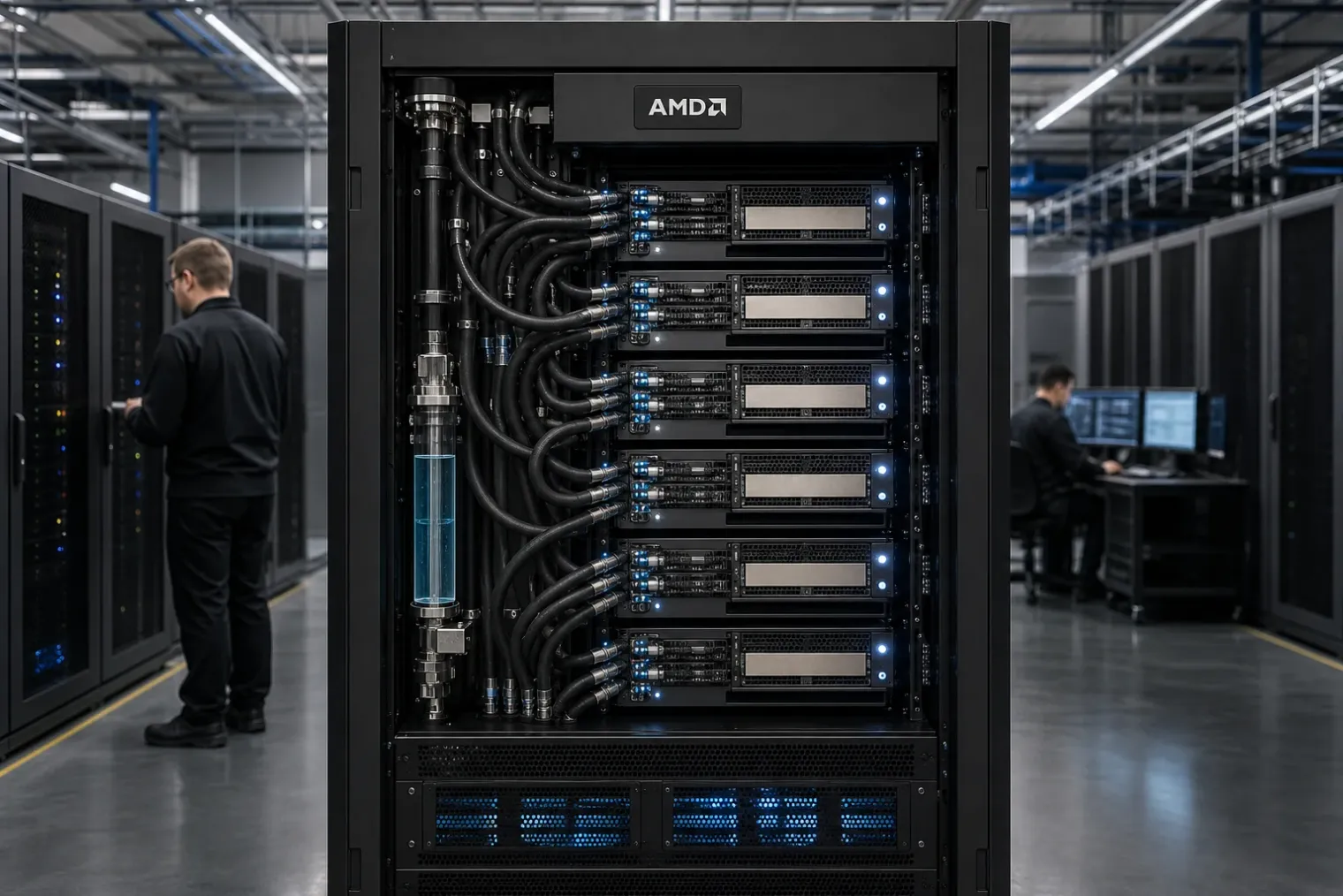
Those numbers should not be interpreted as a conventional graphics-card launch. The MI455X is a data-centre accelerator intended for direct liquid cooling and deployment in AMD’s Helios rack-scale platform. Rather than selling performance as the outcome of one processor in isolation, AMD is presenting the device as the building block of a closely integrated system containing compute, memory, interconnect, networking and software.
That distinction matters. The immediate challenge in advanced AI is often not simply calculating more operations. Large models need extensive memory capacity for parameters, temporary data and inference state, while groups of accelerators must exchange information quickly enough to avoid spending too much time waiting for data. AMD’s specification choices address those constraints directly.
Memory capacity is the central claim
The 432GB HBM4 allocation is the most consequential MI455X feature. High-bandwidth memory sits close to the compute die and is designed to move data at far higher rates than conventional server memory. Its capacity can influence how a model is partitioned across accelerators, how much context an inference service can retain and how many requests a system can process concurrently.
A larger memory pool does not mean every model will fit on one accelerator, nor does it remove the need for efficient software. Modern frontier models generally span many processors, especially during training. But more memory per device can reduce the number of partitions needed for a given workload. That can simplify execution and lessen some communication overheads.
AMD says the MI455X delivers up to 23.3TB/s of memory bandwidth. Capacity and bandwidth serve different purposes: capacity determines how much data can be stored close to the processor, while bandwidth determines how quickly the processor can access it. AI infrastructure needs both. A system with ample capacity but inadequate bandwidth can still leave compute units underutilised, particularly in inference workloads that repeatedly read model weights and cache data.
The move to HBM4 also illustrates how dependent accelerator roadmaps have become on advanced memory packaging and supply. The economics, availability and operating characteristics of HBM will therefore be significant factors in the MI455X’s commercial adoption, alongside the processor’s stated computational throughput.
A 320-billion-transistor package
AMD’s 320-billion-transistor figure reflects an advanced multi-die package rather than a single monolithic piece of silicon. The MI455X combines components manufactured on 2nm and 3nm-class processes, along with memory stacks and packaging technologies that connect those elements at high bandwidth.
The transistor count is notable as an indication of system complexity, but it is not an independent measure of useful AI performance. Transistors are spent on many functions, including compute resources, cache, interfaces, control logic and interconnects. Workload results will depend on software support, numerical format, memory access patterns, communication behaviour and the balance between computation and data movement.
AMD specifies up to 40.3 petaFLOPS for FP4 tensor operations and up to 20.1 petaFLOPS for FP8 and FP6 tensor operations. Such low-precision formats are increasingly important in AI because they can provide higher throughput and lower memory use when models and training methods can preserve accuracy with reduced precision. They are not interchangeable measures of performance for all applications. Scientific computing and other accuracy-sensitive tasks may need higher-precision formats, which is one reason AMD also offers a separate MI430X variant aimed at high-performance computing.
Helios turns the accelerator into a system proposition
The MI455X is intended to scale through AMD Helios, a platform built around repeatable four-GPU trays and configurations of up to 72 accelerators per rack. AMD says a full Helios rack can provide 31TB of HBM4 memory. The platform uses UALink-based scale-up connectivity, with AMD quoting up to 3.6TB/s of scale-up bandwidth per MI455X.
This approach is AMD’s answer to the way AI infrastructure is increasingly bought and deployed. Large customers are evaluating racks and clusters, not merely individual accelerators. They must consider power delivery, liquid cooling, networking, serviceability, software frameworks and the ability to keep thousands of processors working efficiently together.
It also means that AMD’s competitive case cannot rest solely on peak hardware specifications. The company must demonstrate that ROCm software, compilers, libraries, frameworks and operational tools deliver predictable performance on production workloads. Portability from CUDA-based environments, debugging, model support and long-term maintenance will all affect the practical cost of adoption.
Claims need independent workload evidence
AMD compares the MI455X favourably with Nvidia’s Vera Rubin platform in its own material, including comparisons of memory capacity, bandwidth and selected theoretical AI metrics. These are useful indicators of AMD’s intended market position, but they are vendor claims measured under stated assumptions. They should not be treated as a universal result across model architectures or deployment conditions.
Meaningful comparisons will require independently reproducible results across training and inference, including latency, throughput at different request loads, energy use, reliability and the cost of a complete system. Emerging endpoint-focused benchmarks may be particularly relevant because inference buyers increasingly care about time to first token, sustained token generation and service quality rather than a single peak-operation number.
AMD has already announced major planned deployments involving its MI450-series hardware, including a partnership with Anthropic that targets up to two gigawatts of AMD accelerators in Helios systems. The first gigawatt under that arrangement is scheduled to begin deployment in the first half of 2027. That gives the MI455X a potential route into large-scale installations, but it also underlines that the platform’s broad commercial impact will be determined over the next deployment cycle rather than on launch day.
What the specifications signal
The MI455X is AMD’s clearest statement that the contest for AI data centres has moved beyond a race for faster individual chips. Its defining features are memory-rich packaging, high-speed scale-up connectivity and a rack design that treats the accelerator as one component of a larger machine.
For buyers, the 432GB figure may be more consequential than the transistor headline: it offers a direct way to assess whether a system can accommodate large models and growing inference caches with fewer accelerators. For AMD, however, the harder task is converting strong hardware specifications into a mature, available and efficiently operated platform. The MI455X’s significance will ultimately be measured not by its component count, but by whether Helios systems can deliver competitive performance and economics at production scale.


