
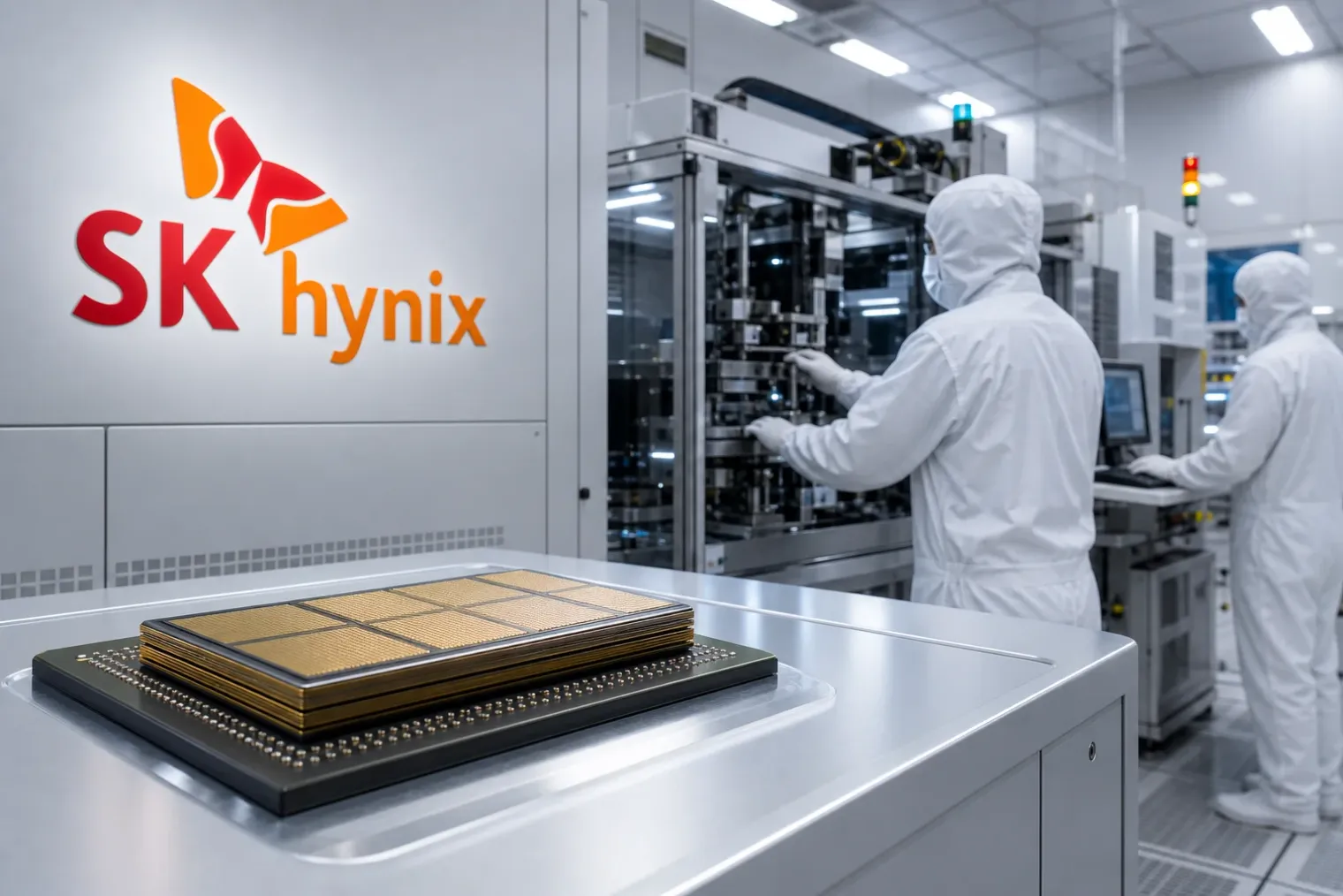
A long-range warning from a market leader
SK hynix chief executive Kwak Noh-jung has said the current shortage of memory semiconductors could continue through the end of 2030. The remarks were made in West Lafayette, Indiana, after the company’s groundbreaking ceremony for a new advanced-memory packaging facility.
The forecast should be understood as an assessment from one of the industry’s largest suppliers rather than a settled market consensus. Kwak acknowledged that no one can know precisely how long a shortage will last and that a downturn remains possible. His central argument is that the next memory cycle may not resemble previous booms and busts, because artificial-intelligence infrastructure requires more sophisticated and tightly integrated memory than conventional PCs and smartphones.
That distinction matters. A shortage in commodity DRAM can often be addressed over time by raising wafer output. The supply of high-bandwidth memory, or HBM, is constrained not only by DRAM production but also by chip stacking, advanced packaging, testing, yields and customer qualification. Expanding every part of that chain takes years.
Why AI has changed the memory equation
HBM places multiple memory dies in a vertical stack and links them closely to processors used for AI workloads. The approach supplies substantially more data bandwidth than conventional memory arrangements while helping manage power use. It has therefore become a critical component for the accelerators installed in large-scale AI training and inference systems.
The industry’s problem is not simply demand for a single premium product. Memory makers are allocating capital, engineering talent and manufacturing capacity towards HBM, while AI servers also require large quantities of conventional server DRAM and high-performance enterprise storage. As a result, investment in AI memory can tighten availability elsewhere in the market.
SK hynix itself has described a situation in which customer demand exceeds its supply capability. In its preliminary second-quarter 2026 results, the company reported revenue of KRW 79.3 trillion and operating profit of KRW 60.5 trillion, both records in its presentation. It also said it had started mass shipments of HBM4 during the quarter and was increasing long-term supply discussions with customers.
The financial results demonstrate why suppliers are treating the shift as structural. Higher-value memory and advanced packaging can be considerably more profitable than older commodity products. Yet strong profits do not translate immediately into abundant supply. New cleanrooms, equipment installations and packaging lines require large capital commitments and a lengthy ramp to reliable high-volume output.
Indiana illustrates the timing gap
The Indiana project is an example of the difference between an investment announcement and near-term supply relief. SK hynix plans to use the West Lafayette site for next-generation HBM packaging, testing and research and development. The company expects cleanroom operations to begin in the second half of 2028, with production planned for 2029.
The facility is strategically significant for the United States because it would add a domestic advanced-packaging step to an AI memory supply chain that is currently concentrated in Asia. Wafers are still expected to be manufactured in South Korea and sent to Indiana for packaging and testing. That means the site should improve proximity to US customers and shorten development feedback loops, but it will not independently solve the upstream constraint on advanced DRAM wafers.
SK hynix has also committed substantial investment in South Korean capacity, including plans extending through 2031. Its strategy is therefore to expand supply across fabrication and packaging, while avoiding the uncontrolled spending that historically contributed to sharp oversupply and price collapses in memory markets.
A forecast, not a guarantee
The case for a prolonged shortage rests on three assumptions: AI infrastructure spending remains elevated, HBM demand grows faster than qualified capacity, and suppliers retain capital discipline as they expand. Each assumption is plausible, but none is certain through 2030.
The most obvious risk to the forecast is a pullback in AI data-centre spending. A reduction in orders for accelerators or cloud capacity would lower demand for HBM and could release some pressure on conventional memory. Faster-than-expected yield improvements, successful entry by additional qualified suppliers, or major advances in memory efficiency could have a similar effect.
There is also a commercial reason to treat any supplier’s market outlook with caution. A long period of constrained supply supports pricing power and justifies investment in capacity. Still, the prediction is more nuanced than a claim of permanent scarcity: it reflects the difficulty of matching specialised memory supply to a new class of demand while the technology, packaging methods and customer designs continue to evolve.
What it could mean for hardware buyers
For the largest AI operators, the practical consequence is likely to be deeper use of multi-year supply agreements and closer collaboration with memory manufacturers. Secure access to qualified HBM may become a competitive differentiator, alongside access to advanced processors, power and data-centre space.
For server manufacturers, PC brands and smartphone companies, the effect depends on whether HBM investment continues to divert capacity from standard DRAM and NAND. If it does, higher component costs could persist and manufacturers may have less flexibility to increase memory or storage specifications without raising device prices.
Consumers should not assume that a forecast of a long HBM shortage means every retail memory module will be unavailable for four years. HBM, conventional DRAM and flash storage are related markets with different products, customers and supply constraints. But the direction of travel is clear: memory is no longer a low-profile component purchased late in hardware design. In the AI era, it has become a central constraint on system performance, cost and delivery schedules.
SK hynix’s 2030 warning is therefore best seen as a signal of the scale and duration of the infrastructure build-out now under way. Whether the shortage ultimately lasts that long will depend less on one company’s output than on how quickly the entire ecosystem can expand advanced manufacturing and packaging without outrunning demand.
Sources
- SK hynix CEO Says Memory Shortage Will Last Through 2030 — TechPowerUp
- SK hynix President Sees Memory Shortage Lasting Through 2030 — Seoul Economic Daily
- SK hynix Announces 2Q26 Financial Results — SK hynix Newsroom
- SK Hynix to start AI chip output in Indiana in 2029, sees memory shortage through 2030 — Reuters via Investing.com
- 2026 Market Outlook – Focus on the HBM-Led Memory Supercycle — SK hynix Newsroom


