
An official connection, not a product launch
Intel has provided its clearest public indication yet that its future Nova Lake-S desktop processors will use the LGA1954 socket. A page in the company’s Design-In Tools store is titled “ILM Kit for the LGA1954 NVL-S Interposer for the Gen5 VR Test Tool”, directly placing the socket designation beside NVL-S, the abbreviation widely used for the desktop Nova Lake platform.
That matters because earlier reports connecting Nova Lake-S to LGA1954 relied on shipping records, component listings and industry leaks. Those sources were useful indicators of platform development, but they did not establish that Intel itself used both names together. The engineering listing does.
It is nevertheless a narrow confirmation. The item is validation equipment rather than a retail processor, motherboard or chipset announcement. Intel has not used the listing to publish the processors’ names, specifications, release date, chipset family, memory support or compatible cooling hardware. It should therefore be read as confirmation of a platform association, not as confirmation of the broader set of specifications circulating ahead of launch.
What the listing describes
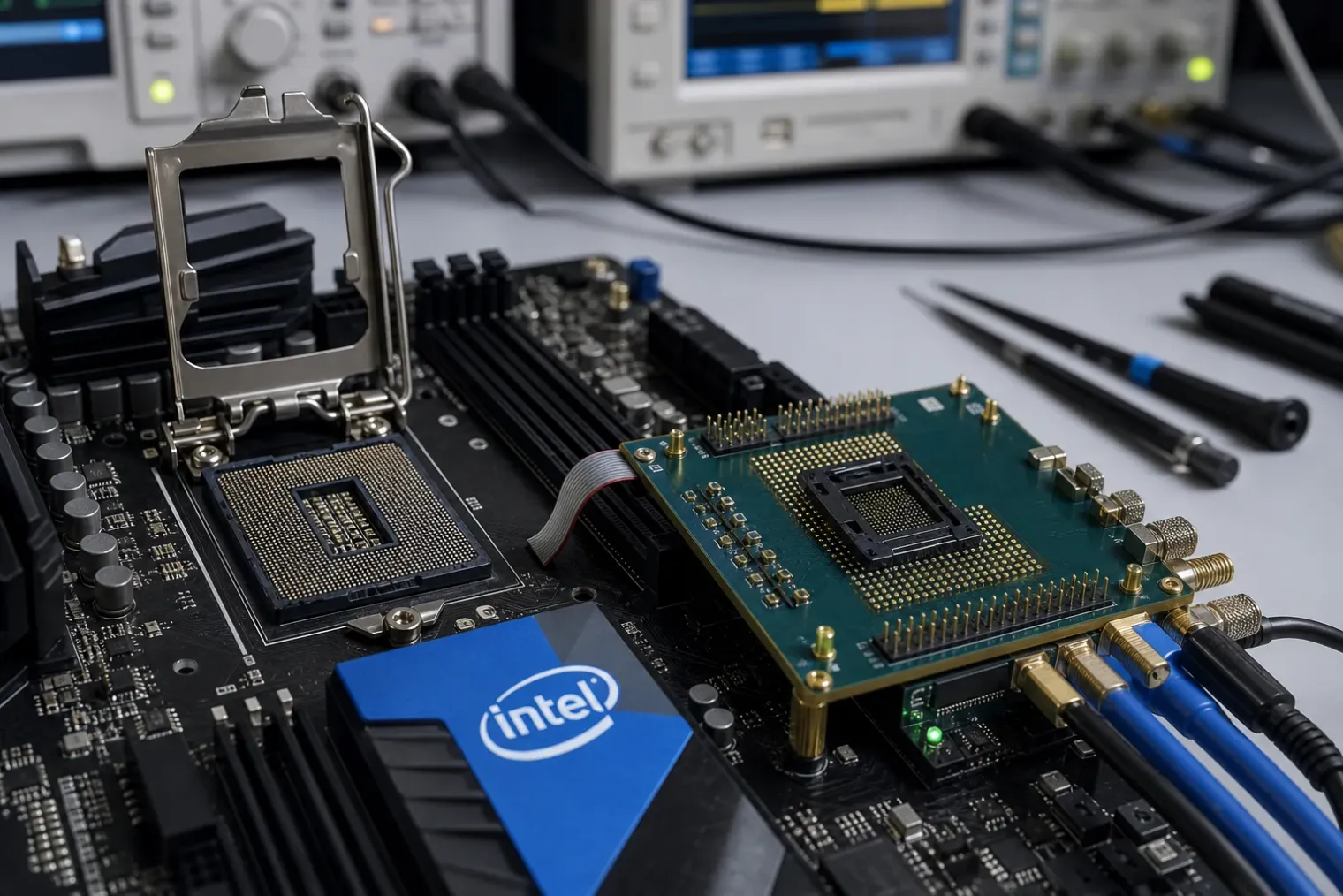
The product name identifies an ILM kit and an interposer for a fifth-generation voltage-regulator test tool. An independent loading mechanism, or ILM, is the metal retention assembly that secures a land-grid-array processor in a motherboard socket. An interposer is a specialised intermediary board or fixture used to access or measure platform signals during development and validation.
In practical terms, this is equipment for motherboard and power-delivery engineering, not a component intended for a conventional desktop build. Its appearance is significant precisely because platform-validation tools must be matched to the mechanical and electrical requirements of the socket they are designed to test.
The listing also suggests that Nova Lake-S platform work has reached a stage at which Intel and its partners require formal tooling for voltage-regulator validation. That is a normal part of preparing a new desktop ecosystem, but it offers no reliable basis for estimating performance, power draw or availability. Engineering tools often appear well before final products, and designs can still change during qualification.
A new motherboard will be required
LGA1954 is distinct from LGA1851, the socket used by Intel’s current Core Ultra 200S desktop processors. Intel’s own documentation identifies the 200S line as LGA1851, and the company has previously stressed that a new socket can remain physically similar to its predecessor while still being electrically incompatible.
The consequence for prospective Nova Lake-S buyers is straightforward: an upgrade from an LGA1851 desktop system will require a motherboard built for LGA1954. A processor cannot be made compatible through a BIOS update when its package, socket contacts and platform wiring differ.
That does not automatically settle the question of cooler reuse. Mechanical retention dimensions, mounting-hole layouts and required mounting pressure are separate matters from electrical socket compatibility. Reports from the hardware supply chain have discussed possible LGA1954 cooling arrangements, including a two-lever loading mechanism on some boards, but Intel has not yet issued consumer-facing mechanical guidance. Owners planning a future upgrade should wait for motherboard and cooler manufacturers to publish explicit compatibility information.
Why the socket change is notable
A socket transition is routine when a processor generation needs different electrical connections, power delivery or I/O capabilities. It becomes commercially important because the motherboard is one of the largest costs in a desktop platform upgrade. A new socket normally also starts a new cycle of chipset, firmware and board design.
LGA1851 itself succeeded LGA1700 for Intel’s modern desktop Core Ultra range. Intel noted at the time that the two sockets shared physical dimensions but were not cross-compatible, illustrating why outwardly similar boards and coolers cannot be used to infer processor support. LGA1954 now indicates another clear platform boundary after the LGA1851 generation.
For consumers, the immediate implication is not that an LGA1954 board should be purchased early. No retail Nova Lake-S CPUs or final board specifications have been announced. Rather, the confirmation helps buyers make a more informed distinction between an upgrade to an existing LGA1851 system and a decision to wait for Intel’s next desktop platform.
Rumours remain separate from confirmed facts
The confirmation should also bring greater discipline to discussion of Nova Lake-S. Several claims have been attached to the platform, including potential core counts, 900-series chipset names, longer-than-usual socket support and specific retention mechanisms. Some may prove correct, but they are not validated by the Design-In Tools entry.
In particular, the appearance of an LGA1954 validation kit does not establish:
- the number or configuration of retail processors;
- final CPU performance, power limits or pricing;
- motherboard model names or chipset capabilities;
- support for future processor families beyond Nova Lake-S;
- retail launch timing; or
- backward compatibility for coolers or other accessories.
There is a meaningful difference between Intel recognising LGA1954 and NVL-S in internal-facing tooling and Intel publishing a complete platform specification. The first has now occurred; the second has not.
What to watch next
The most useful next evidence will come from formal product materials: processor announcements, motherboard manuals, chipset documentation and cooling compatibility lists from manufacturers. Those sources should clarify the platform’s I/O configuration, memory requirements, power-delivery expectations and mechanical design.
For now, Intel’s listing resolves one important uncertainty. Nova Lake-S is associated with LGA1954 in an Intel-operated engineering resource, rather than only in third-party reporting. That makes the prospect of a new Intel desktop motherboard generation substantially more concrete, while leaving the central questions of capability, cost and timing unanswered.


