
A meaningful confirmation, delivered quietly
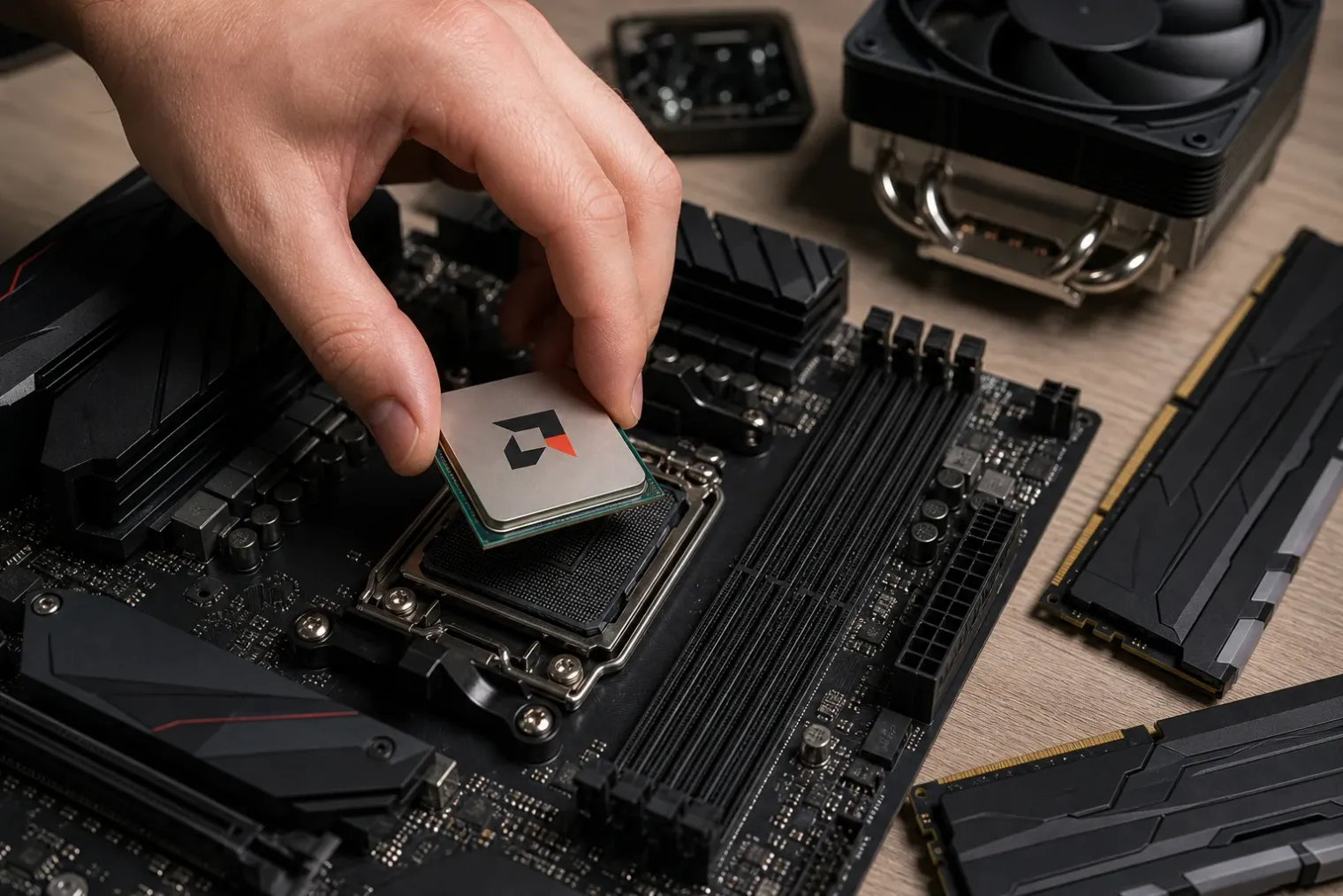
AMD has supplied a more concrete sign that its next desktop processor generation will retain Socket AM5. Entries found in the company’s Technical Information Portal associate the codename Olympic Ridge with AM5, while related entries identify Medusa1 as supporting both AM5 and the mobile-oriented FP10 package. The Olympic Ridge association is the key development for desktop builders: it connects an upcoming Zen 6 client family to AMD’s existing desktop socket.
This is a confirmation of platform direction rather than a conventional product announcement. AMD has not published a launch presentation for Olympic Ridge, announced a retail Ryzen name, listed processor models, or given performance, pricing, power or availability details. Nevertheless, a company technical database that maps processor families to platforms is stronger evidence than the earlier chain of industry reports, software-detection updates and supply-chain speculation.
The finding also gives practical substance to AMD’s broader commitment, made at Computex in May 2026, to support AM5 through 2029. At that time, the company promised a longer upgrade runway but did not publicly name the future desktop families that would use the socket. Olympic Ridge now appears to be one of them.
What AM5 support actually means
For current AM5 owners, the news points to the possibility of a processor-only upgrade rather than a replacement of the motherboard, memory and cooling platform. AM5 introduced DDR5 memory to AMD’s mainstream desktop range and is used by Ryzen 7000, 8000 and 9000 desktop families. Keeping the socket through another architecture can spread the initial cost of an AM5 build across more upgrade cycles.
That benefit should not be interpreted as a universal compatibility promise for every board already in service. A shared socket establishes the physical and electrical platform baseline, but a motherboard must still receive firmware that recognises and configures a new processor. AMD’s own support guidance notes that a BIOS update may be required for a motherboard to boot with a newer Ryzen processor.
The ultimate position will therefore vary by model and manufacturer. Board vendors will need to publish CPU-support lists and compatible BIOS versions; users of older boards will need to check both before purchasing a future chip. Firmware storage capacity, power-delivery design, memory validation and vendor support policies can all affect how smooth an upgrade becomes. A lower-cost board may support an Olympic Ridge processor, for example, without necessarily being the most suitable match for its highest-power variants.
The sensible conclusion today is that AM5 owners have received a stronger indication of upgrade potential, not a guarantee that every existing board will support every future CPU.
Why the timing matters
AMD launched AM5 alongside Zen 4 desktop processors in 2022, replacing the long-lived AM4 platform. AM4 became a significant part of AMD’s desktop proposition because it accommodated several processor generations and gave users a comparatively clear upgrade route. The company is applying a similar message to AM5: platform continuity is intended to be part of the value of the wider PC build, not merely an incidental technical detail.
That matters most in the enthusiast and mainstream DIY markets, where changing CPU sockets can force purchases beyond the processor itself. A socket transition can require a new motherboard and, depending on the platform, new memory and a revised cooling arrangement. AM5’s use of DDR5 means users that remain on the platform avoid a further memory-standard transition in the near term.
There is also a competitive dimension. Desktop CPU performance remains important, but platform longevity can shape buying decisions well before a user intends to upgrade. A buyer choosing an AM5 motherboard now is being offered a longer prospective path to later processors than was explicitly documented only a few months ago.
Still, a long socket lifecycle involves trade-offs. Retaining compatibility can constrain changes to input/output design, memory standards and power requirements that might be easier to introduce with a new socket. AMD’s decision suggests that it sees sufficient scope to advance its client processor designs within AM5 while preserving the installed base’s upgrade value.
Olympic Ridge remains largely undefined
The new documentation should not be used to fill in a product specification sheet. Olympic Ridge is a codename, and the AM5 entry establishes its intended platform association. It does not independently confirm a Ryzen series number, a manufacturing process, core counts, cache configurations, integrated graphics, AI hardware, PCIe capabilities or the existence of particular high-end gaming models.
Reports before the documentation appeared had linked Olympic Ridge to Zen 6 desktop processors, including suggestions of higher core counts and future cache-enhanced variants. Those details remain unannounced. Similarly, reports of a 2027 arrival may prove directionally plausible, but AMD has not provided an official consumer launch date. The distinction matters because internal codenames and platform references often surface well before final commercial products, and product plans can change.
Medusa1’s appearance alongside Olympic Ridge should also be treated carefully. Its listing for AM5 and FP10 indicates that AMD may use a related family across more than one client implementation. It does not, by itself, establish how a socketed Medusa1 product would be positioned, or whether it would be sold broadly at retail. Olympic Ridge is the clearer signal for the conventional desktop Ryzen line because its documentation association is exclusively with AM5.
What buyers should do now
For people planning a new PC, this development strengthens the case for choosing AM5 where AMD’s present processors meet the required performance and budget. It should not, however, turn a future, unpriced processor into the main reason to delay or accelerate a purchase. Hardware should be selected for the workloads and software available today, with the potential upgrade path treated as additional value.
Existing AM5 users have little reason to act immediately. The useful steps are straightforward:
- keep a record of the exact motherboard model and installed BIOS version;
- use stable firmware releases and follow the board maker’s upgrade guidance;
- wait for official processor support lists before assuming compatibility;
- assess cooling and power-delivery requirements once actual Olympic Ridge models are announced.
AMD has therefore moved the AM5 story forward, but not completed it. The documentation provides a credible platform-level confirmation that Olympic Ridge is planned for AM5, aligning with the company’s support-through-2029 commitment. The remaining questions — what the processors will be called, how they will perform, when they will arrive and which boards will support them — still require formal product announcements and vendor validation.
Sources
- AMD Confirms AM5 Compatibility with "Olympic Ridge" Desktop "Zen 6" — TechPowerUp
- AMD Computex 2026: 10 Years of AM4, AM5 Support Through 2029 and Expanded RDNA 4 Gaming — AMD
- BIOS Updates for AMD Ryzen Desktop Systems — AMD
- AMD confirms Zen 6 Medusa1 APUs and Olympic Ridge CPUs for AM5 socket — VideoCardz


