
A proposed acquisition, not yet a completed deal
AMD announced on August 6, 2026, that it had reached a definitive agreement to acquire Toronto-based Taalas, a developer of specialised AI inference silicon. The transaction remains subject to customary closing conditions and regulatory approvals, so it should be described as a proposed acquisition rather than a completed one. AMD did not disclose a purchase price or expected closing date.
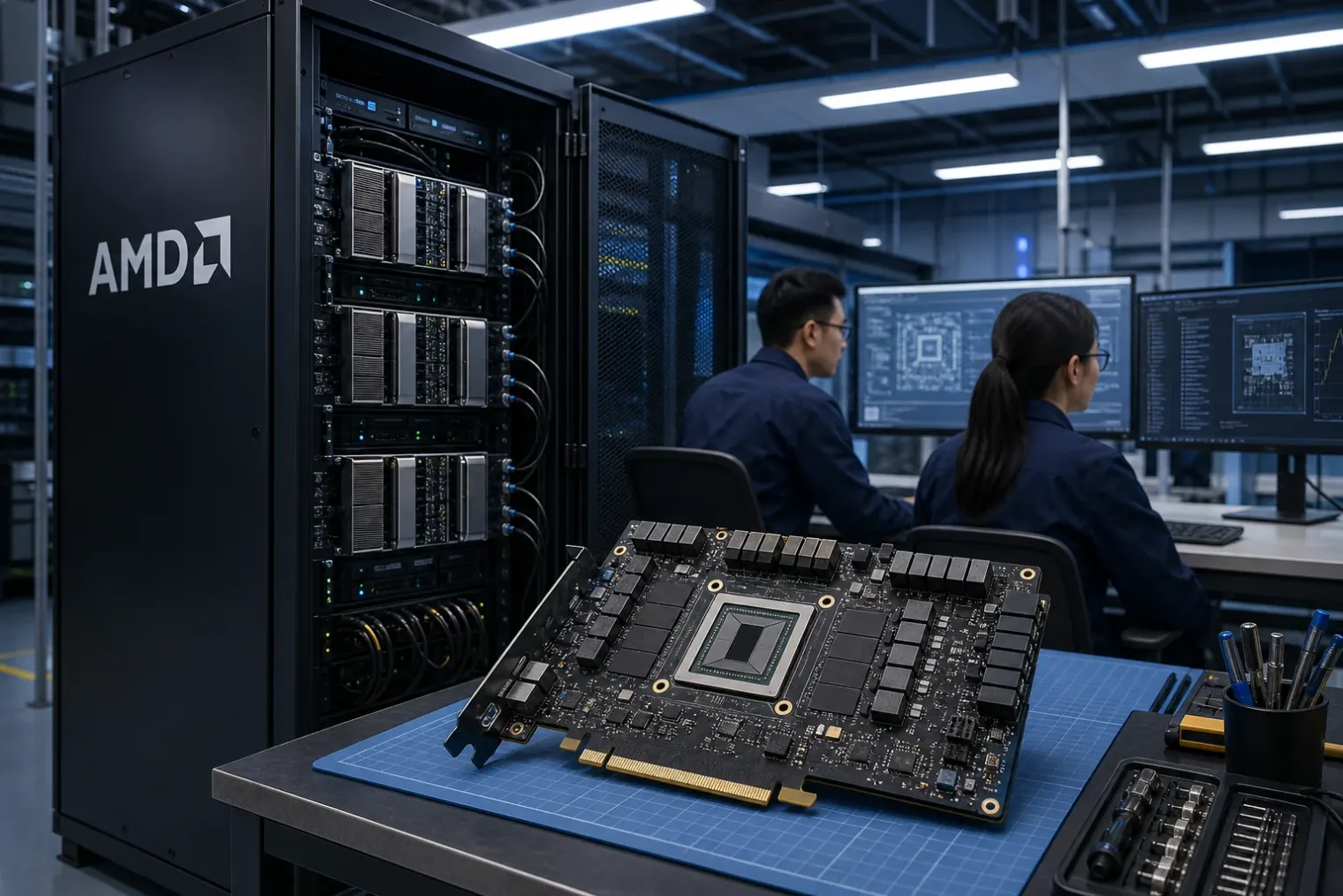
The strategic appeal is clear. AMD has been broadening its AI position across processors, data-centre GPUs, networking, rack-scale systems and software. Taalas offers a markedly different route to inference: instead of using programmable hardware to run a broad variety of models, it designs silicon around a particular model and its weights. AMD plans to incorporate that technology into its accelerator roadmap and develop system-level offerings alongside its Instinct GPUs.
This is not a conventional move to add another GPU product line. It is a wager that the economics of AI serving will increasingly reward extreme specialisation in workloads that are stable, high-volume and sensitive to latency or power consumption.
What “the model is the computer” means
Most large language models run on programmable accelerators. Their weights are stored in high-bandwidth memory and repeatedly moved through compute units as the system generates each token. This makes GPUs versatile: the same infrastructure can serve many models, change precision formats, support new software techniques and be reassigned as demand evolves. But moving data consumes time and energy, particularly in token-by-token generation.
Taalas seeks to remove much of that memory traffic by encoding the model architecture and weights directly into the chip’s physical design. Its first technology demonstrator, HC1, was designed around the Llama 3.1 8B model. The company says the approach stores the model in a mask-ROM-based fabric, paired with programmable SRAM for functions such as the key-value cache and some fine-tuning data.
The result is a chip with exceptionally little of the flexibility associated with a GPU. In exchange, it can be optimised for a known model and inference pattern. Taalas describes this approach as “Hardcore Models”: hardware in which the model is not merely loaded and executed, but embodied in the silicon.
That distinction explains both the acquisition’s promise and its limitations. A chip that is purpose-built for one model may be highly attractive where an organisation expects to use that model at massive scale for an extended period. It is much less attractive when model weights, architecture or customer requirements change quickly.
Interpreting the performance claims
Taalas has reported that HC1 can generate about 17,000 tokens per second per user on Llama 3.1 8B. Its comparison material places Nvidia Blackwell-generation hardware far below that level for the same narrowly defined workload, producing the headline claim that the system can be roughly 50 times faster.
Such figures are meaningful as evidence of what intense hardware-model co-design may achieve, but they are not a general comparison between Taalas and Nvidia’s Blackwell platform. HC1 is built for one relatively small, aggressively quantised model, while a Blackwell GPU is intended to train and run many models, handle changing workloads and operate across a far wider range of precisions, batch sizes and system configurations.
Taalas itself has acknowledged quality trade-offs in its first-generation silicon. The initial Llama implementation combines custom 3-bit and 6-bit parameters, which can create quality degradation relative to GPU benchmarks. The company has said a subsequent generation is intended to use standard 4-bit floating-point formats.
The correct commercial question is therefore not whether hardwired silicon universally supersedes GPUs. It is whether a model-specific design provides a sufficiently large saving in latency, power and total cost for applications where reduced flexibility is acceptable.
Why AMD may see a fit
AMD is pursuing an AI portfolio designed to span processors, GPUs, networking, software and rack-scale infrastructure. Its data-centre segment generated $5.775 billion in first-quarter 2026 revenue, up 57% year on year, underscoring both the scale of the opportunity and the capital available to pursue differentiated technologies.
Taalas can fill a gap within that strategy. AMD’s Instinct GPUs address flexible training and inference workloads, while CPUs coordinate broader data-centre tasks. Model-specific silicon could potentially serve a distinct layer: mature inference workloads where operators prioritise predictable output, rapid token generation and lower energy use over the ability to change models at will.
AMD has explicitly said it expects to combine Taalas technology with Instinct GPUs. That suggests a heterogeneous architecture rather than a replacement strategy. GPUs could remain responsible for training, experimentation, prompt processing, flexible models and workloads that change frequently. Taalas-derived components could be deployed for repetitive generation workloads once a model and use case become sufficiently settled.
The acquisition also brings a small, specialised engineering team to AMD. Taalas was founded in 2023 and developed its first demonstrator with a lean organisation. For AMD, the value may lie as much in the design automation and methodology required to turn a model into a chip rapidly as in HC1 itself.
The central execution challenge
The fundamental challenge is model churn. AI developers regularly release new versions, alter architectures, expand context windows, revise safety methods and improve reasoning capabilities. Hardware that takes a model as fixed input must keep pace with that cycle. Taalas has argued that it can adapt a design for a previously unseen model in about two months by changing only a limited number of mask layers, but that process still carries fabrication, verification, supply-chain and demand-forecasting risk.
The approach also becomes harder as models grow. HC1 fits an eight-billion-parameter model on one chip, but larger models would require multiple custom chips. Taalas has presented concepts for much bigger systems, yet their commercial viability will depend on manufacturing yields, packaging, interconnects, model stability and customer volumes.
AMD will need to decide where the technology belongs in its product roadmap, how much customisation it can economically support, and whether customers will commit to model-specific infrastructure for long enough to justify it. Integration into a company that sells broadly programmable compute may also test whether Taalas can retain the focus that made its approach distinctive.
A targeted challenge to inference economics
The acquisition does not settle the contest between general-purpose AI accelerators and custom silicon. It instead acknowledges that inference is becoming diverse enough for both approaches to coexist. Training frontier models and serving rapidly changing services still favour flexible systems. But a mature model used millions of times a day for a well-defined task may justify hardware built around its exact structure.
For AMD, Taalas offers a potential way to compete on a dimension beyond raw GPU scale: making specific AI workloads economically different. If the company can turn the startup’s demonstration into reliable, updateable and commercially deployable products, it could establish a specialised inference tier alongside its broader data-centre platform. The larger significance of the deal will depend not on the striking benchmark headline, but on whether customers accept the trade between flexibility and efficiency.
Sources
- AMD Acquires Taalas to Advance Compute Solutions for Rapidly Growing AI Inference Market — AMD Investor Relations
- The Path to Ubiquitous AI — Taalas
- Taalas Specializes to Extremes for Extraordinary Token Speed — EE Times
- AMD Financial Results First Quarter 2026 — AMD Investor Relations


