
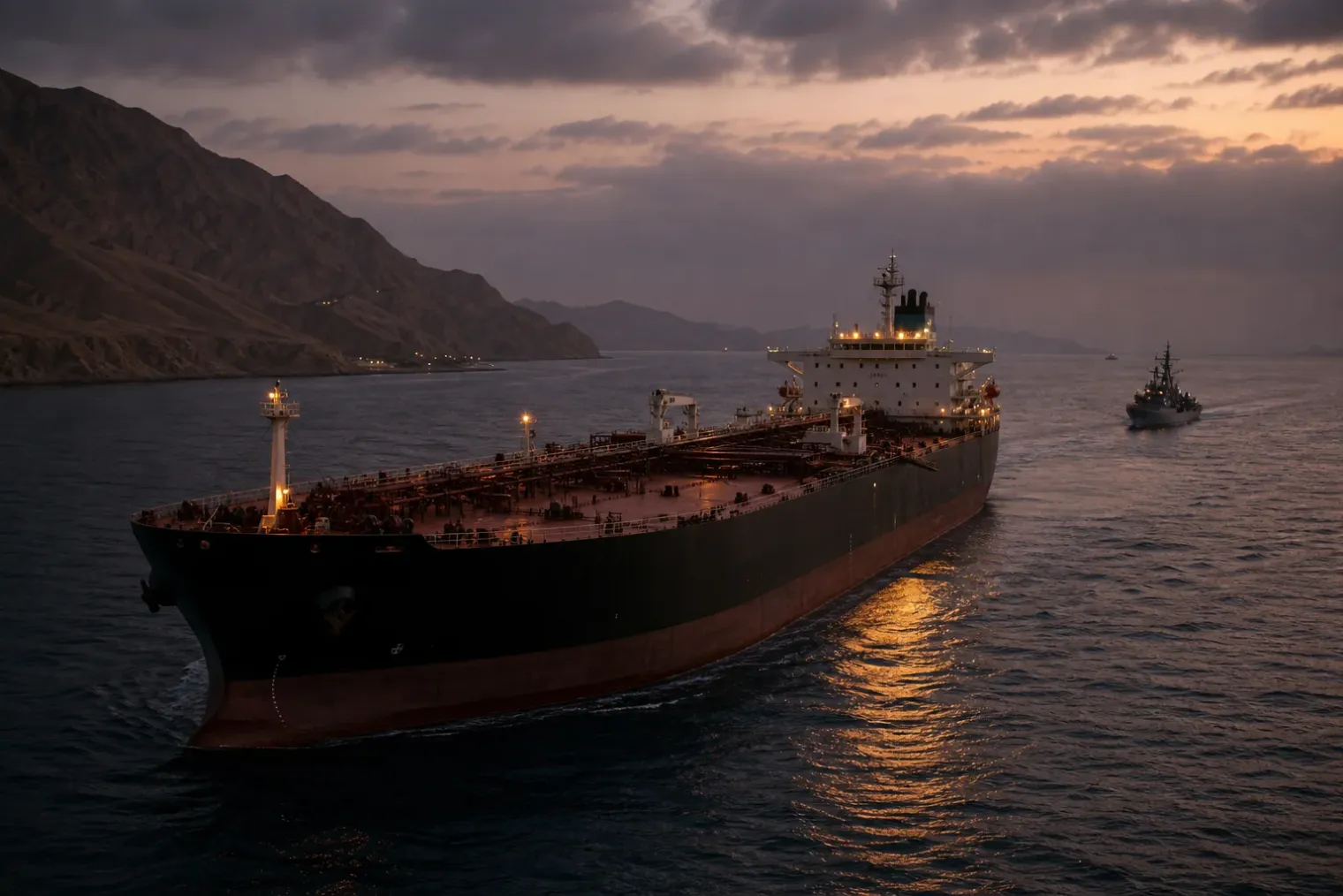
A renewed geopolitical shock for markets
U.S. equity futures moved lower in early trading after American forces struck Iranian rocket launchers near the Strait of Hormuz, ending a lull in direct military action and bringing energy-security risk back to the centre of investors’ calculations. Crude prices rose at the same time, underlining the market’s immediate concern: not simply the latest military operation, but the possibility that it may further disrupt a waterway critical to global oil and liquefied natural gas trade.
Dow Jones, S&P 500 and Nasdaq futures were all modestly lower on Sunday night, while both Brent crude and West Texas Intermediate gained. The reaction was restrained compared with some earlier episodes in the conflict, but it reflected a familiar pattern. Equity investors tend to price in the risks of higher energy costs, persistent inflation and weaker corporate margins when tensions threaten supply routes. Oil traders, meanwhile, react first to the probability of reduced physical flows, shipping delays, higher insurance costs and retaliation against vessels or regional infrastructure.
The immediate market moves are therefore less a verdict on the military significance of the strikes than an assessment of the risks surrounding the Strait of Hormuz.
Why Hormuz remains the key variable
The U.S. military said it targeted launchers on Larak island after observing Revolutionary Guard forces preparing rockets and sea mines. Iran said the attack caused casualties and pledged consequences. Iranian media later reported missile launches toward U.S. bases in Jordan, while Jordan said it intercepted missiles that entered its airspace.
Those developments matter to financial markets because the strait connects the Persian Gulf with the Gulf of Oman. Under normal conditions, it handles a substantial share of internationally traded oil. Even when the passage is not formally closed, fewer transits, security incidents and the threat of mines can sharply reduce usable capacity. Shipping firms, charterers and insurers may avoid the area or demand higher compensation for making the journey.
The volume of traffic, rather than a simple declaration that the strait is open or closed, is the more useful measure of risk. Commercial traffic has been running at reduced levels, and recent conditions have already forced producers and buyers to adjust routes and supply plans. The U.S. Energy Information Administration estimated that crude oil and petroleum liquids movements through Hormuz averaged 4.9 million barrels a day in the second quarter of 2026, down from 21.6 million barrels a day in the final quarter of 2025.
That reduction has consequences beyond the Gulf. Importers in Asia and Europe must compete for alternative barrels, refiners have to adapt to different crude grades, and producers with routes that bypass Hormuz gain strategic value. The resulting disruption can be felt in freight markets, refined-product prices and inflation expectations well before a shortage becomes visible at petrol stations.
Oil’s rise adds an inflation complication
The rise in crude following the strikes comes after a year in which oil prices have repeatedly responded to shifts in the conflict. Brent had traded as low as $69 a barrel in early July after a memorandum of understanding between Washington and Tehran, according to the EIA. Renewed tanker attacks and constraints on traffic later drove the benchmark as high as $105 on July 23.
On August 30, Brent rose to about $89.79 a barrel and U.S. crude to about $84.94 a barrel. The price levels are important, but the direction and durability of the move matter more for wider markets. A one-day spike can reverse quickly if the security situation stabilises. A sustained rise, however, can add to fuel, transport and manufacturing costs, increase inflation forecasts and influence expectations for interest rates.
That is an uncomfortable mix for equities. Higher oil prices can benefit energy producers and some industrial suppliers, but they can weigh on airlines, transport groups, chemicals companies and consumer-facing businesses. The effects are not uniform: firms with pricing power, secure supply contracts or limited direct fuel exposure may be better placed than those facing immediate cost pressure.
For central banks and bond markets, the issue is whether higher energy prices become a temporary external shock or feed into broader prices and wage-setting. Investors will be watching inflation-sensitive market indicators, Treasury yields and official commentary particularly closely if oil remains elevated for several weeks.
A fragile baseline, not a return to normality
The latest strikes arrived after the U.S. administration had recently placed greater emphasis on economic pressure against Iran. But the return to direct action reinforces how difficult it is to separate military, diplomatic and commercial developments in this conflict. A pause in attacks can reduce the geopolitical premium in oil; an incident involving launchers, mines or tankers can quickly restore it.
The EIA’s August outlook assumed that Hormuz transits would remain severely constrained through the month, with a gradual improvement beginning in September. It forecast Brent to average roughly $85 a barrel in the third quarter, before easing as output and trade flows recover. That forecast now depends even more heavily on de-escalation and on the ability of commercial vessels to move safely.
The outlook should therefore be treated as conditional rather than as a firm prediction. More attacks on ships, damage to export infrastructure or a wider regional response could tighten supply further. Conversely, credible security arrangements, improved transit volumes or a renewed diplomatic understanding could reduce the risk premium quickly.
What investors will watch next
The next phase will be determined by evidence rather than headlines alone. Markets will focus on whether Iran’s promised response expands the confrontation, whether shipping traffic increases or declines, and whether fresh damage occurs to tankers or regional energy facilities.
Several indicators are likely to set the tone:
- the scale and persistence of crude-price gains after regular trading resumes;
- movement in oil-product and tanker-freight prices, which can reveal stress beyond benchmark crude;
- changes in Hormuz transit volumes and maritime-security warnings;
- Treasury yields and inflation expectations; and
- the relative performance of energy stocks against transport, travel and consumer sectors.
For now, the fall in U.S. stock futures and the increase in oil prices show that investors are again assigning a higher probability to a prolonged supply disruption. Whether that concern becomes a broader market sell-off will depend on the security of a narrow stretch of water that remains disproportionately important to the global economy.
Sources
- Dow Jones Futures Fall, Oil Prices Pop As U.S. Strikes Iran — Investor's Business Daily
- US forces strike Iranian rocket launchers on the Strait of Hormuz — Associated Press
- Short-Term Energy Outlook, August 2026 — U.S. Energy Information Administration
- Statement of Administration Policy on U.S. Armed Forces Hostilities in Iran — The White House


