
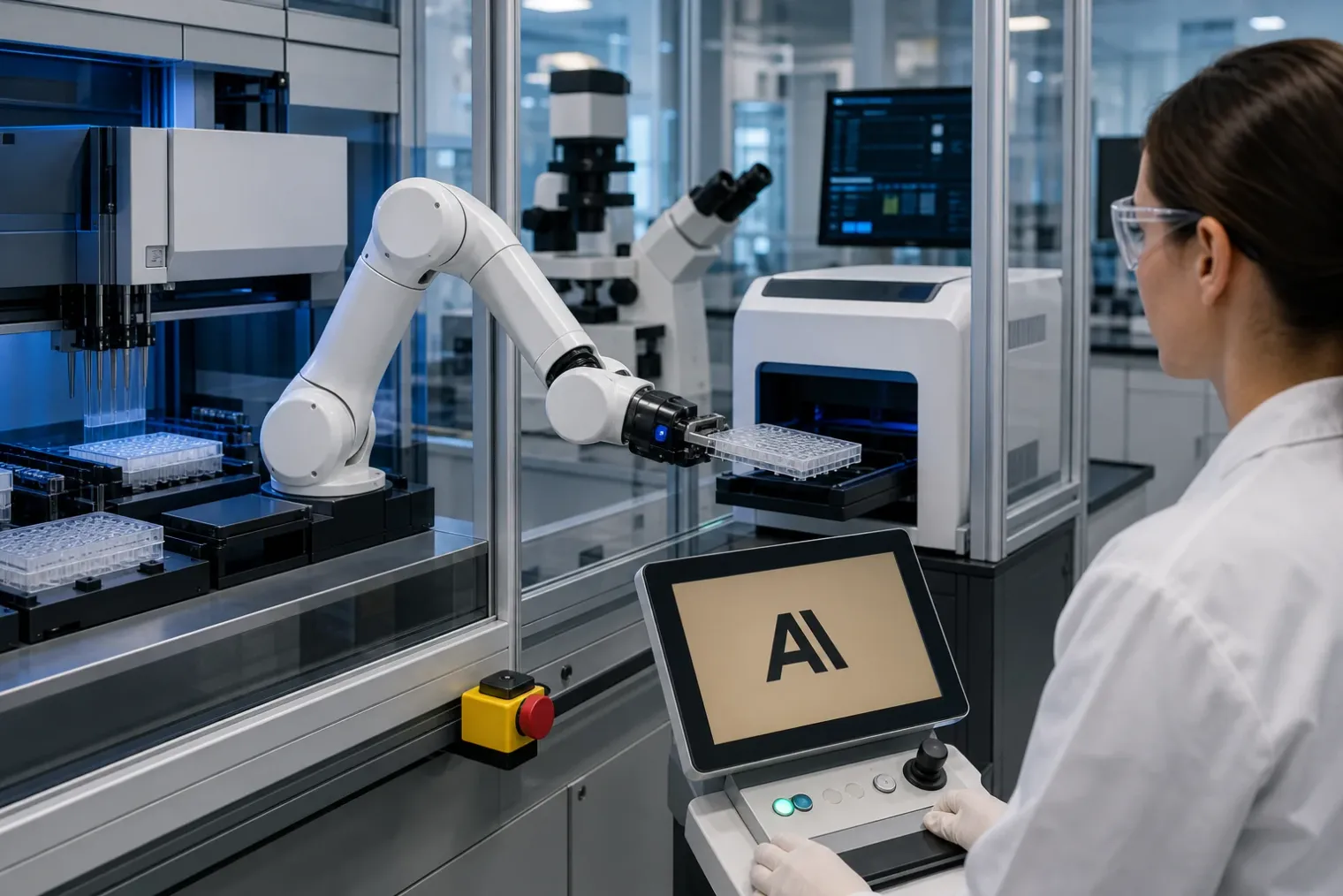
A bridge from software agents to physical equipment
Anthropic has opened a limited research preview of the Model Hardware Standard (MHS), a proposed shared specification for AI agents operating programmable equipment in scientific research and advanced manufacturing. Announced on 27 August 2026, the initiative is aimed at a practical but consequential problem: laboratory instruments, factory machines and robots often use incompatible interfaces, leaving organisations to build costly custom integrations before systems can work together.
The standard is not a new robot brain, nor a claim that a language model has mastered physical reasoning. It is better understood as an interoperability and control layer. MHS gives devices a common driver structure, basic read and write operations, and a machine-readable description of what each device can observe, change and refuse to do. An agent can then discover connected equipment and coordinate it through the Model Context Protocol, command-line tools or conventional APIs.
That distinction matters. The immediate opportunity is less about turning general-purpose chatbots into independent scientists than about removing the engineering friction that keeps automation systems isolated. A liquid handler, robotic arm, plate reader and camera may each be technically programmable while remaining difficult to use in one coherent workflow. MHS seeks to provide the shared vocabulary that lets an AI agent supervise those tools together.
Why standardisation could matter
Modern research and manufacturing already depend on specialised automation, but its value is constrained by integration work. Systems are commonly assembled around vendor software, bespoke scripts and local expertise. The result can be reliable within a narrow workflow yet slow to adapt when an experiment changes or an additional instrument is introduced.
Anthropic’s proposal makes every participating device describe its capabilities and limits in a standard format. In principle, an agent could read a temperature, alter a setting only within permitted bounds, check a camera feed for the outcome and pass the next step to a different instrument. For long-running or time-sensitive operations, the framework can package deterministic command sequences into code rather than having the model reason through every low-level action in real time.
This design reflects a sensible division of labour. Language models are increasingly useful for planning, interpreting unstructured instructions, analysing results and handling exceptions. Machines remain better suited to executing repeatable, tightly timed motions. MHS is intended to connect the two: the model operates at a supervisory level, while device drivers and scripts carry out the controlled physical work.
The potential gains are clearest in flexible environments. A factory line repeating one stable task may already have a conventional control system. Academic and discovery labs, by contrast, often modify protocols, combine instruments from several suppliers and need to respond to unexpected results. A common interface could lower the threshold for automating those variable workflows.
Early demonstrations show both promise and constraint
The research preview includes examples from laboratory partners. Genentech used MHS in a proof of concept involving a liquid handler, robotic arm and plate reader for a protein assay. The company reported that Claude could perform trial runs, compare measurements with an expert-produced reference and adjust liquid-transfer settings. Carnegie Mellon University described an agent-controlled serial-dilution workflow that coordinated equipment with incompatible underlying interfaces, while researchers at the University of Washington demonstrated remote monitoring and scheduled instrument handoffs.
These examples suggest that MHS can make orchestration easier and can support closed-loop experiments: measuring an outcome, changing a parameter and trying again. That is a significant operational capability. It can reduce time spent on monitoring, repetitive setup and the handoffs between separate instruments.
But the cases are proofs of concept, not evidence that autonomous laboratories are ready for unsupervised deployment. Their effectiveness depends on carefully defined equipment, specific protocols, expert-supplied safety ranges and a prepared software harness. A standard can reduce integration complexity; it cannot independently establish whether an experiment is scientifically well designed, whether a sample has been contaminated or whether an unusual reading reflects a meaningful result.
Anthropic’s own account illustrates the gap. In the Genentech work, the model initially treated errors caused by foaming protein samples as though they were software problems, retrying in a way that aggravated the physical issue. Researchers had to supply the relevant physical explanation and corrective procedure. That episode is important because it shows why well-labelled machine data does not substitute for practical knowledge of materials, biological processes and laboratory context.
Safety begins at the device boundary
MHS is framed as a safety-oriented standard because the consequences of an incorrect command are no longer confined to a file, an email or a database. They may include damaged equipment, degraded samples, unsafe laser settings or collisions between machines. The proposed approach is to put enforceable limits into the device description itself: an agent may learn what a machine can do, but it should also encounter hard constraints on what it is allowed to do.
This is the right direction, but it should be regarded as one layer of control rather than a complete safety solution. Agent safety depends on the whole operating system around the model: permissions, authentication, network security, emergency stops, human approvals, monitoring, audit logs and the quality of the device driver. If any of those are weak, a capable model and a neatly standardised interface can amplify rather than reduce risk.
Anthropic has said it will use the preview to develop additional safety evaluations and best practices before open-sourcing MHS. That phased approach is appropriate. Physical automation needs testing not only for normal operation but also for stale sensor readings, network loss, conflicting commands, failed instruments, ambiguous instructions and attempts to misuse connected hardware.
The company’s recent robotics research also offers a useful reality check. It found that current frontier models perform far better when they supervise high-level, pretrained robot policies than when they directly control motors or joints. Models can make meaningful progress on navigation and manipulation, but still struggle with sustained spatial memory, self-localisation and long open-loop plans. In other words, physical competence remains uneven, and the interface between the model and the machine strongly shapes the result.
An open ecosystem is the larger ambition
MHS is model-agnostic in principle and is designed to work with any hardware that has a programmable interface. Anthropic says it plans to make the standard open source after the preview, with early involvement from organisations spanning laboratory automation, robotics, electronics and manufacturing.
That ambition resembles the role of the Model Context Protocol in software: replace one-off connections with a shared way for agents to find and use tools. Whether MHS becomes similarly influential will depend on adoption by hardware manufacturers, the quality of its drivers and whether it can interoperate with existing industrial control and safety systems without adding unacceptable complexity.
For now, MHS should be seen as infrastructure for supervised physical agents, not a declaration that AI systems are prepared to roam laboratories and factories alone. Its most credible promise is modest but valuable: make diverse equipment easier to connect, make operating limits more explicit, and give experts better tools to automate routine work. If that foundation proves dependable, it could help move AI-assisted experimentation from isolated demonstrations towards more practical, auditable workflows.
Sources
- This Is How Anthropic Thinks AI Agents Should Navigate the Physical World — WIRED
- Previewing the Model Hardware Standard — Anthropic
- Claude plays robotics — Anthropic
- Trustworthy agents in practice — Anthropic


