
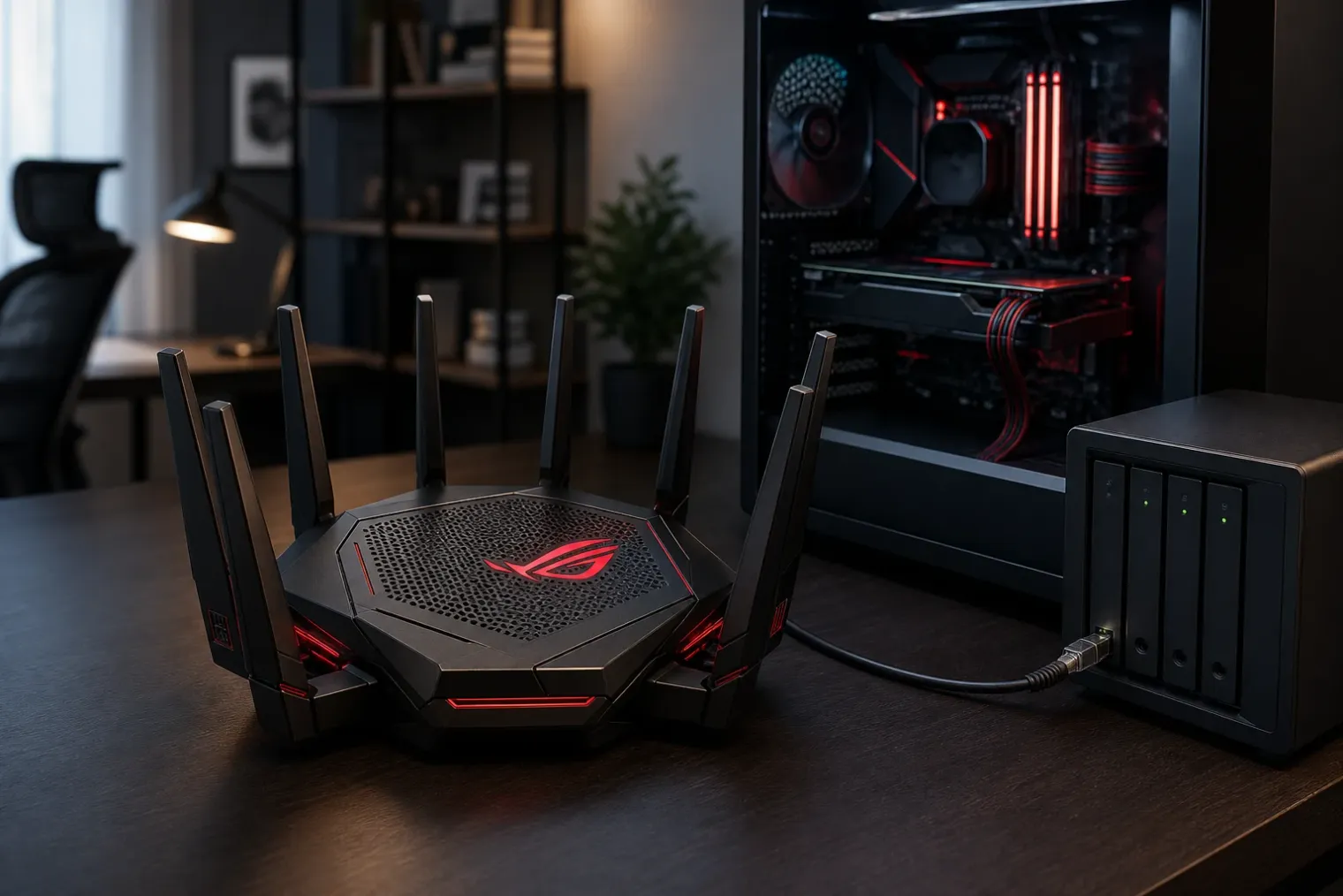
A router built around reliability rather than a new speed race
ASUS has listed the ROG Rapture GT-BN98 as its first Wi‑Fi 8 gaming router, positioning the device at the leading edge of a wireless generation that remains under development. The important qualification is visible in ASUS’s own technical specifications: the router supports draft IEEE 802.11bn, the proposed standard commonly known as Wi‑Fi 8.
That makes the GT-BN98 an early product rather than a conventional generational upgrade. Wi‑Fi 8 is being developed under the “Ultra High Reliability” programme, which shifts emphasis from simply raising theoretical peak transfer rates to making wireless links more consistent in difficult conditions. Those conditions include homes with many connected devices, crowded neighbouring networks, longer distances from the router and environments where low-powered smart-home equipment struggles to maintain a connection.
The IEEE working group’s current material shows that 802.11bn is still moving through draft ballots. As a result, final features, interoperability requirements and certification details may change before the standard is completed. ASUS also states that its performance figures are preliminary vendor test data, and that full Wi‑Fi 8 functionality requires compatible client devices as well as the router.
Quad-band hardware with substantial wired capacity
The GT-BN98 is a quad-band router covering 2.4 GHz, two separate 5 GHz bands and 6 GHz. ASUS rates the combined wireless segment at up to 25,000 Mbps, comprising 1,376 Mbps on 2.4 GHz, 5,764 Mbps on each 5 GHz band and 11,529 Mbps on 6 GHz. As with other router headline ratings, these figures aggregate multiple bands and represent link-rate potential rather than the speed available to one device in a typical home.
The hardware is unusually well provisioned for wired networks. It includes two 10Gbps Ethernet ports, four 2.5Gbps ports in total when the flexible WAN/LAN port is counted, and a separate gigabit LAN port. One 10Gbps port can operate as WAN or LAN, while another is dedicated to LAN use. That layout is relevant to users with multi-gigabit fibre, fast network-attached storage or a gaming PC connected by cable.
ASUS lists a 2.6 GHz quad-core processor, 2 GB of RAM, 256 MB of flash storage and eight external antennas. The router also offers USB 3.2 Gen 1 and USB 2.0 ports, support for ASUS’s AiMesh system, and operating modes including access point, repeater and media bridge.
The physical design follows the established ROG Rapture approach: a large desktop chassis, prominent antennas, RGB lighting and extensive cooling. ASUS says it has increased the thickness of the aluminium top plate and improved airflow relative to its older GT-AXE16000 model. Such changes matter less as a headline feature than as a recognition that a multi-band, multi-gigabit router has a sustained thermal and processing workload.
What Wi‑Fi 8 is intended to change
For many consumers, Wi‑Fi 7 has already delivered the major visible advances: 6 GHz access, 320 MHz channels, high-order 4096-QAM modulation and multi-gigabit potential at short range. Wi‑Fi 8 retains much of that technical foundation, but proposes mechanisms intended to improve performance when radio conditions are less ideal.
ASUS highlights four prospective outcomes: higher median throughput at medium and longer ranges, wider coverage for internet-of-things devices, lower latency through multi-access-point coordination, and more efficient spectrum use in crowded environments. The distinction between median throughput and a maximum data rate is significant. A reliability-oriented standard can be valuable if it reduces sudden drops in performance while moving around a home, rather than only improving a benchmark conducted close to the router.
This could be particularly relevant in apartment buildings, larger homes and mixed-use networks where video calls, game downloads, streaming, cloud backups and smart-home devices compete for airtime. The Wireless Broadband Alliance similarly frames Wi‑Fi 8 around improved reliability and coordination for demanding, real-time network uses.
However, it would be premature to treat the GT-BN98’s claims as guaranteed user outcomes. Range is affected by building materials, local interference, regional radio rules, device antennas and client software. Furthermore, a new router alone cannot activate the full set of Wi‑Fi 8 functions: phones, laptops, gaming handhelds and other wireless clients will need compatible chipsets and final software support.
Gaming features extend beyond the radio standard
ASUS is differentiating the GT-BN98 not only through Wi‑Fi 8 but also through ROG gaming software. Its Triple-Level Game Acceleration combines device recognition, a designated gaming port and traffic prioritisation. Adaptive Quality of Experience is intended to assign bandwidth dynamically according to network conditions and application demand.
The company also bundles a service called GTNet, which it says analyses latency and selects a more reliable route to game servers. That promise should be understood as a network-management feature, not a replacement for a good internet connection. A router can prioritise local traffic and potentially avoid a poor network path, but it cannot eliminate latency imposed by an internet service provider, a distant game server or congestion outside the home network.
Other management functions include interference monitoring through WiFi Insight, guest-network segmentation, parental controls, VPN functions and security tools under the AiProtection branding. These features may be useful to households that want one device to manage gaming, work, visitors and smart-home equipment, although the router’s final long-term value will also depend on firmware maintenance and support policies.
An early-adopter proposition
The GT-BN98 is best understood as a premium platform for enthusiasts with unusually demanding local networks, rather than an essential upgrade for every gamer. Its wired interfaces, processing resources and quad-band architecture can deliver benefits immediately for users with multi-gigabit infrastructure. Its draft Wi‑Fi 8 support, by contrast, is a forward-looking investment.
ASUS has not published a regional price or firm retail availability date on the official product page. That absence is consequential: buyers cannot yet weigh the product’s cost against mature Wi‑Fi 7 routers, which already have a broad base of compatible clients.
The announcement nevertheless illustrates how networking suppliers are beginning to commercialise hardware ahead of final Wi‑Fi 8 standardisation. For ASUS, the GT-BN98 is a way to claim an early position in the next wireless cycle. For prospective buyers, the more practical question is whether their current devices, broadband connection and home layout create a problem that the router can solve today—or whether Wi‑Fi 8’s eventual client ecosystem is worth waiting for.
Sources
- ROG Rapture GT-BN98 — ASUS ROG
- ROG Rapture GT-BN98 – Tech Specs — ASUS ROG
- IEEE 802.11 Working Group — IEEE
- Wi-Fi 8 — Wireless Broadband Alliance


