
Qualification moves a specialised tool into a new application
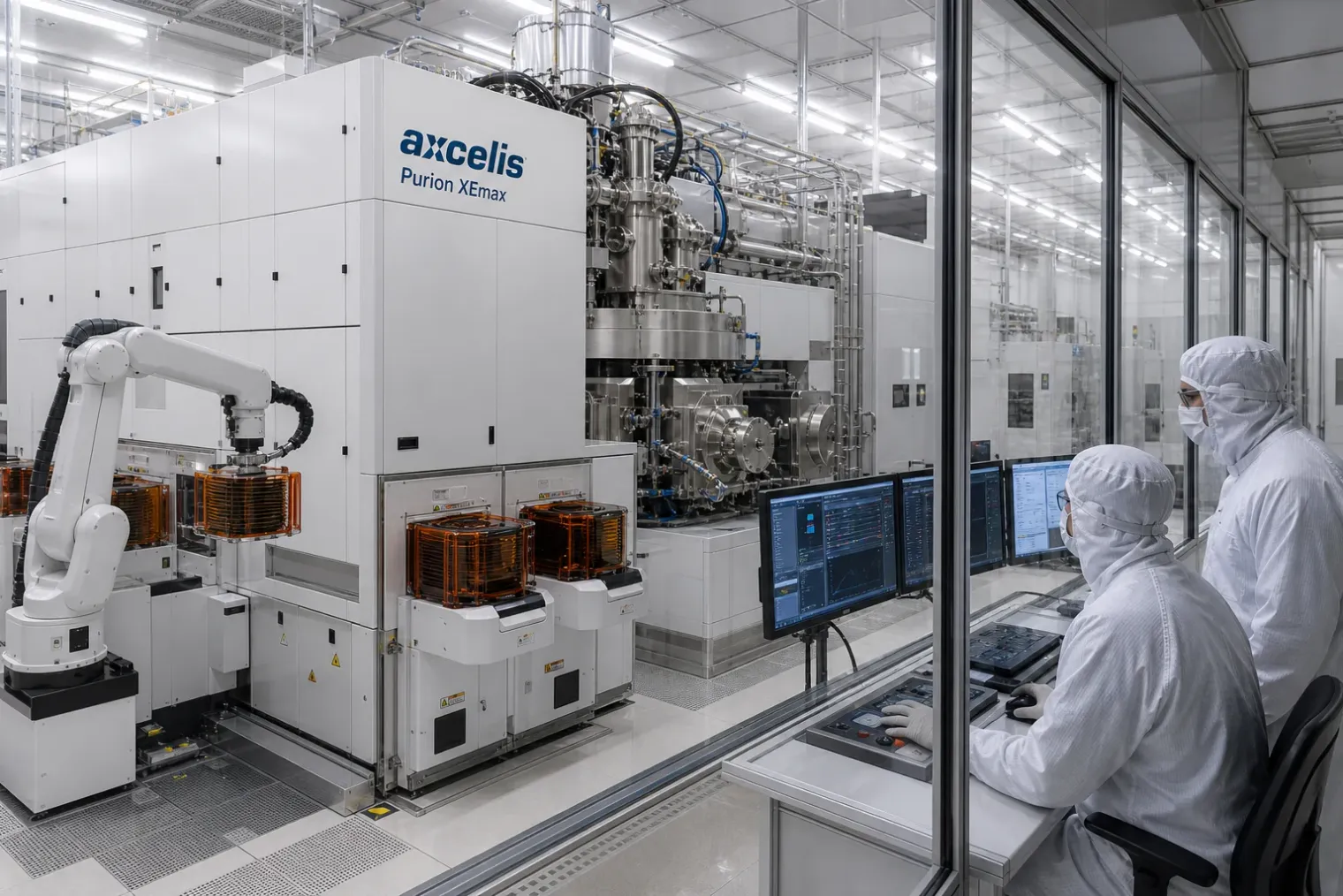
Axcelis Technologies said on 28 July 2026 that a leading semiconductor foundry had completed evaluation of its Purion XEmax ion implanter for the production of power-management integrated circuits, or PMICs. The customer was not identified, and the company did not disclose the number of systems involved, their price, installation schedule or expected production volumes.
The announcement is nevertheless significant as a manufacturing milestone. A completed evaluation means the tool has met a customer’s requirements for the stated process application and can be used in production. It does not, by itself, establish a broad purchasing commitment, but it potentially places the platform in contention for follow-on orders if the foundry expands the relevant process.
The application calls for implantation energies up to 15 MeV, a range Axcelis positions as ultra-high energy. The company says the Purion XEmax combines a dual radio-frequency linear accelerator architecture with its Boost technology. In practical terms, the system is designed to place dopant ions deeper in a wafer while maintaining process control and managing contamination, capabilities that can matter in specialised semiconductor structures.
Why PMICs are relevant
PMICs regulate, convert and distribute electrical power in electronic systems. Depending on the product, they can integrate functions such as voltage conversion, battery charging, power sequencing and thermal protection. They are used across consumer electronics, communications equipment, industrial systems and vehicles.
This makes the qualification notable for a company whose recent growth strategy has been closely associated with power semiconductors, including silicon-carbide devices used in electric vehicles and industrial power conversion. The newly disclosed customer use case is not necessarily a silicon-carbide programme: Axcelis described it specifically as an emerging PMIC device application. That distinction matters because the power-management market includes a wide range of chip architectures and substrate materials.
The deeper significance is the process requirement. Conventional ion implantation is a central method for changing the electrical properties of selected regions of a semiconductor wafer. Higher-energy implantation broadens the set of device structures that a manufacturer can build, particularly where dopants need to be positioned well below the surface. Whether that advantage translates into volume demand depends on the customer’s eventual device design, yield results and end-market requirements.
A new use case for an established platform
Purion XEmax is not a newly introduced system. Axcelis announced a production qualification for the platform at a CMOS image-sensor manufacturer in October 2022, also highlighting its capability to reach 15 MeV. The latest evaluation therefore extends the evidence of use from image sensing into power-management chips rather than demonstrating a new maximum energy specification.
That expansion is commercially relevant because semiconductor-equipment suppliers benefit when an existing platform can be applied across multiple chip categories. It can enlarge the addressable market while allowing the supplier to build on an installed base, service organisation and established process knowledge. It also reduces the need to develop an entirely separate product for every specialised customer requirement.
However, the announcement should be read with appropriate limits. Axcelis has characterised the customer only as a leading foundry, so the market cannot independently assess the scale of its PMIC business, the technology node involved or the timing of commercial output. A successful evaluation is a stronger signal than a laboratory demonstration, but it is not equivalent to reporting revenue, backlog or a multi-tool purchase order.
Fit with Axcelis’ power-device strategy
Power-oriented applications remain important to Axcelis. In its 2025 annual report, the company said power devices represented 55% of the value of system shipments during that year. For the first quarter of 2026, power-device shipments accounted for 35% of total systems revenue, while the wider mature-process segment represented 68% of shipped-systems revenue. The figures are measured differently and cover different periods, but together they show that power-related markets remain material to the business even as product mix changes.
The company has also broadened its dedicated power portfolio. In September 2025 it launched the Purion Power Series+, covering high-current, medium-current and high-energy implantation requirements for next-generation power devices, including superjunction structures. The Purion XEmax announcement sits alongside that wider programme, though it is positioned as an ultra-high-energy extension of the company’s high-energy family rather than as a standard Power Series+ model.
For Axcelis, the most important next indicators will be whether the evaluation produces a formal purchase order, whether the configuration is replicated at additional customer sites and whether PMIC demand becomes a recurring end market for the XEmax. The company had four Purion evaluation systems deployed at strategic customer sites at the end of 2025, underlining that evaluations are an established route to qualification but do not all carry the same commercial outcome.
What the milestone does — and does not — establish
The confirmed point is narrow but meaningful: an unnamed foundry has qualified Axcelis’ highest-energy Purion configuration for a PMIC process requiring 15 MeV implantation. That validates a specific production application for a tool built around a capability that is uncommon within the company’s product range.
It does not establish that the foundry has committed to high-volume deployment, that the technology will become a standard PMIC process, or that the qualification will materially affect Axcelis’ near-term financial results. Those conclusions would require disclosed orders, shipment data or customer production information.
Still, the result gives Axcelis a credible reference point in an adjacent segment of the power semiconductor landscape. In a capital-equipment market where process qualification can shape future tool selection, that reference may prove more valuable if advanced PMIC designs increasingly require deeper, high-energy implantation steps.
Sources
- Axcelis Announces Successful Purion XEmax Eval Closure at Leading Semiconductor Foundry — Axcelis Technologies, Inc. via PR Newswire
- Axcelis Technologies 2025 Annual Report on Form 10-K — U.S. Securities and Exchange Commission
- Axcelis Technologies Quarterly Report for the Quarter Ended March 31, 2026 — U.S. Securities and Exchange Commission
- Axcelis Announces Successful Qualification of Purion XEmax for Production — Axcelis Technologies, Inc.
- Axcelis Announces Launch of Purion Power Series+ Ion Implant Platform — Axcelis Technologies, Inc.


