
A significant result, not a solution to the Riemann hypothesis
A claim that artificial intelligence has solved the Riemann hypothesis would rank among the largest announcements in modern mathematics. That has not happened. On August 10, Anthropic reported that an unreleased research version of Claude had established a stronger unconditional lower bound for the share of non-trivial zeros of the Riemann zeta function that lie on the critical line. Two days later, Scientific American correctly stressed the distinction: the Riemann hypothesis remains open.
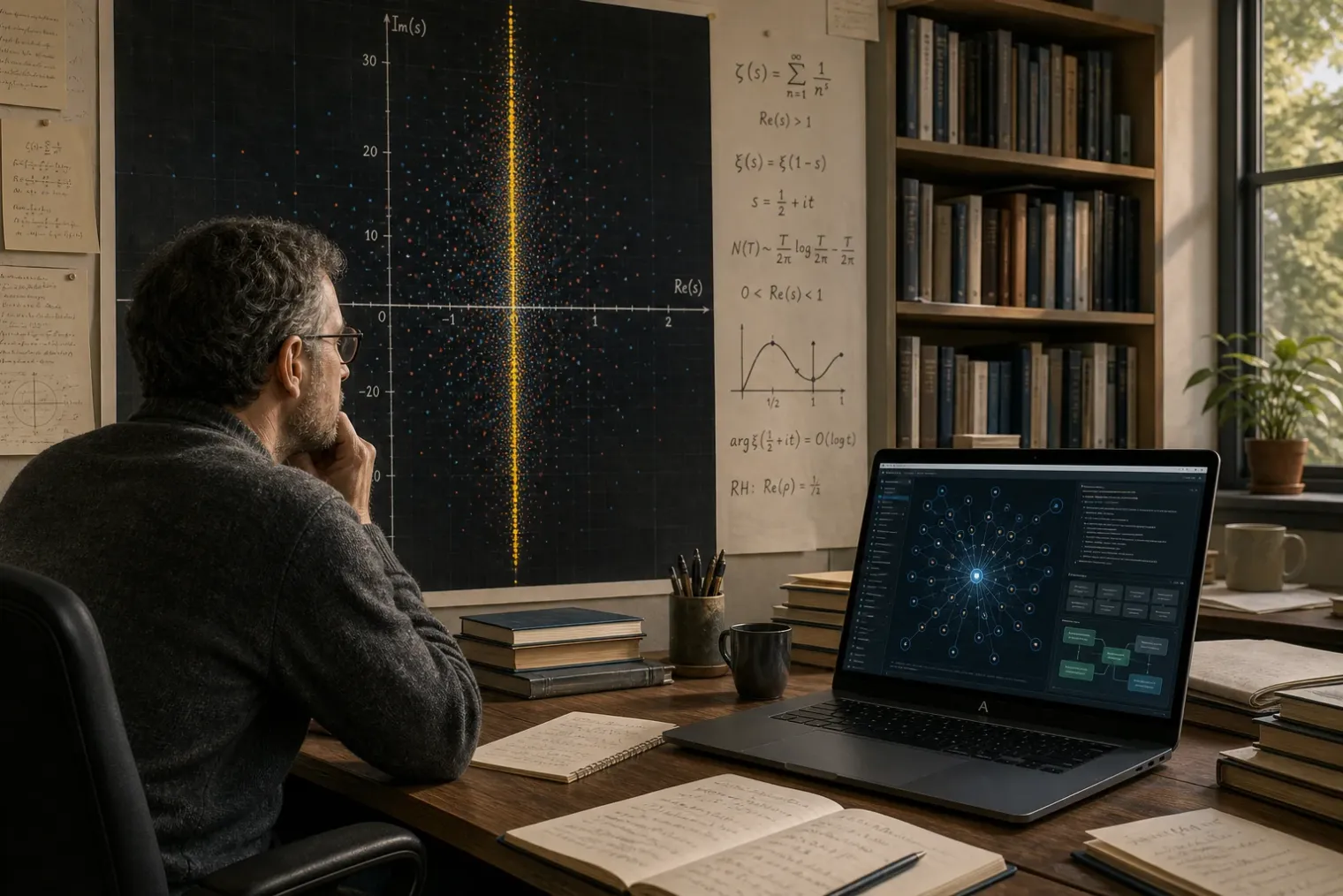
The difference is more than technical. The hypothesis says that every non-trivial zero of the zeta function has real part one-half. Claude’s result says that, asymptotically, at least about 67.25% of those zeros lie on that line. This is a substantial advance over the previous unconditional record of more than 41.6%, but a lower bound on a proportion cannot establish a universal claim about every zero.
Even a proof that 99.999% of the zeros lie on the critical line would not prove the Riemann hypothesis. A sparse, infinite or even finite collection of exceptions could still exist. Conversely, the remaining roughly one-third in the new certified bound are not known to be exceptions; the method simply does not account for them.
Why the Riemann hypothesis matters
Bernhard Riemann proposed the hypothesis in 1859 while studying the distribution of prime numbers. The zeta function encodes deep information about how primes are spaced along the number line. Its non-trivial zeros determine the size and shape of the error terms in estimates for the number of primes below a given threshold.
The critical line, defined by complex numbers with real part one-half, is central to that relationship. If all non-trivial zeros lie there, many estimates throughout number theory become sharper. The conjecture has also accumulated consequences in areas including algebra, combinatorics and cryptography. It is one of the Clay Mathematics Institute’s Millennium Prize Problems, with a US$1 million award for a valid proof or disproof.
That status can create an unhelpful shorthand: any progress involving the critical line becomes framed as progress “on the Riemann hypothesis”. It is related progress, but it is not necessarily progress towards a proof. In this case, Anthropic itself says it does not expect Claude’s techniques to lead to a resolution of the hypothesis.
What Claude’s paper establishes
Claude’s paper, titled “More Than Two Thirds of the Zeros of the Riemann Zeta Function Lie on the Critical Line”, improves several unconditional statements. Its headline result is that at least two thirds of the zeros are simple and lie on the critical line, with an optimised construction yielding a constant of approximately 0.6725. It also derives a stronger bound for the proportion of distinct zeros.
The previous 41.6% benchmark emerged from a long line of work based on Levinson’s method and refinements of it. Claude’s argument takes another route. It combines recent unconditional work on pair correlations of zeta zeros with a 2000 result of Enrico Bombieri, then applies a linear-algebraic analysis to a finite-dimensional form associated with the zeros.
In simplified terms, the proof extracts information from aggregate statistics of zeros and primes. It uses a matrix framework in which zeros on the critical line and possible off-line zeros contribute different structural signatures. A rank-and-trace inequality then converts those constraints into a guaranteed minimum number of on-line zeros.
This is why specialists have treated the work as meaningful rather than merely computational. The value is not just a better decimal number; it is the identification of a way to make an argument previously associated with an assumption of the Riemann hypothesis work unconditionally. The paper also states candidly that the method has an internal ceiling well below 100%, so it cannot simply be extended incrementally until it proves the full conjecture.
Autonomous search, human validation
Anthropic says the result emerged after a staff member gave Claude an open-ended prompt to attempt the Riemann hypothesis. In two sessions, the system generated hundreds of unsuccessful ideas, coordinated roughly 60 subagents, performed numerical checks and searched the literature. The reported process used 31 million output tokens and included model-generated reviews and attempts to reproduce the proof independently.
Those details illustrate a developing model for AI-assisted mathematical research: broad exploration, specialised subagents, automated checking and later expert review. They should not, however, be mistaken for a replacement for mathematical validation.
Anthropic says two in-house mathematicians examined the result, while number theorists Brian Conrey and Dan Goldston reviewed it on short notice. The company also released a Lean formalisation. Formal proof systems are especially useful because they check whether each encoded logical step follows from specified axioms and definitions. Yet formal verification does not remove every question: people must still determine that the formal statement accurately captures the intended theorem, that imported results are appropriately represented, and that the result is novel and correctly situated within the literature.
The public paper addresses this distinction by separating the formalised theorem from the natural-language mathematical exposition and by crediting earlier work that supplies its analytic inputs. That transparency is important in a field where language models can retrieve or recombine prior ideas without reliably documenting their provenance.
A narrower but more credible measure of progress
The episode offers a better benchmark for AI mathematics than claims that a system has conquered an iconic unsolved problem. Claude did not prove the Riemann hypothesis, and no evidence currently indicates that the hypothesis is closer to resolution through this particular approach. But it appears to have produced a rigorous, non-trivial advance on a longstanding adjacent problem, using an approach that human experts judged worth examining and communicating.
That is already consequential. Mathematical research often advances through improved bounds, new representations and unexpected bridges between existing theories rather than through immediate solutions to celebrated conjectures. AI systems may prove useful where they can sustain large searches across technical possibilities, test alternative formulations and connect results spread across specialised literatures.
The standard for accepting such contributions must remain high. A convincing AI-generated result requires a clear statement, reproducible derivation, careful literature checks, independent human scrutiny and, where feasible, formal verification. By that standard, Claude’s zeta-zero result is best understood neither as a final triumph over the Riemann hypothesis nor as a trivial publicity exercise. It is a serious claimed advance in analytic number theory—and a reminder that the hardest question in the story remains unanswered.
Sources
- No, Anthropic’s AI didn’t just solve math’s hardest problem — Scientific American
- Learning more about Claude's mathematical capabilities — Anthropic
- More Than Two Thirds of the Zeros of the Riemann Zeta Function Lie on the Critical Line — Anthropic
- The Millennium Prize Problems — Clay Mathematics Institute
- An unconditional Montgomery Theorem for Pair Correlation of Zeros of the Riemann Zeta Function — arXiv


