
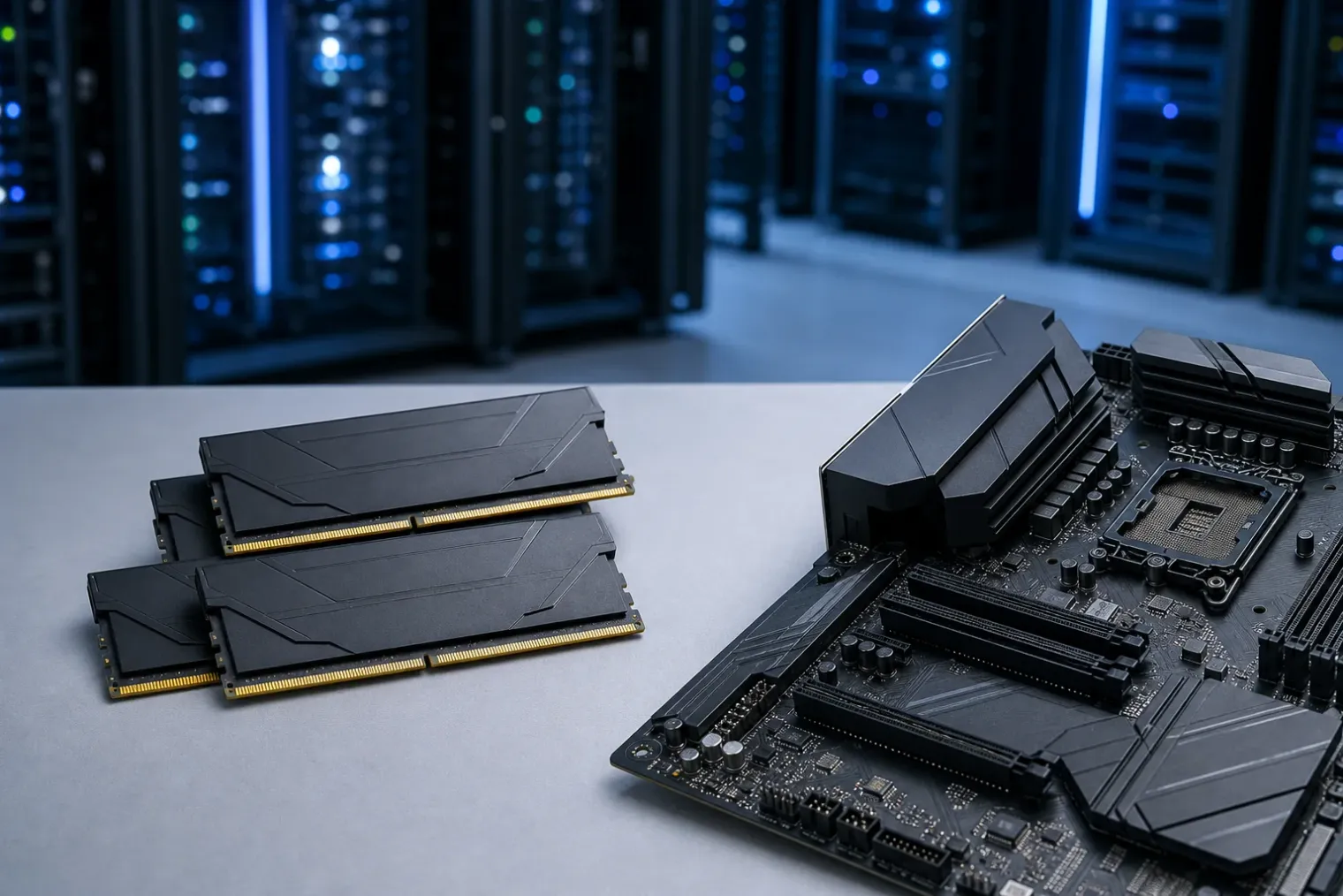
A record retail jump, with an important qualification
Memory prices have entered an unusually volatile phase. Recent US retail tracking found that a 64GB DDR5-5600 kit averaged about $1,118 in August 2026, compared with roughly $191 a year earlier: a rise of 485%. Similar 64GB DDR5-6000 kits showed a 473% increase. Those figures underpin claims of a near-500% annual surge and help explain why the increase is being described as a record in consumer memory pricing.
The headline needs to be read precisely. A 500% increase means a price becomes about six times its starting level, not five times. It also does not mean that every memory product, every country or every sales channel has increased by the same amount. The most dramatic moves are concentrated in high-capacity DDR5 kits, where retail availability and the mix of listed products can change sharply. Lower-capacity DDR5 products have also risen materially, but by less; the US comparisons put 32GB DDR5 kits broadly in the 355% to 429% range depending on speed.
Even so, the broader direction is clear. DDR4, the older mainstream standard, has not provided a cheap refuge. The same retail dataset showed annual increases of roughly 120% to 177% for commonly sold DDR4 kits. European price monitoring has also reported large increases, although the size of the rise differs by period and methodology. This is not merely a short-lived promotion cycle or a single retailer’s anomaly.
Why AI infrastructure is changing the market
The immediate cause is a collision between concentrated demand and constrained supply. Cloud service providers and server manufacturers are purchasing large quantities of high-capacity DRAM for AI inference, general-purpose servers and associated data-centre infrastructure. Enterprise storage demand has also increased, raising pressure on NAND flash used in solid-state drives.
Memory makers have a strong financial reason to give priority to those uses. Server-grade memory and high-bandwidth memory can carry higher margins than the chips used in desktop PCs, entry-level notebooks and consumer storage. High-bandwidth memory is especially important because it is closely integrated with AI accelerators and requires multiple stacked DRAM dies. The manufacturing resources, engineering attention and wafer capacity directed at those products reduce flexibility elsewhere in the market.
The effect is compounded by procurement behaviour. When large customers fear they may not receive enough memory later, they seek allocations earlier and build inventories. That can turn an already tight market into a sharper shortage. During the first quarter of 2026, market researcher TrendForce forecast conventional DRAM contract prices to rise 90% to 95% from the previous quarter, with PC DRAM expected to more than double. Its forecast for the second quarter still pointed to increases of 58% to 63% for conventional DRAM and 70% to 75% for NAND flash.
Those are contract-market figures rather than shop prices, but they illustrate the cost shock flowing through the supply chain. Module makers and PC vendors buy chips under negotiated commercial arrangements; consumers later see the result in the prices of DIMMs, laptops, graphics cards, SSDs and finished systems. Retail prices can overshoot contract changes when stocks are thin, distributors adjust quotations rapidly, or popular configurations disappear from shelves.
Consumer hardware absorbs the pressure unevenly
For desktop builders, the biggest immediate consequence is that capacity has become a much more consequential budget decision. Moving from 32GB to 64GB was previously a routine upgrade for users running demanding games, virtual machines, creative applications or local AI tools. At current elevated prices, it can alter the economics of an entire PC build.
The impact extends beyond memory modules. Notebook brands must decide whether to raise prices, lower standard memory and storage configurations, or accept lower margins. Manufacturers of smartphones, televisions, networking equipment and industrial devices face comparable choices. Storage is affected too: NAND capacity is increasingly directed towards enterprise SSDs, while retail SSD, memory-card and USB-drive markets have less ability to pass higher component costs on to buyers.
The burden will not fall evenly across the market. Premium systems can sometimes carry higher prices because their buyers place more value on performance. Entry-level devices have much less room to absorb an increase in bill-of-materials costs. That increases the risk of weaker shipment volumes, lower base specifications, longer replacement cycles and a widening gap between budget and high-end hardware.
There is also a substitution effect. Buyers unable to justify a new DDR5 platform may retain DDR4 systems for longer. Yet rising demand for compatible older modules can itself support DDR4 prices, as the latest retail comparisons indicate. In other words, choosing the previous generation may reduce the initial cost, but it no longer guarantees inexpensive memory.
Prices are still rising, but the pace is moderating
The market’s extraordinary first-half price gains do not necessarily imply that each coming quarter will be as severe. In July, TrendForce projected third-quarter 2026 increases of 13% to 18% for conventional DRAM contracts and 10% to 15% for NAND flash. It attributed the slower pace partly to a higher base after earlier increases and partly to consumers reaching an affordability limit.
That is a moderation, not a return to normal pricing. The same outlook described DRAM supply as extremely tight and noted that suppliers were continuing to direct capacity towards AI and server applications. PC makers may replenish inventories, but higher component costs are expected to feed into notebook prices and weigh on volumes. In NAND, enterprise demand remains supportive even as consumer-oriented storage demand weakens.
The distinction matters for anyone interpreting the near-500% retail headline. A slower quarterly increase can coexist with exceptionally high prices compared with a year earlier. It may also take time for any future easing in chip contracts to reach retail shelves, especially if manufacturers and distributors are cautious about inventory.
What would change the outlook
A sustained correction would require more than a brief slowdown in consumer PC sales. Supply would need to improve through output expansion, better production yields or a shift of capacity back towards conventional DRAM and client storage. Demand would need to soften, or large infrastructure customers would need to ease their inventory commitments. None of those changes is instantaneous in semiconductor manufacturing.
For consumers and smaller businesses, the practical conclusion is less dramatic than the market figures: buy the capacity that an immediate workload genuinely requires, verify compatibility before purchasing, and compare complete-system prices rather than treating RAM as an isolated upgrade. The near-500% increase is real for selected high-capacity DDR5 retail configurations, but it is best understood as evidence of a wider supply-allocation problem across the memory industry, not as a universal price tag for every RAM buyer.
Sources
- Memory Prices Break a Record With Nearly 500% Surge in the Last 12 Months — TechPowerUp
- Memory prices climb 500% in 12 months, up to 10x the lowest ever tracked prices — Tom's Hardware
- Memory Price Outlook for 1Q26 Sharply Upgraded — TrendForce
- AI Server Demand to Drive Memory Contract Price Increases in 2Q26 — TrendForce
- AI Server Demand Continues to Support Memory Prices in 3Q26 — TrendForce


