
A shift in the cyclone forecasting benchmark
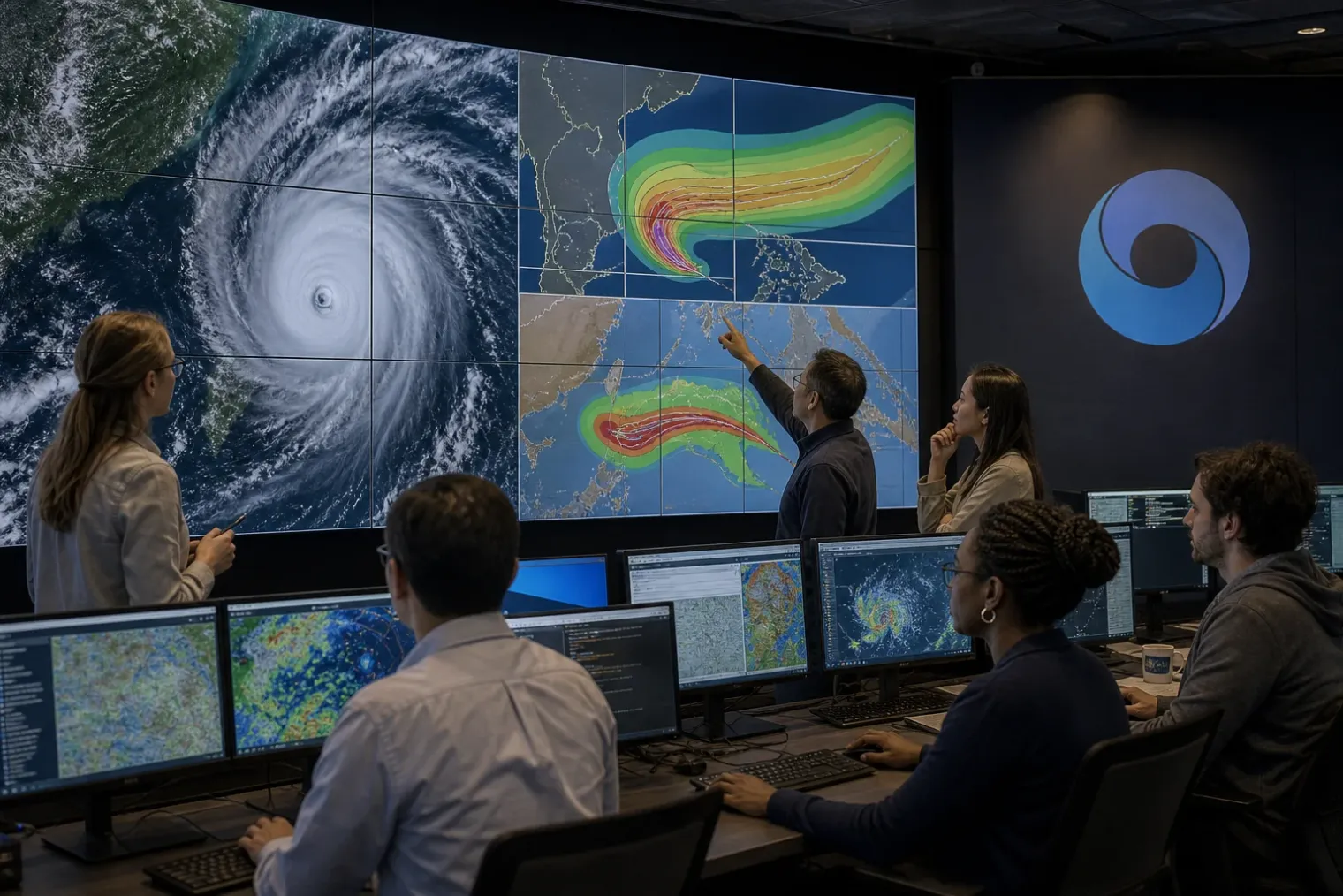
Google DeepMind and Google Research have released WeatherNext Cyclones, an artificial-intelligence model designed to forecast tropical cyclone tracks, intensity and wind structure. The central claim is significant but needs careful interpretation: across historical evaluations, the system’s three-day forecasts were on average as accurate as comparison models’ two-day forecasts. In that sense, the model provides more than 24 hours of additional predictive skill.
That is not identical to an automatic extra day of public warning for every hurricane or typhoon. Official alerts depend on more than a model’s track error. Forecasters must assess confidence, potential hazards, local exposure, emergency-management readiness and the risk of false alarms. Nevertheless, a reliable improvement at a three-day lead time could give meteorological agencies more time to identify credible risks, discuss scenarios with authorities and prepare more precise public messaging.
The work was published in Nature on August 6, 2026, alongside an open release of model code and weights. The release follows earlier WeatherNext experiments that were shared with the US National Hurricane Center during the 2025 hurricane season.
Why tropical cyclones remain difficult
Tropical cyclones are unusually demanding forecasting problems because their movement and their strength arise from processes at very different scales. A storm’s track is largely shaped by broad atmospheric steering currents. Its intensity, by contrast, depends on compact and rapidly changing conditions around the inner core, including ocean heat, moisture, wind shear and convection.
Conventional numerical weather prediction addresses this problem with physics-based simulations. Global models represent the broad circulation that guides a storm, while higher-resolution regional models can better resolve some processes near the cyclone’s core. Both approaches are computationally intensive, and neither removes the inherent uncertainty of atmospheric evolution.
WeatherNext seeks to reduce the usual trade-off. It is trained jointly on global atmospheric data and on expert-curated records of historical cyclones. The resulting system forecasts the wider atmosphere while also learning cyclone-specific characteristics, including track, intensity and the extent of damaging winds. Google says the model was trained with nearly 20 terabytes of atmospheric data and a historical database covering nearly 5,000 storms.
The model uses an ensemble approach: instead of producing one definitive path, it generates many plausible evolutions from the same starting conditions. For the current system, Google says it can produce 1,000 scenarios for a cyclone. This matters because emergency planning is often driven not only by the most likely outcome but also by lower-probability, high-impact possibilities, such as rapid intensification shortly before landfall.
What the reported extra day means
WeatherNext Cyclones was evaluated against leading forecast systems using historical storms from 2023 and 2024. Google reports a lead-time advantage of more than 24 hours, averaged across track, intensity and wind-structure measures. Its earlier experimental cyclone model had already shown a five-day track forecast that was, on average, 140 kilometres closer to the observed location than the European Centre for Medium-Range Weather Forecasts ensemble benchmark in tests covering 2023 and 2024.
The new result extends the ambition beyond storm position. Intensity and wind-field forecasts are especially important because they influence evacuation decisions, port closures, power restoration planning and communication of the areas most likely to experience damaging conditions. They are also among the most difficult elements to predict accurately.
The headline comparison should not be read as a declaration that physics-based forecasting has been replaced. WeatherNext is tested against particular baselines, time periods and evaluation methods. Forecast quality can vary by ocean basin, storm type, lead time and the available observations. A model that improves average error can still perform poorly in an individual, unusual storm.
The more meaningful implication is operational: if the advantage holds up over diverse live seasons, AI systems could give human forecasters an earlier and sharper picture of the range of plausible outcomes. That is a potentially valuable addition to, rather than a substitute for, numerical models, satellite data, aircraft observations and expert judgement.
Hurricane Melissa offered a real-world test
Google has pointed to Hurricane Melissa in October 2025 as an early example of the model’s practical value. WeatherNext forecast rapid intensification and a Jamaica landfall with high confidence about five days ahead, according to Google’s account. The National Hurricane Center’s post-storm documentation also noted that the Google DeepMind guidance performed well in forecasting Melissa’s intensity and rapid intensification.
A single event cannot establish a model’s overall reliability, particularly for rare and extreme storms. But Melissa illustrates why probabilistic forecasting is important. Rapid intensification can compress the time available for communities to prepare; a model capable of assigning meaningful probability to severe outcomes earlier in a storm’s evolution can help forecasters examine risks before they become obvious in a consensus forecast.
The episode also underlines that useful AI forecasting is a sociotechnical system, not merely a machine-learning benchmark. The value comes from how well model output is presented, scrutinised and incorporated into established warning workflows. Forecast agencies must be able to identify when an AI result is credible, when it conflicts with other guidance and when uncertainty should be emphasised.
Open access may accelerate independent testing
Google has made the WeatherNext Cyclones and WeatherNext 2 code and weights available under open licences. That step gives researchers and meteorological services the opportunity to reproduce results, test the model in different basins and develop local applications. The repository includes models trained through 2024, including a version used operationally during the 2025 Atlantic season.
Independent evaluation is particularly important for AI weather models. Historical benchmark scores are necessary, but operational trust depends on transparent testing across unseen storms and on clear evidence about failure cases. Agencies will also need to determine the computing requirements, data dependencies and calibration practices needed to use the system responsibly.
The model’s efficiency could widen access. Google says a 15-day forecast ensemble can be generated in under a minute on specialised tensor-processing hardware, while a smaller model is intended to be easier to run. That does not eliminate the infrastructure gap between wealthy national centres and lower-resourced services, but open code and lower computational cost could make advanced guidance more accessible than traditional supercomputer-heavy workflows.
Forecasting assistance, not an official warning system
The release does not change the basic public-safety rule: people should follow forecasts and warnings issued by their national or local meteorological authority. WeatherNext’s outputs are decision support, and the company itself directs users to official agencies for alerts.
Still, the research marks an important development in weather AI. The notable claim is not that an algorithm can predict every deadly cyclone a day sooner. It is that a single model may be narrowing a longstanding gap between predicting where a cyclone will travel and predicting how dangerous it may become. If that result survives broad operational scrutiny, it could improve the time and information available to those who make life-safety decisions before a storm reaches shore.
Sources
- WeatherNext: AI model achieves breakthrough in forecasting cyclones — Google DeepMind
- Operational tropical cyclone forecasting with AI — Nature
- Tropical Cyclone Report: Hurricane Melissa — National Hurricane Center
- WeatherNext — Google DeepMind


