
A broader toolset reaches the US market
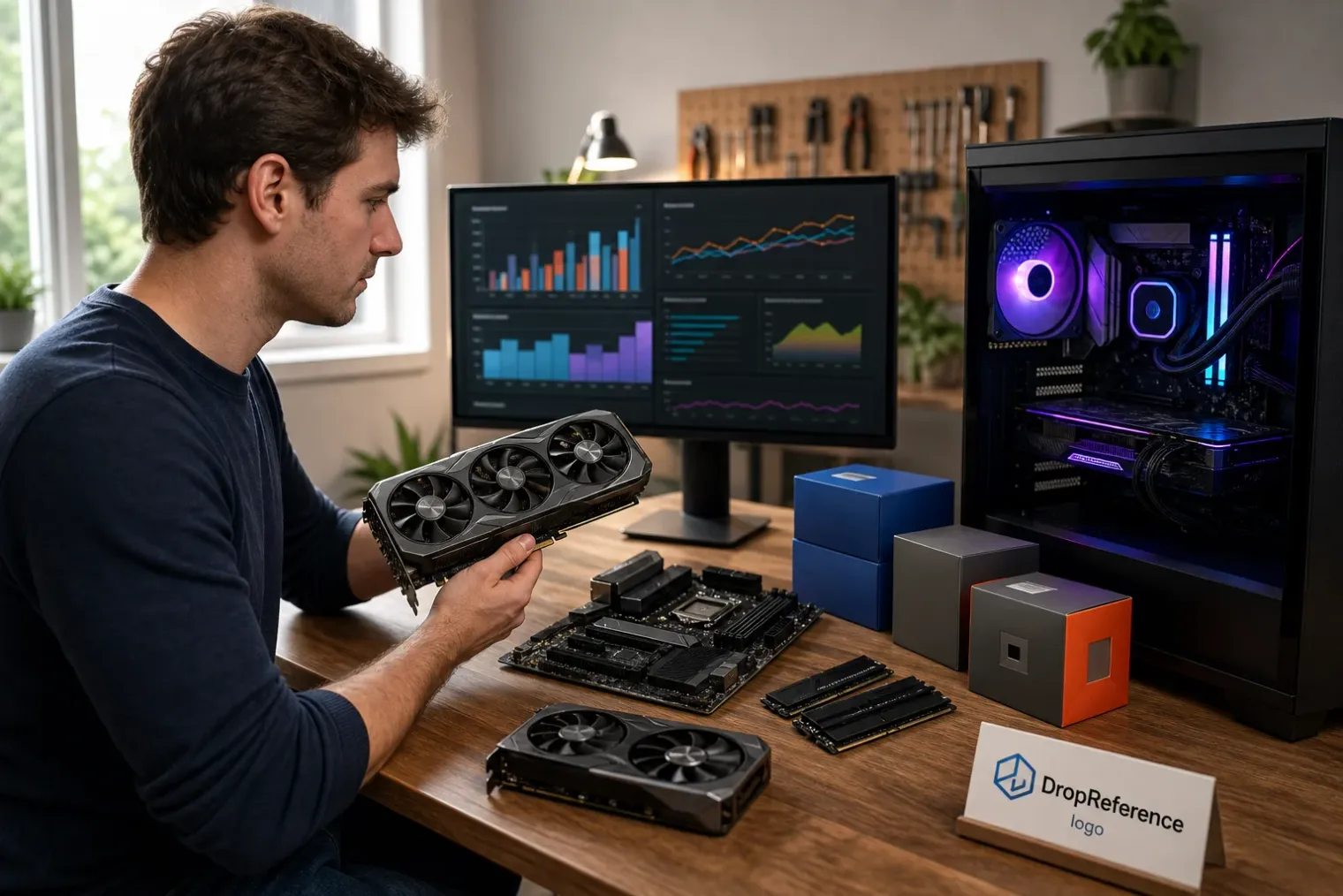
DropReference has launched its PC-part comparison service in the United States, extending a platform that combines retailer listings with a PC configurator, community advice and estimated gaming performance. The timing matters because assembling a gaming PC has become less about locating individual specifications and more about weighing changing availability, differing model variants and the real cost of achieving a target experience.
The service presents itself as a comparison layer rather than a retailer. Users can select a shipping country, browse components and assemble a system through three paths: a community-led route, a guided configurator and an expert mode with full part selection. The company says its pricing system analyses offers from more than 20 e-commerce sites, while the configurator applies compatibility checks intended to flag issues such as unsuitable sockets or insufficient power supplies.
For US buyers, the central proposition is convenience. A single build can be assessed against live offers and adjusted as prices or stock change, avoiding the need to compare retailer pages manually. That can be especially useful when nominally similar graphics cards, memory kits or storage drives differ in cooler design, capacity, warranty terms or delivery costs.
Price comparison is useful, but not the whole transaction
Retail price aggregation can simplify an initially fragmented market, yet the lowest listed price is not automatically the lowest cost of ownership. Sales tax, shipping, seller reputation, return conditions, bundled promotions and the availability of a particular version all affect a purchasing decision. A price-comparison result should therefore be treated as a starting point for checking the final retailer checkout page.
The platform’s business model is also relevant. DropReference states that it uses affiliate partnerships and earns commission on qualifying Amazon purchases. Affiliate funding is a common way to keep comparison services free for users, but it means shoppers should remain alert to the distinction between an available offer and an independently verified recommendation. The service’s stated ability to display multiple vendors and prices can be helpful in preserving choice, provided users inspect the retailer, product details and stock status themselves.
US availability appears to be more than a language setting. Recent pages on the site show US dollar pricing, US retailer references and a United States shipping-country option. The expansion consequently gives the company a local market context for its price display rather than simply exposing a European-focused catalogue to American visitors.
From compatibility checks to performance estimates
DropReference is attempting to link two questions that are often handled separately: whether a collection of parts will work together, and what level of gaming performance it is likely to deliver. Its configurator takes account of component compatibility, while its Benchmark feature allows users to enter a graphics card, processor and optional memory selection to view estimated results for more than 125 games.
The performance tool covers 1080p, 1440p and 4K displays, and the company says it reports both average frame rate and one-percent-low results. The latter measure is valuable because an average frame rate alone can conceal short periods of poor frame delivery that users perceive as stutter. Pairing those estimates with current component prices is the platform’s more distinctive idea: the shopper can compare the incremental cost of a faster graphics card with the predicted benefit in the games and resolution they care about.
That approach is more practical than choosing hardware purely by a name, generation or isolated synthetic benchmark. It can also make trade-offs clearer. A buyer seeking smooth 1440p play, for example, may decide that a less expensive graphics card meets their target, leaving budget for a better display, larger storage drive or quieter cooling.
The limits of a single performance number
Estimated frame rates must nevertheless be interpreted carefully. Actual performance depends on game version, graphics preset, ray tracing, upscaling settings, driver revisions, background software, cooling, power limits and the precise version of a component. Processor performance can also become more important at lower resolutions or high refresh rates, while graphics-card performance usually has greater influence at demanding resolutions and settings.
A credible comparison service is therefore most useful when it makes the assumptions behind its estimates clear. Buyers should look for the selected resolution, quality preset and whether performance-enhancing technologies are included. They should also compare the estimates with established independent reviews for expensive purchases, particularly where a system is intended for one demanding game or specialised workloads such as video editing and 3D rendering.
Compatibility guidance has similar limits. Automated checks are good at identifying clear conflicts, but they cannot always capture physical clearance in a compact case, motherboard firmware requirements, the quality of a power supply, case airflow or the trade-off between noise and temperature. The final build should still be checked against manufacturers’ specifications.
Positioning in a mature PC-building market
The US market already has well-known part-list tools and a large ecosystem of reviewers, retailer storefronts and enthusiast communities. DropReference’s opportunity is not simply to duplicate a bill-of-materials calculator. Its potential differentiation lies in joining region-aware offers, guided selection, automated compatibility, community input and game-specific performance estimates in one workflow.
The guided mode may be particularly relevant to first-time builders who know their budget and preferred games but do not yet understand platform choices. Expert users, meanwhile, are more likely to value broad catalogue control, price history and quick comparisons between alternative builds. The service will need reliable retailer matching, timely stock data and transparent benchmark methodology to satisfy both groups.
DropReference’s arrival gives US consumers another way to narrow a complicated hardware search. Its most useful role will be as an informed planning tool: identify viable builds, expose price differences and frame realistic performance trade-offs. The final decision should still rest on current retailer terms, detailed component specifications and independent testing.
Sources
- DropReference Launches in the US with PC Part Price Comparison and Gaming Performance Estimates — TechPowerUp
- DropReference - The price comparison site for PC gamers — DropReference
- Build the gaming PC of your dreams for free — DropReference
- DropReference launches Benchmark: The comprehensive tool to test your setup on 125+ games in 2026 — DropReference
- Best Graphics Card 2026: comparison, ranking, and buying guide for PC gamers — DropReference


