
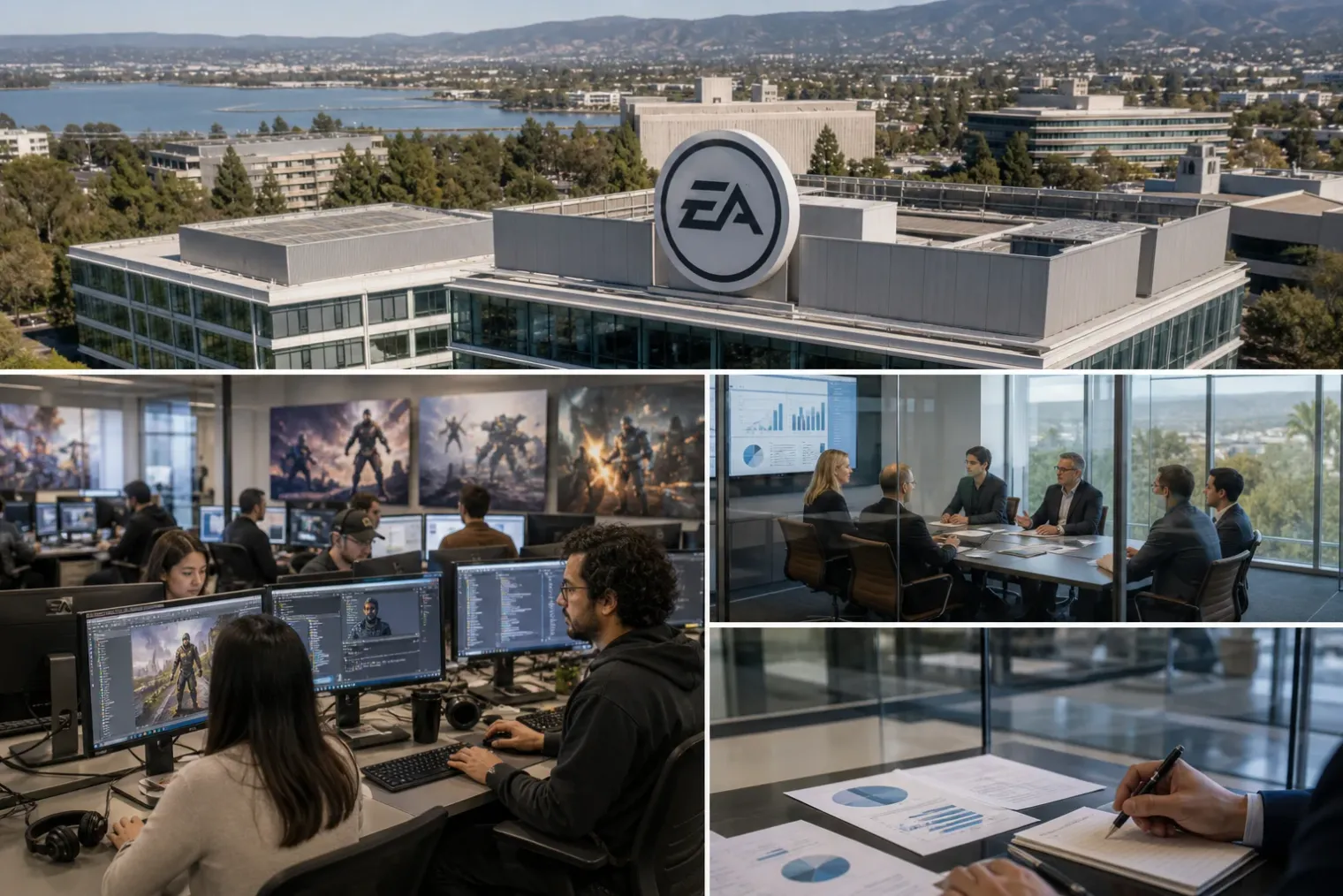
A completed take-private transaction
Electronic Arts has completed its sale to a consortium comprising Saudi Arabia’s Public Investment Fund (PIF), Silver Lake and Affinity Partners, becoming a privately held company after decades on the public markets. The transaction, announced in September 2025 and completed on August 4, 2026, values EA at approximately $55 billion.
The completion changes the ownership structure of one of the games industry’s most commercially significant publishers. EA’s portfolio includes major sports franchises as well as Battlefield, The Sims, Apex Legends, Need for Speed, Dragon Age and other established brands. Its headquarters remains in Redwood City, California, and Andrew Wilson continues as chief executive.
EA shareholders are to receive $210 in cash for each share. When the deal was unveiled, the price represented a 25% premium to EA’s unaffected share price on September 25, 2025. With the transaction closed, EA common stock is no longer listed on a public market.
How the deal was financed
The consortium combines a sovereign investor with two private investment firms. PIF, Saudi Arabia’s sovereign wealth fund, already held a 9.9% interest in EA before the agreement and rolled that stake into the acquisition. Silver Lake is a technology-focused investment firm, while Affinity Partners is led by Jared Kushner.
The original financing plan combined roughly $36 billion in equity, including PIF’s rolled-over stake, with $20 billion in debt financing committed by JPMorgan Chase. EA’s announced enterprise value includes the effect of debt and other obligations rather than representing only the cash paid to public shareholders.
That financing mix will be central to the company’s next phase. Private ownership can give management more latitude to make investments whose benefits may take several years to emerge, without an immediate public-market reaction to every quarterly result. Yet the debt component also creates a powerful incentive to protect cash flow, manage costs and maintain the dependable recurring revenue that has become fundamental to EA’s business.
This tension is familiar in large leveraged buyouts. The owners’ ability to support long-term development, new technology and international expansion will be tested alongside the need to service borrowings and generate returns on a very large investment.
A different operating environment
As a public company, EA had to publish regular financial reports and engage continuously with shareholders and market analysts. Private ownership removes the public share price as a daily measure of investor sentiment and allows the company to disclose less operational detail to the wider market.
That does not automatically mean a change in EA’s creative or commercial strategy. The company’s biggest businesses are built around sports games, live services, digital content and large player communities. These are durable assets, but they require steady investment in development, infrastructure, licensing, marketing and player support.
The new owners have framed the acquisition as an opportunity to invest in growth and innovation. PIF has also pointed to artificial intelligence as an area of potential investment in EA’s game development. The practical significance will depend on how EA applies such tools, whether to streamline internal work, support content production, improve live operations or develop entirely new player experiences.
For employees and studios, private ownership could provide more room for long development cycles and selective bets outside annual release schedules. The opposite risk is that pressure to meet financial targets favours proven franchises, cost reductions and narrower portfolio choices. Neither outcome is predetermined by the change in ownership alone.
Regulatory clearance and scrutiny
The transaction required approval from shareholders and multiple regulators. The European Commission cleared PIF’s acquisition of sole control of EA under EU merger rules in July, concluding that the deal would not raise competition concerns. The review reflected the fact that the transaction primarily transferred ownership of EA rather than combining two major competing game publishers.
The acquisition has nevertheless attracted broader scrutiny. PIF’s growing presence in games, esports and entertainment has made its investment strategy a subject of international debate. Critics have raised concerns about Saudi Arabia’s human-rights record and about the influence that control of a large publisher could have over a global entertainment platform. Supporters and dealmakers have emphasised the fund’s capacity to provide patient capital and its ambition to expand Saudi Arabia’s role in gaming.
Affinity Partners’ involvement has also drawn attention because of Kushner’s political profile and the firm’s financial links with PIF. These issues do not alter the completed legal transaction, but they increase the public attention likely to accompany major strategic decisions at EA.
What players and partners should watch
The immediate effect for players is limited: EA’s games, studios, publishing relationships and leadership remain in place. The more meaningful consequences will emerge over time through decisions on investment priorities, staffing, release schedules, licensing and the balance between established series and new intellectual property.
Three signals will be particularly important. First, EA’s capital allocation will indicate whether the owners are prioritising expansion, acquisitions and studio investment or debt reduction and cost discipline. Second, the treatment of creative teams and less predictable franchises will show how much autonomy the private structure provides. Third, the company’s use of AI and player data will be closely watched by employees, consumers and regulators.
EA’s move private is therefore more than a share-market event. It places a globally recognised games business at the intersection of sovereign investment, private equity and a rapidly evolving entertainment market. The acquisition gives its new owners substantial assets and reach; their strategic choices will determine whether the deal produces greater creative capacity, tighter financial control, or a combination of both.
Sources
- Electronic Arts, the World's Largest Game Studio, Officially Goes Private — TechPowerUp
- EA Announces Agreement to be Acquired by PIF, Silver Lake & Affinity Partners for $55B — Electronic Arts
- Electronic Arts merger agreement and transaction announcement — U.S. Securities and Exchange Commission
- Video game giant Electronic Arts closes $55 billion go-private sale of its business — Associated Press
- Saudi PIF's $55 billion EA deal approved under EU merger rules — Reuters via Euronext


