
From assistance to authored test assets
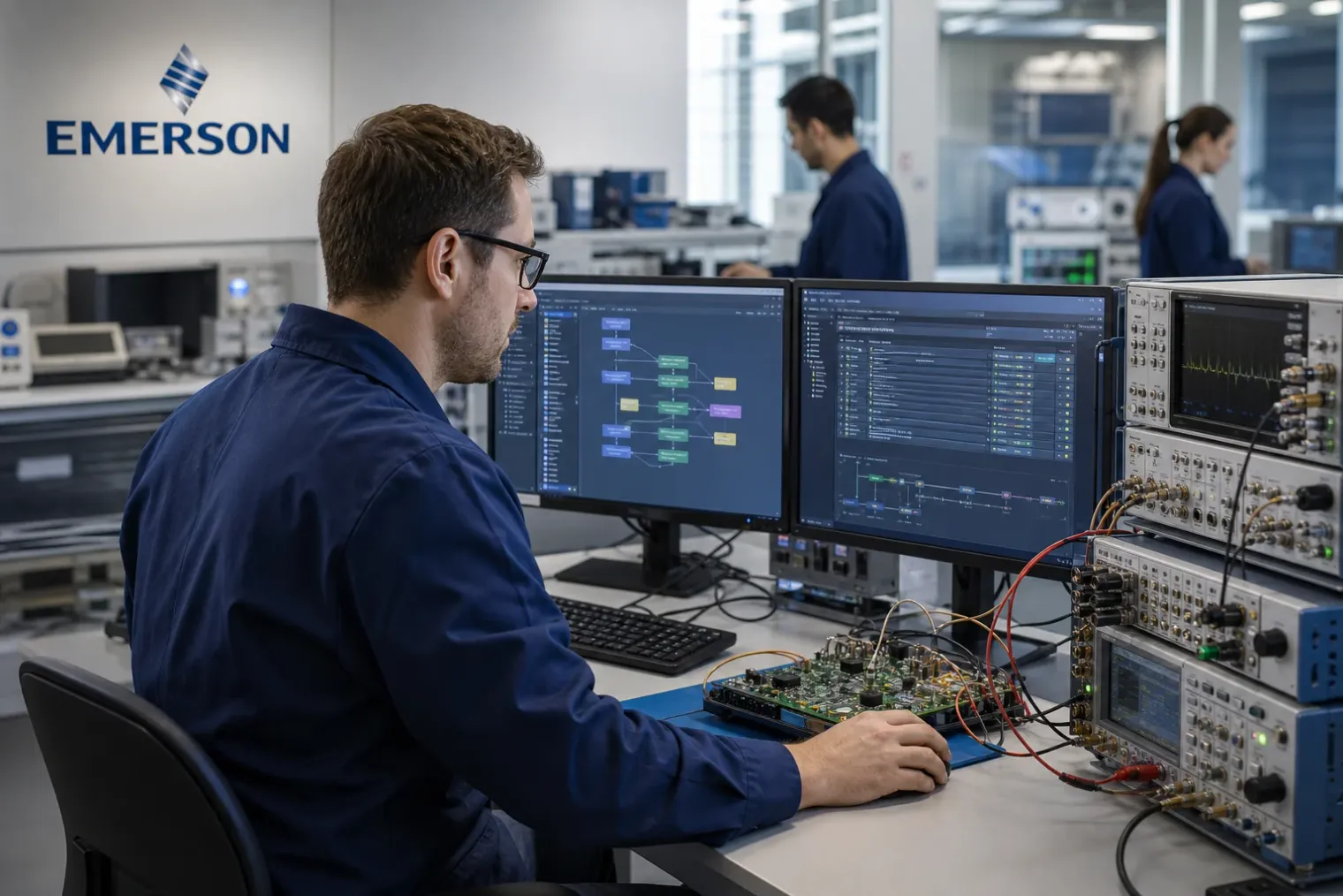
Emerson has expanded the generative capabilities of NI Nigel AI, its embedded assistant for the NI LabVIEW+ Suite, with prompt-based code generation in LabVIEW and automated test-sequence creation in TestStand. Announced on July 28, 2026, the release marks a more consequential step than the code completion and contextual help that Nigel previously offered: it aims to produce initial engineering artefacts rather than merely suggest the next action.
The distinction matters in test and measurement. A LabVIEW virtual instrument, or VI, can encode how connected hardware is configured, measured and controlled. A TestStand sequence can organise the steps, limits, reporting and code modules used to validate a product. Automating the first draft of either can remove repetitive setup work, but also introduces a need to check that generated logic matches the device, requirements and safety constraints of a particular programme.
NI describes the LabVIEW feature as focused initially on creating measurement code for hardware connected to a user’s system. In TestStand, the new capability can use a supplied specifications document to create a sequence, map existing code modules or generate editable placeholders. This is a narrower proposition than unrestricted software generation: the intended output is tied to structured test workflows and existing engineering tools.
A claim of faster development, not autonomous validation
Emerson says internal benchmarking across representative workflows found that the new capabilities can reduce the time and effort required to develop and deploy test systems by up to 50 percent. That is a company performance claim rather than an independently published benchmark, and it should be read accordingly. Results will depend on factors including the maturity of requirements documents, the reuse of existing modules, the complexity of hardware interfaces and the level of review required before execution.
The more durable value may lie in reducing the friction between a requirement and an executable test. Test teams often translate documents into sequence structures, connect those structures to code modules, configure instruments and then refine the process as failures reveal ambiguities. If AI can establish a usable starting point while preserving links to specifications and modules, it could shift engineers’ time toward test strategy, diagnostics and exception handling.
That does not eliminate the engineering task. Generated measurement code may make incorrect assumptions about an instrument configuration, timing or error condition. A sequence derived from a specification can inherit vague wording or omit edge cases. In regulated or high-consequence applications, those risks make review, simulation, controlled execution and traceable approval processes essential. NI itself cautions that generative AI can make mistakes and says users should review outputs for accuracy.
Context is the product differentiator
The release builds on Nigel’s earlier capabilities in code completion, project awareness and TestStand sequence review. Emerson’s argument is that a test-focused assistant can be more useful than a general-purpose chatbot because it operates alongside engineering code, structured data, modular instruments and defined validation workflows.
That positioning reflects a broader enterprise AI pattern. The greatest practical gains are often expected not from a single general model answering questions, but from AI being given constrained access to the context, tools and data structures of a specific business process. In this case, the relevant context includes local hardware, LabVIEW projects, test specifications and reusable modules.
The approach has advantages and limits. Domain context can help make generated output more immediately relevant, reduce the need for engineers to translate their needs into generic programming terms and encourage consistency across teams. However, usefulness depends on the quality of the surrounding engineering environment. Poorly maintained module libraries, incomplete specifications and inconsistent naming conventions will constrain the output, even if the assistant is technically capable.
The feature also remains dependent on internet access and product eligibility. Nigel is available to users of supported LabVIEW and TestStand versions with the required software-service entitlement, rather than being a universally available capability across all NI editions. That commercial and deployment boundary may influence uptake among organisations with mixed toolchains or tightly controlled development environments.
Governance becomes part of the workflow
Emerson presents the expansion as compatible with security, governance and regulatory alignment. That emphasis is important because test software can sit close to intellectual property, prototype hardware and production-validation decisions. The central question for prospective users is not only whether the tool can generate an initial VI or sequence, but how data is handled, how outputs are reviewed and how a team records the final engineering decision.
The company’s software roadmap identifies a Nigel cloud service using Azure OpenAI and lists further hosting options as in development. Organisations will therefore need to assess contractual terms, access controls, data classification and the suitability of cloud-based assistance for their projects. The authentication documentation also points to account-based access and entitlement management, which means IT and engineering leaders will need to treat adoption as an operational governance issue, not simply a desktop-software upgrade.
The timing also coincides with more formal product-security expectations in Europe. The EU Cyber Resilience Act establishes lifecycle cybersecurity requirements for software and connected products placed on the EU market. Its reporting obligations take effect on September 11, 2026, while full application is scheduled for December 11, 2027. The Act does not validate AI-generated test code, but it reinforces the importance of secure development practices, vulnerability processes and evidence that products have been developed and maintained responsibly.
The practical test for Nigel AI
For Emerson, the update broadens Nigel from an in-product advisor to a tool that can actively create candidate engineering work. It also extends the assistant across the wider LabVIEW+ Suite, including InstrumentStudio, FlexLogger and VeriStand, with the stated aim of supporting work from interactive measurement through data logging, hardware-in-the-loop testing and deployment.
The most credible use case is likely to be accelerated first drafts in repeatable, well-governed workflows: generating a measurement routine for recognised hardware, translating a stable requirements document into a TestStand skeleton, or helping a team find and reuse approved modules. Those are areas where a prompt-driven interface can reduce routine effort without requiring engineers to surrender authority over the result.
The decisive measure will not be how much text or code Nigel can generate. It will be whether the software produces outputs that engineers can inspect, adapt and trust within established validation controls. Emerson’s claimed productivity gains may prove meaningful in selected workflows, but the value of the release will ultimately depend on traceability, review discipline and the quality of the test assets that organisations bring to the system.
Sources
- Emerson Advances AI Across Software Portfolio, Accelerating Test Productivity by Up to 50 Percent — Emerson via PR Newswire
- NI Nigel AI for Test & Measurement Workflows — NI
- Emerson Enhances NI LabVIEW+ Suite with Advanced AI and Code Completion for Test Engineers — NI
- NI Software Roadmaps — NI
- Cyber Resilience Act – Implementation — European Commission


