
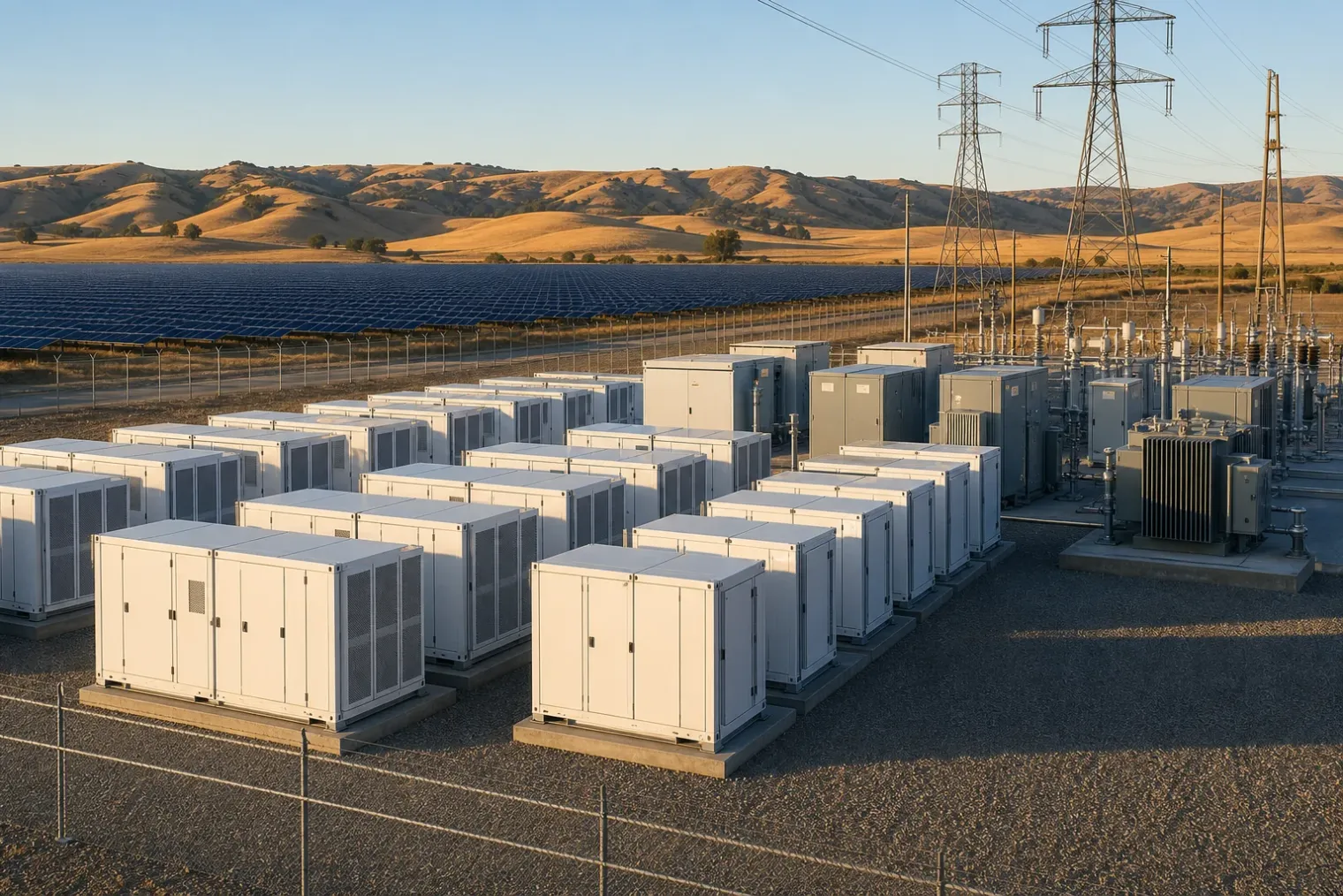
A first project designed for eight hours of output
ESS Tech and renewable-energy developer Juniper Energy have announced a letter of intent covering the deployment of 500 MWh or more of sodium-ion battery energy storage systems in the United States by 2032. The proposed partnership starts with a 10 MW / 80 MWh project in California, which is targeted to begin commercial operation in 2027.
The numbers describe two separate aspects of a storage plant. The 10 MW rating is its maximum power output, while the 80 MWh rating is the amount of electricity it can store. At its rated output, the first installation would therefore be capable of discharging for roughly eight hours. That duration places it beyond the four-hour configuration common in many grid battery projects and makes it potentially relevant for shifting solar generation from daytime into the evening demand period.
The announcement should nonetheless be read as an early commercial step rather than confirmation of a fully contracted construction programme. A letter of intent sets a framework for collaboration but does not itself guarantee procurement, financing, permits or delivery. ESS says the wider 500 MWh target remains subject to successful execution of the initial project and to future project development.
A new direction for an iron-flow specialist
The deal is notable because ESS has historically focused on iron-flow batteries for long-duration storage. Its established systems use iron, salt and water and are aimed at applications requiring repeated cycling across longer discharge periods. Sodium-ion technology is a separate battery chemistry and a strategic addition rather than a replacement for the company’s existing approach.
In July, ESS introduced Bridge, a modular sodium-ion alternating-current storage system. The company describes each building block as a 1.2 MWh unit housed in a 10-foot container, with system configurations intended to cover discharge durations from one hour to 16 hours or more. The California project is expected to combine Bridge units with ESS’s energy-management system.
That positioning highlights an attempt to cover more of the stationary-storage market. Iron-flow systems are designed for long-duration applications, while sodium-ion products are being presented for short- and medium-duration roles, including utility projects, commercial sites, critical infrastructure and data centres. The distinction matters because battery projects are selected not simply by their chemistry, but by the required duration, cycling pattern, footprint, site conditions and cost over the asset’s useful life.
ESS had already signalled this change in April through a separate letter of intent with Alsym Energy, covering up to 8.5 GWh of US-made sodium-ion cells and modules. The Juniper arrangement is therefore an important test of whether that supply and integration strategy can turn into operating installations.
Why sodium-ion attracts attention
Sodium-ion batteries operate on broadly similar principles to lithium-ion batteries, moving ions between electrodes during charging and discharging, but substitute sodium for lithium. Sodium is abundant and widely available, giving the chemistry potential supply-chain advantages where developers want to reduce dependence on lithium and other constrained inputs.
For stationary grid storage, lower energy density than leading lithium-ion systems can be less important than it is for electric vehicles or portable electronics. A larger or heavier battery installation can be acceptable when it sits on a utility site, provided the total project cost, safety performance, operational needs and usable lifetime are competitive. That makes sodium-ion a plausible option for fixed storage even if it does not displace lithium-ion across every market.
However, potential is not the same as proven economics. The US Department of Energy has identified sodium-ion as a technology with substantial room for cost reduction, while also noting its limited deployment at commercial scale and the lack of consistent industry-wide projections for future costs and performance. Manufacturing scale, cell durability, integration experience and bankable operating data will all be decisive.
ESS also makes several performance and operating claims for Bridge, including air cooling, a 20-year design life and reduced thermal-runaway risk compared with conventional lithium-ion systems. These are product design objectives at an early commercial stage, not independently demonstrated outcomes from the planned California project. The company’s own forward-looking disclosures identify risks around product development, supplier dependence, domestic supply-chain availability, financing and its ability to secure binding orders.
California as a practical proving ground
California is a logical location for a long-duration battery demonstration. The state has extensive solar generation, pronounced daily variation in electricity supply and demand, and an established market for large battery systems. An eight-hour asset could potentially capture electricity during lower-price periods and discharge across a longer evening peak, while also offering grid services depending on its interconnection and operating contracts.
The project’s relatively modest 10 MW power rating is not likely to alter the state grid on its own. Its significance is technological and commercial: it would provide a real-world validation point for ESS’s sodium-ion platform, installation process, controls and operating model. If it enters service on schedule and performs reliably, it could support the larger 500 MWh procurement ambition. Conversely, delays or underperformance would weaken the case for subsequent projects.
The planned development also reflects a broader shift in energy storage from a single-chemistry market towards portfolios of technologies. Lithium-ion remains deeply established in US grid batteries, but developers are exploring alternatives that may offer different supply chains, fire-safety characteristics, temperature tolerance or duration profiles. Sodium-ion has a credible place in that search, although it is still at an earlier stage of deployment.
The milestone is execution, not the headline capacity
The most important measure of this announcement will be whether the 80 MWh California system reaches commercial operation in 2027 and produces dependable operating data. The 500 MWh figure is an intention extending to 2032, not an order book that has already been delivered or fully committed.
For ESS, the agreement offers a potential route from an iron-flow specialist into a broader non-lithium storage supplier. For Juniper, it provides an opportunity to assess sodium-ion storage in a utility-scale setting. For the wider industry, the project will be another practical indication of whether sodium-ion can move from promising chemistry to repeatable, financeable grid infrastructure.
Sources
- ESS and Juniper Energy Sign Agreement for 500 MWh+ of Sodium-Ion Energy Storage Deployments — ESS
- ESS Introduces Bridge, a Modular Sodium-Ion Battery Energy Storage System — ESS
- Achieving the Promise of Low-Cost Long Duration Energy Storage — US Department of Energy
- Sodium-ion BESS: ESS signs LOI for 500 MWh of US deployments — Energy-Storage.News


