
From plate lookups to investigative hypotheses
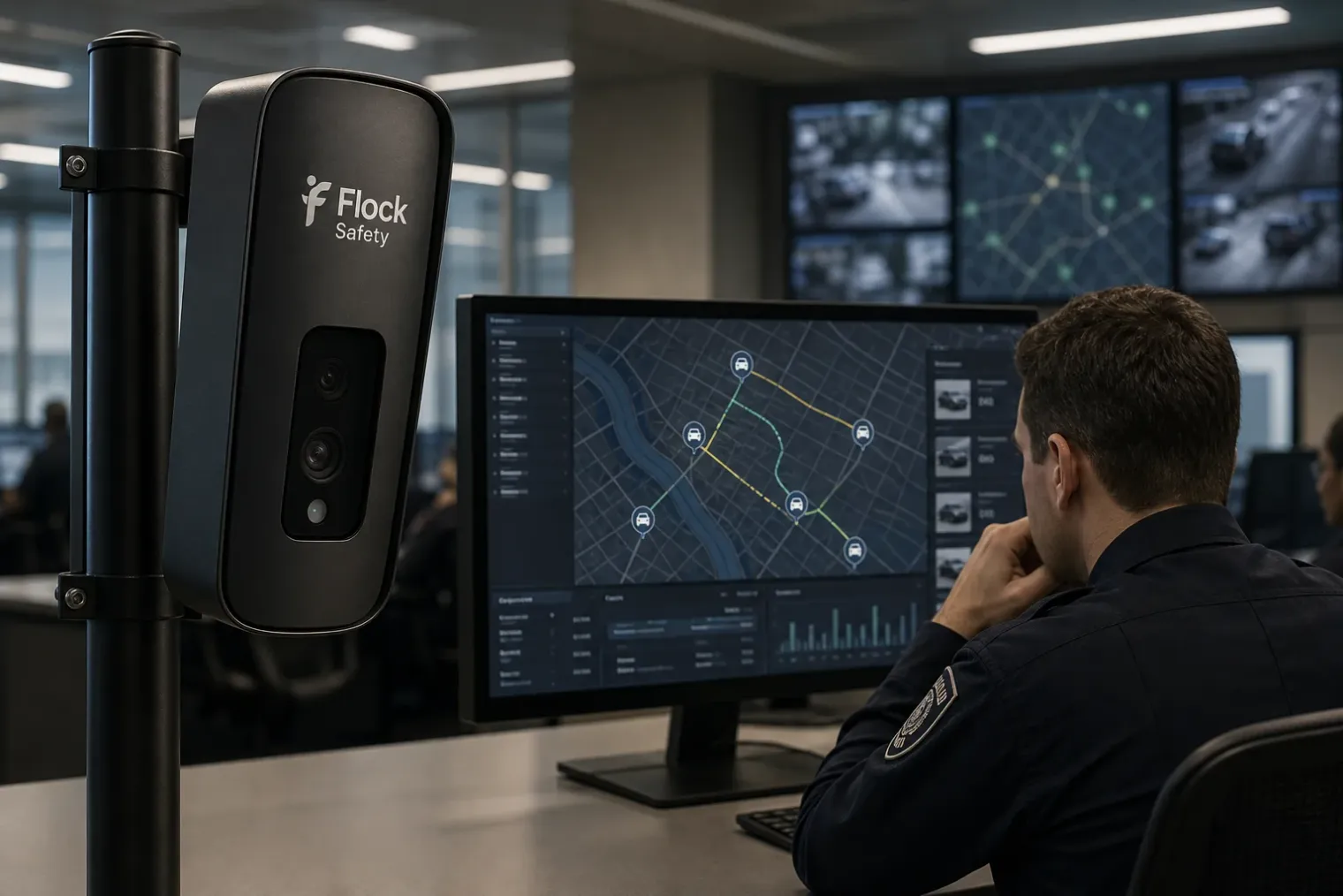
Flock Safety built its public profile around automated licence plate recognition: cameras capture passing vehicles, convert plates and vehicle attributes into searchable records, and help agencies locate cars connected to active cases. A new investigation by WIRED indicates that the company is developing a much broader AI interface for police work, known internally as Nightshift and more recently as OS Investigate.
The important distinction is not simply that an AI assistant has been added to a police database. The reported design changes the starting point of an inquiry. Instead of requiring an officer to begin with a known plate, person or incident, the system can be asked to identify vehicles whose movements match an asserted pattern: repeated visits to locations, trips between areas, or presence around a specified place during a specified period.
That model can make large collections of records easier to search. It can also make it easier to generate leads about people who have not been identified as suspects. The practical and legal significance of that shift will depend on the system’s final functions, the information available to each agency, and the controls applied to individual searches.
What the published code appears to reveal
WIRED reported that it examined front-end files delivered through Flock login pages and reconstructed portions of the application interface without obtaining authenticated access. The files reportedly included 69 suggested prompts and references to 45 tools. They described links between camera and plate data, police records, dispatch information, case files, ballistics data and commercial identity databases.
This is not equivalent to obtaining the system’s server-side code or proving that every described feature works in every deployment. The reporting explicitly notes that the files did not reveal model instructions, server-side checks or final results returned to officers. Yet interface code and prewritten workflows are significant evidence of a product’s planned capabilities and intended use cases.
Among the reported prompt templates are searches for possible witnesses based on the vehicles most frequently seen in a neighbourhood at certain times, and searches for vehicles that make repeat visits to businesses or travel through a sequence of locations. Another reported function ranks vehicles deemed associates of a target car by their repeated proximity in camera detections.
Such features are more consequential than natural-language convenience. They encode investigative assumptions into product defaults. A search for vehicles repeatedly passing through an area may be useful after a defined event, but the same logic can make ordinary routines look suspicious when no underlying crime, target or articulable basis has been established.
AI compresses the distance between data and action
Police departments already use multiple systems that retain records about people, vehicles and incidents. An AI layer can reduce the time needed to move among those sources, draft a lead, map a route or assemble a background profile. That efficiency is the central attraction for investigators working under time pressure.
But speed also changes the scale of discretionary searching. A human analyst performing several separate queries may pause to decide whether each step is relevant and justified. A chat-based system can string those steps together in seconds, turning broad exploratory questions into lists of names, addresses, relatives or vehicles. The result may appear authoritative even when it is merely a correlation produced from incomplete records.
There is a further risk of automation bias. Officers may give a machine-generated lead greater weight because the sequence that produced it is difficult to inspect. A usable police AI system therefore needs more than an input box and an audit log. It should make the underlying data sources, filters, confidence thresholds, exclusions and limitations clear before an investigator acts on an output.
Flock has publicly described its AI offering under the name Flock Nova as an optional investigative aid rather than a system that predicts crime or replaces human decision-makers. It says users remain in control and that actions should be explainable. Those stated principles point in a constructive direction, but they do not by themselves resolve the questions raised by prompt-driven searches for behavioural patterns.
Oversight is the central test
The privacy debate surrounding Flock is not theoretical. In August 2025, the Illinois Secretary of State said an audit found that Customs and Border Protection had gained access to Illinois licence-plate camera data through Flock in violation of state law. Illinois ordered the access shut off, while Flock said it had paused federal pilot projects and later said it would no longer conduct federal pilots.
Flock has also said it introduced keyword blocks for certain searches involving immigration and reproductive-health purposes in Illinois, and has discussed AI-assisted alerts for unusual searches plus optional case-number requirements. These measures may limit some known misuse patterns. However, meaningful accountability depends on their actual configuration, whether they are mandatory, who reviews alerts, how quickly violations are investigated and whether agencies disclose the outcomes.
The reported OS Investigate interface appears to require users to enter a reason for a search, and in some cases a case number. A text field alone is a weak safeguard if vague entries are accepted without a connection to a real investigation. The most useful controls would tie permissions to specific investigations, preserve immutable records of queries and results, prevent prohibited searches before they run, and subject both routine and exceptional use to independent review.
The legal questions are still unsettled
US constitutional law has recognised that highly revealing location records can trigger Fourth Amendment protection. In Carpenter v. United States, decided on June 22, 2018, the Supreme Court held that the government’s acquisition of historical cell-site location records was a search. The ruling was narrow and did not settle the treatment of every location technology.
Flock’s system is not identical to mobile-phone location tracking. Its records arise from cameras that observe vehicles at particular places rather than continuous cellular-network records. Nevertheless, an AI tool that can aggregate years of sightings, infer associations and pair vehicle movements with identity data raises related concerns about the cumulative power of surveillance.
Courts and legislatures will need to address when a pattern search becomes a sufficiently intrusive search of a person’s movements, and what basis police should need before running one. They will also need to distinguish a legitimate search for evidence in a defined case from an open-ended attempt to discover who looks unusual in a dataset.
A governance decision, not merely a product launch
Flock’s reported AI system illustrates a wider transition in policing technology. The critical development is the creation of a conversational layer over extensive data holdings: a tool that can translate a loosely worded request into many investigative steps.
That can help solve crimes when it is bounded by clear objectives, reliable data and accountable human review. It can also normalise broad suspicion when patterns of ordinary life become search criteria. The difference will not be determined by the fluency of the AI model. It will be determined by deployment rules, technical limits, transparency to the public and enforceable consequences when the system is misused.
Before agencies adopt tools of this kind at scale, they should publicly define permissible query categories, prohibit searches based solely on protected activity or vague behavioural suspicion, require documented case connections, retain detailed audit trails and allow external inspection. AI can accelerate investigation, but it should not quietly lower the threshold for placing people under it.
Sources
- Flock Has a Powerful New AI Tool for Police. We Got Its Code — WIRED
- Smarter, Not Scarier: The Role of AI in Ethical Investigative Work — Flock Safety
- Giannoulias’ Audit Finds License Plate Reader Company in Violation of State Law — Illinois Secretary of State
- Carpenter v. United States — Supreme Court of the United States
- Does Flock Share Data With ICE? Here’s Flock’s Answer — Flock Safety


